Association Football Positions: Roles, Evolution, and Modern Tactics
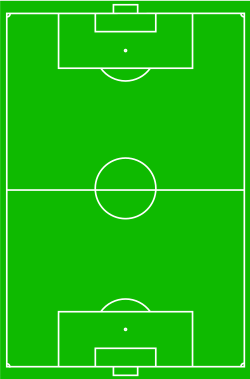
In association football, a team consists of 11 players, each assigned a specific position on the field. While every team must have one goalkeeper, the remaining 10 outfield players are arranged in various combinations based on the team's tactical formation. These positions define a player's primary responsibilities and their general area of operation on the pitch.
The game's tactical landscape has shifted dramatically since the late 1800s. Early formations were aggressively offensive, such as the 1–2–7. By the late 19th century, the 2–3–5 formation became the standard, introducing refined roles like full-backs, half-backs, and outside forwards. Over time, terminology evolved; for instance, the term "half-back" largely disappeared by the 1970s, replaced by "midfield" to describe players operating in the center third of the pitch.
Key Facts
- Mandatory Role: Every team must field one goalkeeper.
- Formation Flexibility: The 10 outfield players can be arranged in any combination of defensive, midfield, and attacking roles.
- Evolution: Positions have shifted from highly offensive (1–2–7) to more balanced modern structures like 4–3–3 or 4–2–3–1.
- Specialization: Modern roles often blend duties, such as wing-backs combining the responsibilities of full-backs and wingers.
The Goalkeeper
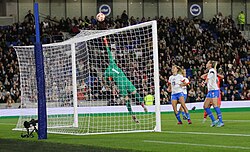
The goalkeeper is the only player permitted to handle the ball within their own penalty area. To distinguish them from outfield players and officials, they must wear a different colored kit, commonly in shades of yellow, green, grey, black, or blue. Since the 1970s, specialized gloves have become standard equipment to improve grip and protect hands from high-velocity shots.
Historically, goalkeepers wore woolly jumpers and caps between the 1910s and 1960s, though these are no longer used in professional play.
Defensive Positions
Defenders are primarily responsible for preventing the opposing team from scoring. Their roles vary based on where they are positioned across the back line.
Centre-back
Also known as the "centre-half," this role evolved from the 2–3–5 formation where the central half-back moved deeper into the defense. The centre-back acts as the heart of the defense, blocking shots and organizing the line.
Full-back and Wing-back
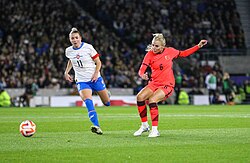
Full-backs typically defend the flanks. A wing-back (or attacking full-back) is a hybrid role—a portmanteau of "winger" and "full-back"—emphasizing offensive contributions. These players are common in 3–5–2 or 5–3–2 formations. In modern 4–3–3 or 4–2–3–1 systems, the distinction between a full-back and a wing-back has blurred as most full-backs are now expected to support the attack.
Midfield Positions
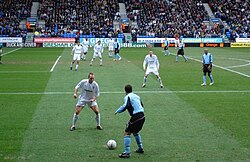
Midfielders operate in the center of the pitch, linking the defense to the attack. They are categorized by their primary objective: defending, controlling the tempo, or creating chances.
Central and Defensive Midfield
Central midfielders manage the transition of the ball. Defensive midfielders focus on breaking up opposition play and protecting the back four.
Attacking and Wide Midfield
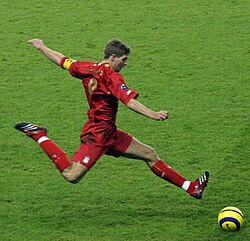
Attacking midfielders focus on creating scoring opportunities. A central attacking midfielder is often called a playmaker or a "number ten." Wide midfielders operate near the touchlines to provide width and delivery into the box.
![Central midfielder Aitana Bonmatí is considered one of the best players in the world.[37]](/images/3d/09/3d09d5ab4c8b56a38afa16092c80b00476bec9cc6931df277377c12a182a00cc.jpg)
Forward Positions
Forwards are positioned closest to the opponent's goal. Their primary goal is to score and create chances, though they also contribute defensively by pressuring the opposition's defense.
Centre Forward (Striker)
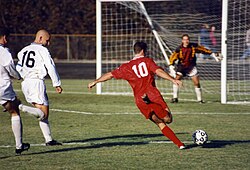
The centre forward is the focal point of the attack. Traditionally, this role required physical strength and height to win headers from crosses. In the modern game, speed and movement are equally vital. Depending on the formation, a striker may play as a "lone striker" (4–2–3–1) or be paired with another forward (4–4–2).
Second Striker
Developed by the Hungarian national team in the mid-20th century and later popularized in Italy as the trequartista or fantasista, the second striker operates between the midfield and the main striker. This role requires high technical skill, vision, and creativity to provide assists and score goals.
Winger
Wingers are attacking players stationed near the touchlines. Their primary attribute is speed, used to dribble past full-backs and deliver crosses. While historically viewed as forwards, the 4–4–2 formation of the 1960s shifted them into midfield roles to increase their defensive duties. Some teams, like the 1966 England "Wingless Wonders" or certain AC Milan formations, have successfully operated without natural wingers, relying instead on attacking full-backs for width.
![Winger Caroline Graham Hansen is known for her dribbling ability, an important quality in wingers.[60]](/images/0d/13/0d1397edd3970bd9fd4627184b0d9883cd3c6b84a39e0d0a6b1bab226bbb8f2f.jpg)
Summary of Football Positions
| Position Category | Key Roles | Primary Responsibility |
|---|---|---|
| Goalkeeper | GK, Sweeper-keeper | Preventing goals; handling the ball in the penalty area. |
| Defense | Centre-back, Full-back, Wing-back | Stopping opposition attacks and initiating build-up play. |
| Midfield | Defensive, Central, Attacking, Wide | Linking defense and attack; controlling possession. |
| Forward | Centre Forward, Second Striker, Winger | Scoring goals and creating scoring opportunities. |
Frequently Asked Questions
What is the difference between a full-back and a wing-back?
A full-back is primarily a defender on the flank. A wing-back is a more offensive hybrid role, often used in three-at-the-back formations (like 3–5–2), where they have significant responsibilities in both attacking and defending.
What does a "number ten" do?
A "number ten" is a central attacking midfielder or playmaker. Their role is to operate in the space between the opposition's midfield and defense to create chances and provide the final pass for the strikers.
Can a team play without wingers?
Yes. Some teams use narrow formations, such as the "Christmas tree" (4–3–2–1) or a midfield diamond, relying on attacking full-backs to provide the necessary width on the pitch.
How has the centre-forward role changed over time?
Traditionally, centre-forwards were expected to be tall and physically strong to win aerial duels. Modern strikers must combine those physical traits with speed, agility, and the ability to participate in quick, short-passing build-up play.
Why do goalkeepers wear different colors?
Goalkeepers wear distinct colors to make them easily identifiable to the referee, teammates, and opponents, as they are the only players allowed to use their hands within the penalty area.