Football Forwards: Roles, Tactics, and Evolution of the Attacker
In association football, a forward (also known as a striker or attacker) is an outfield position situated furthest up the pitch. The primary objective of a forward is to create space for attacks and score goals. Because they operate in advanced positions with limited defensive responsibilities, forwards typically record the highest number of goals for their team.
Modern attacking play favors direct players who can challenge the opponent's defense to create scoring opportunities. While most contemporary formations utilize between one and three forwards—such as the common 4–2–3–1—some unconventional systems may use more or even none at all.
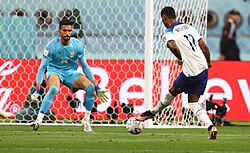
Key Facts
![Brazilian striker Ronaldo (middle, in white) taking a shot at goal. A multi-functional forward, he has influenced a generation of strikers who followed.[5]](/images/20/65/20653c3f2171a099c16d0c39fbbb9d20a21c7da0e248388e99d426e7d2293749.jpg)
- Primary Goal: To create attacking space and score goals.
- Positioning: Placed further up the pitch than midfielders and defenders.
- Common Formations: Typically 1 to 3 forwards, though this varies by tactic.
- The Number 9: Historically synonymous with the centre-forward role.
- Versatility: Modern roles often overlap, with centre-forwards sometimes acting as attacking midfielders.
The Centre-Forward and Target Forward
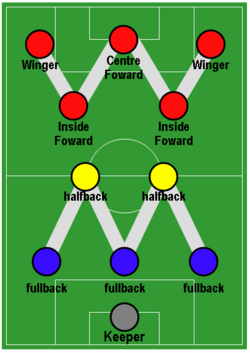
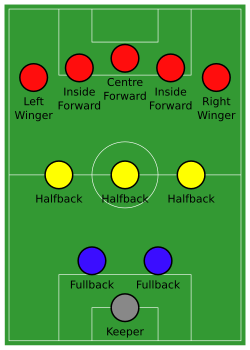
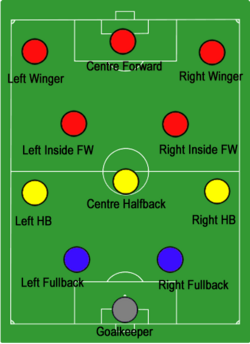
The centre-forward is a broad term encompassing various types of strikers. Historically, the term originates from early formations like the 2–3–5, which featured five forwards: two outside forwards, two inside forwards, and one centre-forward.
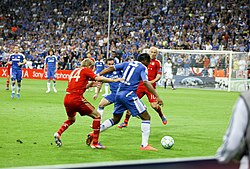
When a player possesses significant height, physicality, and heading ability, they may be utilized as a target forward. This specialized role involves winning long balls, receiving passes with their back to the goal to retain possession, and providing "through balls" (passes into the box) for teammates. While target forwards are often prolific scorers, their primary utility is providing depth and creating chances for others.
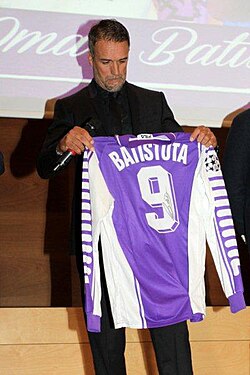
The association between the centre-forward and the number 9 jersey dates back to the 1933 English FA Cup final, where Everton's Dixie Dean wore the number. Dean was a powerful forward who set the record for the most goals scored in a single English football season during 1927–28.
Specialized Attacking Roles
The Second Striker
A second striker often plays behind the main number 9. This role requires a blend of playmaking and finishing, acting as a bridge between the midfield and the primary attacker.
![Wayne Rooney, shown wearing the number 10 jersey, was used at Manchester United as a second striker on many occasions, playing behind the number 9.[10]](/images/ea/10/ea10b4268159c24c166da7a2dbe19b2b7a307fba073d63f4046572a33fdfc461.jpg)
Wingers and Outside Forwards
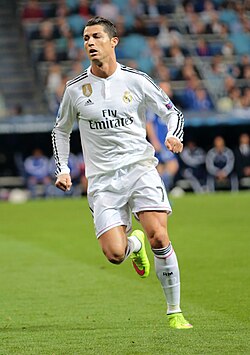
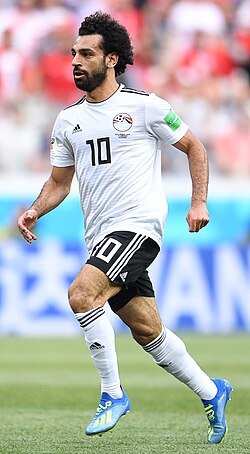
Outside forwards and wingers operate on the flanks. Their responsibilities include dribbling past defenders, producing effective counter-attacks through speed, and delivering crosses into the box. In modern football, the inverted winger has become prominent; this is a player who operates on the opposite side of their stronger foot to cut inside and shoot.
The False 9
The false 9 is a deep-lying centre-forward who drops back into midfield, drawing opposing defenders out of position and creating gaps for other attackers to exploit.
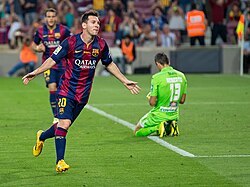
This tactical innovation has a long history. Early examples include Juan Peregrino Anselmo (Uruguay, 1930) and Matthias Sindelar (Austria, 1934). In the 1950s, Hungary's Nándor Hidegkuti utilized this role to great effect, notably in a 6–3 victory over England at Wembley in 1953. This inspired the "Revie Plan" in England, where Don Revie played as a deep-lying forward for Manchester City, helping the team reach the FA Cup Final in 1955 and win it in 1956.
Striker Combinations and Partnerships
Teams often deploy multiple forwards to create complementary dynamics. A common pairing involves a tall, physically imposing player combined with a shorter, technically gifted partner.
![The Edin Džeko (blue, no. 10) and Sergio Agüero (no. 16) duo for Manchester City (2011–2015) is a recent example of a striker partnership made up of a taller and more physically imposing player combined with a shorter and technically gifted partner.[70]](/images/e1/48/e148ae118d84d3c8bda72c82ab1b12feab69df6d472fcc2ab64f4e90ef4b7679.jpg)
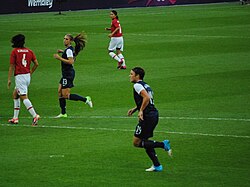
Other successful combinations include high-scoring duos who share a telepathic understanding. For example, Alex Morgan and Abby Wambach combined for 55 goals in 2012, matching a U.S. women's team record set in 1991 by Michelle Akers and Carin Jennings.
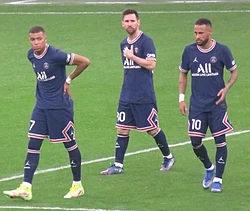
Some teams utilize a trio of elite attackers, such as Paris Saint-Germain's "MNM" strike team consisting of Kylian Mbappé, Lionel Messi, and Neymar.
Summary of Forward Roles
| Role | Primary Characteristic | Key Responsibility |
|---|---|---|
| Centre-Forward | Central positioning | Primary goal scoring and focal point of attack |
| Target Forward | Physicality and height | Winning aerial duels and holding up the ball |
| False 9 | Deep-lying movement | Drawing defenders out of position to create space |
| Inverted Winger | Opposite-foot preference | Cutting inside from the flank to shoot or play |
| Second Striker | Hybrid attacker | Supporting the main striker and playmaking |
Frequently Asked Questions
What is the difference between a centre-forward and a target forward?
Centre-forward is a broad term for any player leading the attack. A target forward is a specific type of centre-forward who uses their height and strength to win headers and hold the ball for teammates.
How does a False 9 differ from a traditional striker?
While a traditional striker stays high up the pitch to finish chances, a False 9 drops deeper into the midfield. This movement confuses defenders and creates space for other attacking players to run into.
What is an inverted winger?
An inverted winger is a player positioned on the wing who uses their opposite foot—for example, a left-footed player on the right wing—allowing them to cut inside toward the goal rather than staying wide to cross.
Why is the number 9 associated with the striker?
The association began during the 1933 English FA Cup final when Everton's prolific scorer Dixie Dean wore the number 9, leading it to become the standard number for the primary centre-forward.
What was the Revie Plan?
The Revie Plan was a tactical variation used by Manchester City in the 1950s, inspired by the Hungarian national team. It involved Don Revie playing as a deep-lying centre-forward to draw the opposing centre-half out of position.