Football Formations: The Evolution of Tactical Systems in Association Football
In association football, a formation refers to the strategic positioning of players relative to one another on the pitch. Unlike sports with rigid positions or set-piece alignments, football is a fluid game. While the goalkeeper remains fixed, other players move dynamically. A formation primarily dictates whether a player's role is predominantly defensive or attacking, and whether they operate centrally or along the flanks.
Managers and head coaches select formations based on their tactical goals—whether to prioritize a strong defense or a potent attack. These systems can change between matches or even during a game to respond to the opponent's strategy. Some teams even employ different formations for their attacking and defending phases of play.
Key Facts
- Formations are denoted by numbers representing rows of players from the most defensive to the most advanced (e.g., 4-5-1).
- The Pyramid (2-3-5) was the first long-term successful formation, dominating from the 1890s to the 1930s.
- The 4-4-2 was the most prevalent system in the 1990s and early 2000s.
- Modern tactics, such as those used by Pep Guardiola, often blend historical systems like the WM with contemporary structures.
- The 4-2-4 was instrumental in Brazil's World Cup victories in 1958 and 1970.
Understanding Formation Notation
Formations are described by a series of numbers. For instance, a "4-5-1" formation consists of four defenders, five midfielders, and one forward. This numerical shorthand allows coaches and analysts to quickly visualize the team's structural balance.
| Formation | Primary Focus | Key Characteristic |
|---|---|---|
| 2-3-5 (Pyramid) | Attack | Five forwards; early standard of the game. |
| 4-4-2 | Balance | Two banks of four; relies on hardworking wide midfielders. |
| 4-3-3 | Possession/Attack | Three forwards; strong central midfield presence. |
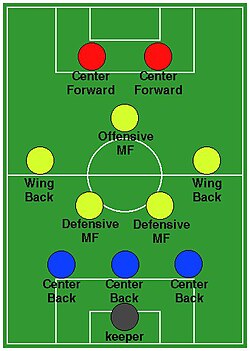
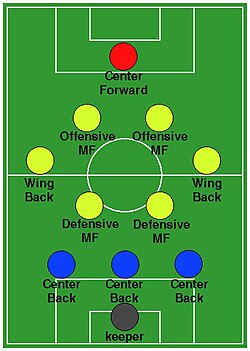
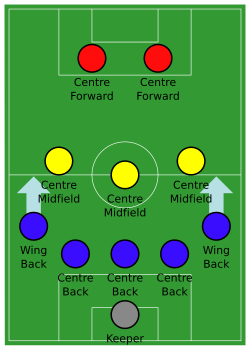
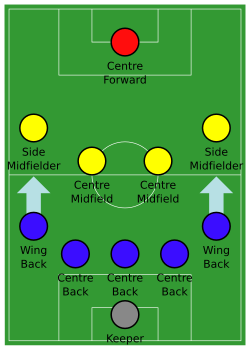
| 3-5-2 | Midfield Control | Three center-backs and attacking wing-backs. |
| 4-2-3-1 | Versatility | Two defensive midfielders supporting a playmaker and wide forwards. |
Historical Formations
The Pyramid (2-3-5)
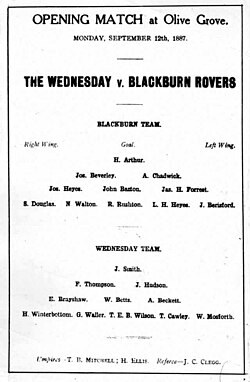
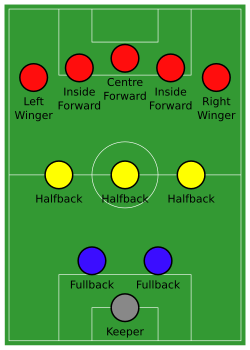
Recorded as a success as early as 1877 in Wales, the 2-3-5—known as the "Pyramid"—became the global standard by the 1890s. It remained the dominant system until the 1930s and was used by Uruguay to secure Olympic gold in 1924 and 1928, as well as the first FIFA World Cup in 1930.
The Metodo (2-3-2-3)
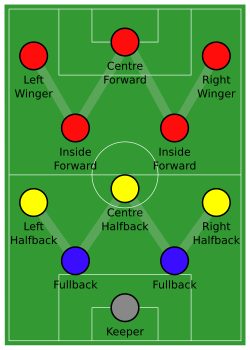
Devised by Vittorio Pozzo for the Italian national team in the 1930s, the Metodo was a variation of the Danubian school. Pozzo pulled two forwards back in front of the midfield to provide more support to his half-backs. This created a more robust defense and enabled lethal counter-attacks, leading Italy to back-to-back World Cup titles in 1934 and 1938.
The WM and WW Systems
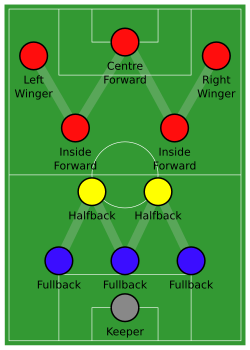
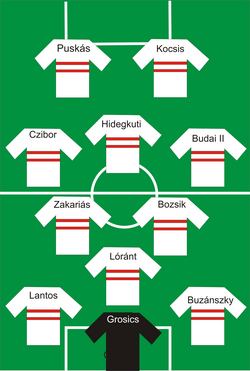
The WM formation provided a structural evolution that balanced the pitch, while the WW formation was famously utilized by Hungary's "Golden Team" to maximize attacking pressure.
The 4-2-4
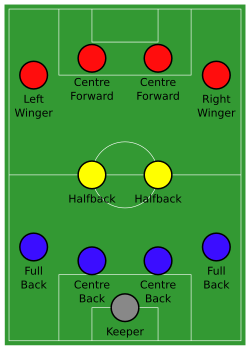
The 4-2-4 gained worldwide fame through the Brazilian national team, contributing to their 1958 and 1970 World Cup wins. Interestingly, manager Syed Abdul Rahim introduced this system to the Indian national team during the "golden era" of Indian football before it was popularized by Brazil. It was also used by Jock Stein's Celtic to win the 1966-67 European Cup.
Contemporary Formations
The 4-4-2 and its Variations
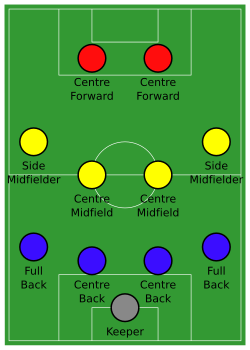
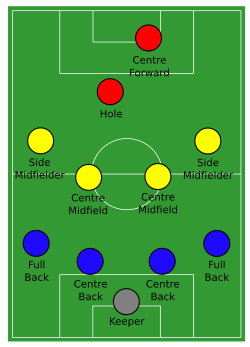
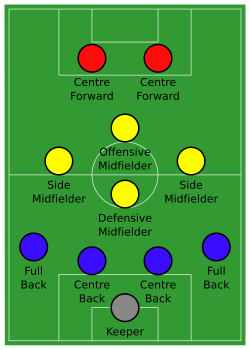
The 4-4-2 was the hallmark of the 1990s, exemplified by Arrigo Sacchi's AC Milan. It requires midfielders to cover vast distances, with one central player acting as a "holding" shield for the defense. However, its decline at the elite level was caused by a lack of central dominance when facing three-man midfields. This led to variations like the 4-4-2 Diamond (4-1-2-1-2) and the 4-4-1-1.
The 4-3-3 and 4-2-3-1
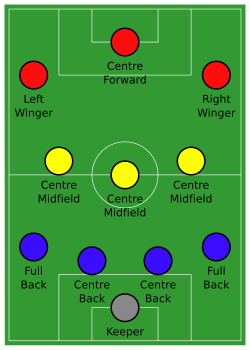
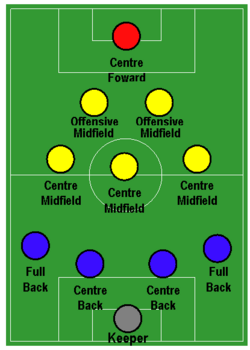
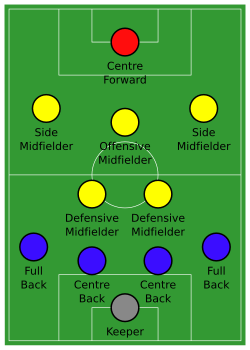
The 4-3-3 evolved from the 4-2-4, offering a stronger midfield. It was famously employed by the Dutch "Total Football" teams of the 1970s and Ajax under Johan Cruyff. The 4-2-3-1 is a modern staple for teams like France and Germany, often using inverted wingers to create a six-man attack and six-man defense layout.

The 4-2-2-2 (Magic Rectangle)
The 4-2-2-2 consists of four defenders, two central midfielders, two support strikers, and two primary strikers. A specific Colombian variation emphasizes triangulation and surprise attacks, while the Brazilian version was notably used in the 1998 World Cup final.
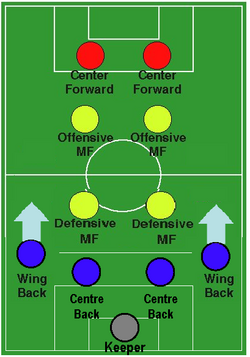
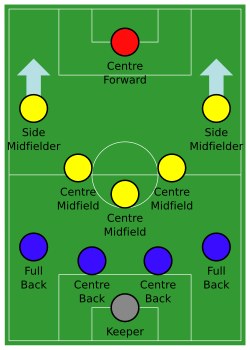
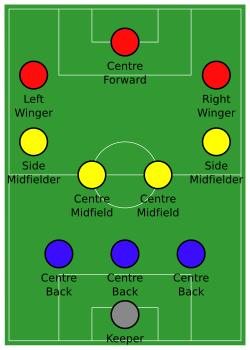
Defensive and Hybrid Systems (4-5-1, 3-4-3, 3-5-2, 5-3-2)
Teams often switch to a 4-5-1 or 5-4-1 to protect a lead. The 3-4-3 is an offensive-minded system used by Antonio Conte's Chelsea to win the Premier League. The 3-5-2, pioneered at the highest level by Carlos Bilardo's 1986 Argentina team, utilizes wing-backs to cover the entire flank. Similarly, the 5-3-2 was a staple of Helenio Herrera's Inter Milan and Brazil's 2002 World Cup squad.
Modern Innovations: The 3-2-4-1
Pep Guardiola has recently utilized a 3-2-4-1 at Manchester City, which helped the club achieve a continental treble in 2022-23. This system involves a defensive midfielder advancing to create a "box" in midfield, drawing structural parallels to the historic WM system.
Frequently Asked Questions
What is the difference between a 4-4-2 and a 4-3-3?
The 4-4-2 uses two banks of four midfielders and two strikers, providing balanced width. The 4-3-3 replaces one midfielder with a third forward, creating a more potent attack and often a more staggered, controlling midfield.
Who invented the Metodo formation?
The Metodo (2-3-2-3) was devised by Vittorio Pozzo, the coach of the Italy national team, who used it to win the 1934 and 1938 World Cups.
Why is the 4-4-2 less common in modern elite football?
The 4-4-2 often struggles with central dominance. Teams using three or more central midfielders (like in a 4-3-3) can outnumber the two central midfielders of a 4-4-2, making it harder for the latter to retain possession.
What is a wing-back?
A wing-back is a hybrid role found in formations like the 3-5-2 or 5-3-2. They combine the duties of a full-back (defending) and a winger (attacking), responsible for patrolling the entire length of the pitch's flank.
How does the 4-2-3-1 function offensively?
In its offensive layout, the 4-2-3-1 often creates a six-man attack consisting of two wide forwards, a playmaker, and a lone striker, supported by the advancing midfielders.