Asian Dust: The Environmental and Health Impact of the Yellow Dust Phenomenon
Known variously as Yellow Dust, kosa, or hwangsa, Asian Dust is a significant meteorological phenomenon that affects much of East Asia. While it occurs year-round, it is particularly intense during the spring months. These massive clouds of fine, dry soil particles originate in the deserts of China, Mongolia, and Kazakhstan, driven eastward by high-speed surface winds.
As these dust clouds travel, they pass over North and South Korea, Japan, and parts of the Russian Far East. In some instances, the concentration of airborne particulates is so significant that they affect air quality as far east as the United States. While historically a natural occurrence, the phenomenon has evolved into a complex modern crisis involving industrial pollution and rapid environmental change.
![Asian dust soars in the arid regions of mainland China and rides on the wind to descend to regions such as Japan.[1]](/images/97/54/9754acad705207ddec4c55a862bfa4d7bdfaf5418cb65a73b1d129c0f55848be.png)
Key Facts
- Origins: Deserts of China, Mongolia, and Kazakhstan.
- Primary Composition: Silicon, aluminium, calcium, and iron, often mixed with industrial pollutants like mercury and cadmium.
- Health Risks: Linked to respiratory diseases, cardiovascular issues, and potential neurological connections.
- Economic Impact: Causes significant costs to the airline industry and increases demand for air purifiers and masks.
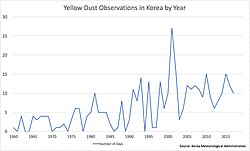
- Trend: The frequency of dust events has increased five-fold over the last half-century.
Historical Context and Modern Escalation
Records of dust storms in Asia date back millennia. Ancient Chinese literature, such as the Zhu Shu Ji Nian, contains accounts of "raining dust" as early as 1150 BC. Similarly, the first known record in Korea dates to 174 AD during the Silla dynasty, where the event was termed "Uto," meaning "Raining Dirt/Earth."
Despite these ancient roots, modern data shows a stark increase in severity. In the 1960s, the average number of Asian dust days per year was approximately two. By the 2000s, this average rose to 11 days. Furthermore, while the 1960s and 1970s saw several years free of dust, there has not been a single year without Asian dust since the turn of the century.
Drivers of Desertification
The intensification of these storms is closely linked to desertification—the process by which fertile land becomes desert. Deforestation and the drying of the Aral Sea in Kazakhstan and Uzbekistan have exacerbated the problem. The Aral Sea began to shrink significantly in the 1960s due to the diversion of the Amu Darya and Syr Darya rivers for Soviet agricultural irrigation projects.
Composition and Particle Science
The composition of Asian Dust has changed alongside human industrialization. While the base material consists of minerals like silicon (24–32%), aluminium (5.9–7.4%), and calcium (6.2–12%), the dust now frequently carries toxic substances from coal burning, such as mercury and cadmium.
Scientists categorize these particles by size, which determines their danger to human health:
- Fine Particulate Matter (PM10): Particles smaller than 10 μm in diameter.
- Ultrafine Particulate Matter (PM2.5): Particles smaller than 2.5 μm in diameter.
PM10 particles are small enough to penetrate deep into the lung alveoli. However, PM2.5 particles are even more dangerous; they can pass through the lungs into the bloodstream or lymphatic system, potentially reaching the brain or fetal organs.
Health and Socio-economic Consequences
Impact on Human Health
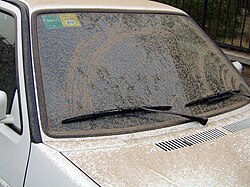
The most critical effect of Asian Dust is its impact on respiratory and cardiovascular health. Studies in Korea and Japan have shown that individuals with asthma suffer the most adverse effects. There is also emerging evidence linking PM2.5 exposure to neurological diseases, such as Parkinson's disease. In South Korea, the OECD has predicted that worsening air pollution could lead to 1,069 premature deaths per million by 2060.
Economic and Industrial Disruptions
The economic toll is multifaceted. The airline industry faces high costs; dust can accumulate on aircraft surfaces, reducing wing lift and causing corrosion or paint discoloration. Cleaning a single B747 jumbo jet can require eight hours of labor and 6,000 liters of water. Conversely, the dust has created a boom for certain sectors, with sales of face masks and air purifiers surging by hundreds of percent during high-dust periods.
| Category | Impact/Observation |
|---|---|
| South Korea (2002) | Socio-economic cost estimated between US$3.9 billion and $7.3 billion. |
| Beijing (2000) | Dust storms accounted for more than 2.9% of the city's GDP. |
| Consumer Goods | Face mask sales increased by 458% during high-dust periods in 2019. |
| Aviation | Increased maintenance costs for cleaning and corrosion prevention. |
International Cooperation and Policy
Because the dust travels across borders, it is a classic example of a negative externality—where industrial and land-use decisions in one country (such as China or Mongolia) impose social and health costs on neighboring nations like Korea and Japan. This has led to significant international debate regarding responsibility for transboundary pollution.
To address this, governments have begun collaborative efforts. For instance, in 2018, South Korea and China met through the Joint Committee on Environmental Cooperation to discuss fighting air pollution and marine pollution together. In South Korea, the issue has even reached the political stage, with major candidates in the 2017 presidential election making air quality a central campaign promise.
Frequently Asked Questions
How does Asian Dust affect daily life?
High levels of dust often lead to advisories or warnings, prompting residents to limit outdoor activities. In South Korea, schools have created indoor spaces for physical education, and professional sports leagues, such as the Korea Baseball Organization, may cancel games during severe warnings.
What is the difference between PM10 and PM2.5?
PM10 refers to fine dust particles smaller than 10 micrometers, while PM2.5 refers to ultrafine particles smaller than 2.5 micrometers. PM2.5 is considered more dangerous because it can enter the bloodstream and reach vital organs.
Can Asian Dust affect the environment outside of East Asia?
Yes. While it primarily affects East Asia, significant concentrations of these particulates can be carried across the Pacific to the United States. Interestingly, the dust also provides a natural nutrient distribution to North Pacific islands like Hawaii.
Why is the dust becoming more frequent?
The increase is attributed to intensified desertification caused by deforestation and the drying of major water bodies like the Aral Sea, alongside rapid industrialization which adds pollutants to the natural dust.
Does weather play a role in dust storms?
Yes, meteorological factors like high-speed winds drive the movement of the dust. Additionally, El Niño can play a role, as winter ice can sometimes prevent dust from being swept off the land.