Asháninka People: Guardians of the Amazon Rainforest
The Asháninka (also known as Asháninca) are a resilient Indigenous people inhabiting the lush rainforests of the Amazon basin. Primarily settled across the regions of Junín, Pasco, Huánuco, and Ucayali in Peru, as well as the state of Acre in Brazil, they have long served as stewards of one of the world's most critical biodiversity hotspots.
Known for their fierce independence and deep connection to the land, the Asháninka have navigated centuries of external pressure while maintaining a distinct cultural identity rooted in the natural capital of the jungle.
Key Facts
- Population: Estimated between 25,000 and 100,000 (approx. 99,122 in 2014).
- Primary Locations: Peru (Junín, Pasco, Huánuco, Ucayali) and Brazil (Acre).
- Language: Asháninka (Arawak family), Spanish, and Portuguese.
- Traditional Clothing: The kushma, a hand-woven cotton robe.
- Subsistence: Slash-and-burn agriculture, hunting, and fishing.
Culture and Traditional Way of Life
Subsistence and Ecology
The Asháninka rely on subsistence agriculture, utilizing biodiversity-friendly techniques. They employ the slash-and-burn method to cultivate a variety of crops, including yucca roots, sweet potato, corn, bananas, rice, coffee, cacao, and sugar cane. Beyond farming, they sustain themselves through fishing and hunting—primarily using spears, bows, and arrows—and by gathering wild fruits and vegetables from the jungle.
Traditional Dress and Adornment
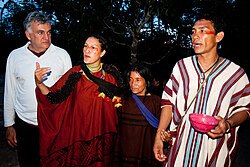
A central element of Asháninka identity is the kushma, a cotton robe collected, spun, dyed, and woven by women on looms. These garments are typically dyed royal blue or brown, with shoulders ornamented with seeds; a single full-length robe can take three months to complete.
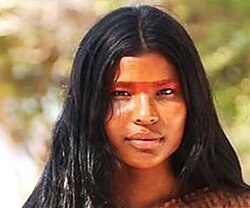
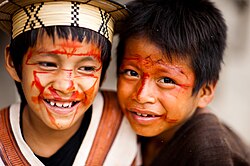
Adornments are deeply symbolic. Men often wear their hair in "bowl" cuts or short styles, while women traditionally wear their hair long. Both genders use Achiote (Bixa orellana), a bright red seed, to paint intricate designs on their faces. Accessories include necklaces and bracelets crafted from seeds, brightly colored feathers, and the teeth of monkeys, peccaries, and tapirs.
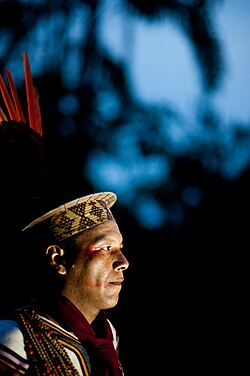
For ceremonial occasions, men wear woven palm leaf crowns decorated with feathers, while women wear woven cotton headdresses.
Language and Social Structure
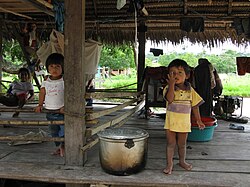
The Asháninka language belongs to the Arawak linguistic family, sharing roots with languages such as Matsiguenga and Yanesha. In Peru, they traditionally organized themselves into small residential groups of about five nuclear families, led by a local chief known as a Kuraka.
History of Resistance and Struggle
Early Encounters and the Rubber Boom
Historically known to the Incas as the Anti or Campa, the Asháninka were feared for their warlike skills and fierce protection of their territory. This independence continued during the Spanish conquest, where they resisted Roman Catholic missionary efforts from the 17th to 19th centuries.
The most devastating period occurred during the rubber boom (1839–1913). Under the enterprise of Carlos Fitzcarrald, many Asháninka were enslaved to extract rubber. It is estimated that 70% of the population perished during this era. This oppression led to a significant rebellion in 1914 in the Pichis area, which successfully evicted rubber tappers from the region.
Modern Conflicts and Human Rights
The late 20th century brought new tragedies. During the 1980s and 90s, the Asháninka were targeted by the Sendero Luminoso (Shining Path) and the MRTA. In the Junín region alone, approximately 6,000 people were killed, 10,000 were displaced, and 5,000 were imprisoned in camps. Between 30 and 40 villages were completely destroyed.
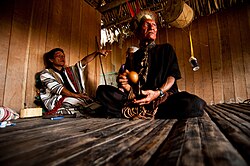
Today, the community faces ongoing threats from illegal logging, drug trafficking, oil companies, and diseases like malaria. Furthermore, large-scale infrastructure projects, such as the proposed 2,000-megawatt Pakitzapango Dam in Peru's Ene valley, threaten to displace up to 10,000 people. Activists like Luzmila Chiricente Mahuanca continue to fight for the protection of indigenous territories.
Demographic Distribution
| Country | Primary Regions/States | Estimated Population | Key River Basins |
|---|---|---|---|
| Peru | Junín, Pasco, Huánuco, Ucayali | ~97,477 (2007) | Apurímac, Ene, Tambo, Pichis, Ucayali |
| Brazil | Acre | ~1,645 (2014) | Breu, Amônia, Arara |
Frequently Asked Questions
What is a kushma?
A kushma is a traditional Asháninka robe made from hand-spun and woven cotton. It is typically dyed in royal blue or brown and can take up to three months for women to complete.
Which language family does the Asháninka language belong to?
The Asháninka language is part of the Arawak linguistic family, which also includes the Yine, Caquinte, and Nomatsiguenga languages.
How did the rubber boom affect the Asháninka?
The rubber boom (1839–1913) was catastrophic, resulting in the enslavement of many Asháninka and the death of an estimated 70% of their population.
What are the current threats to Asháninka territories?
Current threats include illegal logging, drug trafficking, oil exploration, the spread of malaria, and large-scale energy projects like the Pakitzapango Dam.
Who are the Kuraka?
The Kuraka are local chiefs who traditionally provide direction and leadership to small residential groups consisting of approximately five nuclear families.