Artillery Battery: Evolution, Organization, and Naval Application
In military terminology, an artillery battery is a specialized unit comprising multiple systems of artillery, mortars, rocket launchers, or missiles. These systems are grouped together to streamline battlefield communication, enhance command and control, and ensure the necessary dispersion of gunnery crews to minimize vulnerability. While primarily associated with land forces, the term is also used in naval contexts to describe groups of guns on warships.
Key Facts
- Definition: A company-level sub-unit of an artillery branch, typically consisting of 4 to 12 ordnance pieces.
- Composition: Can include howitzers, mortars, rocket artillery, and surface-to-surface missiles.
- Naval Use: Refers to the arrangement of guns on a ship, evolving from broadsides to rotating turrets.
- Command: Usually led by a captain, lieutenant, or major, depending on the army and era.
- NATO Standard: Defined as a unit larger than a platoon but smaller than a battalion.
Land-Based Artillery Batteries
Historical Evolution
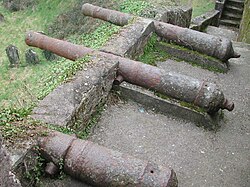
Historically, a battery referred to a cluster of cannons acting as a group, whether in temporary field positions during battles or during the siege of a city. These groups often mixed different types of ordnance, such as cannons, howitzers, and mortars. By the 18th century, the term transitioned into an organizational designation for permanent units. While horse artillery sometimes used the term "troop" and fixed positions used "company," the term "battery" became the standard by the late 19th century.
Mobile Batteries and Tactical Organization
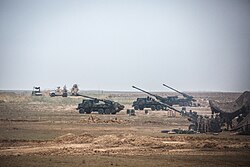
During the Napoleonic Wars, batteries were sometimes grouped into larger field units known as Grand Batteries. Administratively, these were organized into battalions, regiments, or squadrons. In the 20th century, batteries became more complex to accommodate indirect fire—the act of engaging a target without a direct line of sight. This required the addition of forward observers and a staff to calculate firing data, as well as signalers to coordinate fire between dispersed batteries.
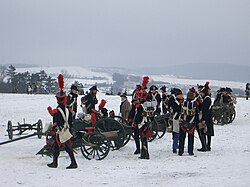
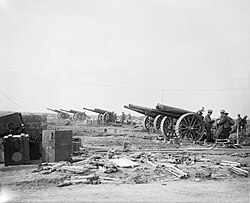
The size of a battery has varied by conflict. During the American Civil War, Union batteries typically had six field pieces, while Confederate batteries often had four. In the 20th century, field artillery usually ranged from four to 12 pieces, though heavy artillery might consist of only two.
Fixed Batteries
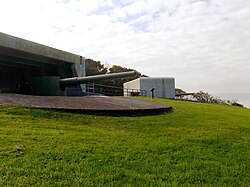
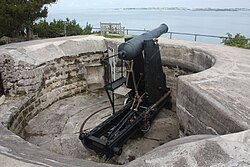
Fixed artillery consists of guns anchored in one spot or on carriages designed only for aiming rather than tactical repositioning. These were common in coastal and frontier defenses, often utilizing larger guns than those transportable by mobile units. These installations included extensive support systems, such as magazines for ammunition storage.
Naval Battery Usage
In the Age of Sail, warships mounted cannons in broadsides—rows of guns along the side of the ship. This changed in the mid-19th century with the introduction of the rotating turret, first seen on the USS Monitor. This allowed a smaller number of guns to concentrate fire in multiple directions.
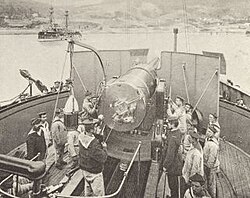
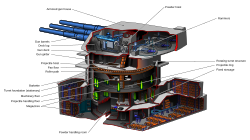
The 1906 launch of HMS Dreadnought revolutionized naval warfare with the "all big gun" concept, featuring a main battery of ten heavy-caliber guns. This rendered previous battleships obsolete by providing overwhelming firepower. Modern warships have largely replaced conventional batteries with guided missiles, though small-caliber guns like the Phalanx CIWS are still used for point defense.
Modern Organizational Structures
United States Army and Marine Corps
In the US Army, a towed howitzer battery generally has six guns, while self-propelled batteries have eight. They are categorized by caliber: Light (105 mm), Medium (155 mm), and Heavy (203 mm or larger). A US battery is typically divided into a firing section and a Fire Direction Center (FDC), which computes firing solutions based on coordinates.
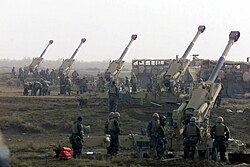
The US Marine Corps utilizes a highly structured organization. A 155mm howitzer battery consists of approximately 147 personnel, including a Battery Headquarters, a Communications Section, a Maintenance Section, and a Firing Platoon. The Firing Platoon is further divided into individual artillery sections, each led by a staff sergeant.
Commonwealth and Other International Models
UK and Commonwealth forces often divide batteries into a "gun group" (handling logistics, survey, and the guns themselves) and a "tactical group" (consisting of the battery commander and observation teams). In this model, the Battery Commander (a Major) often deploys with the infantry or armored unit they are supporting, rather than staying with the guns.
| Battery Category | Typical Caliber/Equipment | Primary Role |
|---|---|---|
| Light | 105 mm or smaller | Rapid deployment and support |
| Medium | Up to 155 mm | General field support |
| Heavy | 203 mm or larger | Long-range bombardment |
| Specialized | Missiles / Rockets / AA | Anti-aircraft or strategic strike |
Frequently Asked Questions
What is the difference between a battery and a platoon?
In artillery, a battery is a company-level unit, which is larger than a platoon. A battery typically consists of multiple platoons or sections and includes its own headquarters and limited self-support capacity.
What does a Fire Direction Center (FDC) do?
The FDC acts as the "brain" of the battery. It receives target coordinates from observers, computes the necessary firing solutions (angle and elevation), and communicates those directions to the gun crews.
How did the HMS Dreadnought change naval batteries?
The HMS Dreadnought introduced the "all big gun" layout, replacing a mix of calibers with a uniform main battery of ten heavy guns. This significantly increased the weight of a broadside and the rate of fire, making previous battleship designs obsolete.
What is a "fixed battery"?
A fixed battery consists of artillery pieces mounted on permanent platforms or carriages that cannot be moved for tactical repositioning. These were historically used for coastal defense and fortress protection.
Who typically commands an artillery battery?
Depending on the military and the era, a battery is usually commanded by a captain, lieutenant, or major.