Military Organization: Structures, Hierarchies, and Command Systems
Military organization is the strategic structuring of a state's armed forces to provide the specific capabilities required by its national defense policy. To maintain order and efficiency, these organizations almost universally employ hierarchical forms, ensuring a clear chain of command from the highest political leadership down to the individual soldier.
While most nations focus on formal military structures, some include paramilitary forces—organized bodies that mirror military discipline but are not strictly military—within their armed forces. Additionally, non-state actors, such as insurgent forces, often emulate these professional structures to improve their operational effectiveness.
Key Facts
- Hierarchical Structure: Modern military organization relies on a tiered system of command to manage troop strength and operational control.
- Civilian Oversight: In most democracies, military forces are managed by a civilian-led government department, such as a Ministry of Defence.
- Standard Branches: The typical model divides armed forces into three primary branches: Army, Navy, and Air Force.
- Joint Forces: A joint force is a unit comprising combat power from two or more different military branches.
- Task Forces: These are temporary groupings created for a specific operational purpose rather than permanent administrative structures.
The Evolution and Administration of Military Command
The use of formalized ranks and hierarchical structures became widespread with the Roman Army. The Romans organized their forces into legions (approximately 5,000 soldiers) led by a legate, which were further subdivided into centuries led by centurions.
In the modern era, the executive control and administration of the military are handled by the state's public administration. In presidential systems like the United States, the President serves as the commander-in-chief, with a cabinet-level defense minister serving as second in command. Below this level, secretaries manage major operational divisions and departmental agencies provide specialized services, such as military science research, capability development, and strategic advice.
Military Branches and Internal Security
Most nations utilize a tripartite division of services: the Army (land), Navy (sea), and Air Force (air). However, many countries adapt this model by establishing independent services for cyber warfare, space operations, medical services, or special forces (such as commandos). Depending on the nation, coast guards and border guards may be integrated into the military or operate as civil law enforcement agencies.
Internal security is often managed by gendarmeries or military police. These paramilitary forces are common globally, though they are less frequent in countries with English common law traditions, where a strict separation exists between civil police and the armed forces.
Commands, Formations, and Units
In Western military terminology, the building blocks of the force are categorized as commands, formations, and units.
- Command: A collection of units and formations under a single officer, typically serving as a strategic headquarters responsible to the national government.
- Unit: A homogeneous organization (combat, combat-support, or non-combat) that is self-contained in its administrative and command functions.
- Formation: In Commonwealth practice, this refers to larger organizations like brigades and divisions, whereas smaller groups are simply called units.
Terminology can vary significantly between branches. For example, a "squadron" may refer to a formation of ships in a navy, a unit in an air force, a battalion-sized cavalry unit in the U.S. Army, or a company-sized sub-unit in Commonwealth armies.
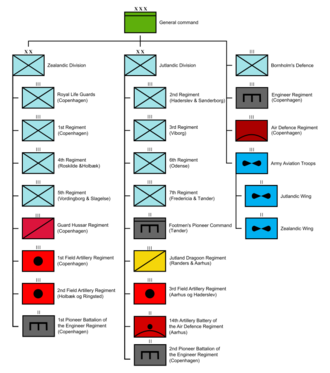
Table of Organization and Equipment (TOE)
To maintain standardization, the U.S. Army uses a Table of Organization and Equipment (TOE). This document prescribes the manning, equipment, and structural guidelines for units from the divisional level down to the smallest elements. This ensures that all units of the same branch, such as infantry, follow a consistent organizational blueprint regardless of their specific designation.
Modern Hierarchical Structures
Army Hierarchy
Army structures are often modeled on British or American systems, though variations exist. For instance, the Corps was introduced by Napoleon around 1805 to provide a flexible grouping of two or more divisions.
| Name | Nature | Approx. Strength | Constituent Units | Typical Leader |
|---|---|---|---|---|
| Army Group | Command | 400,000–1,000,000 | 2+ Armies | General / Field Marshal |
| Field Army | Command | 100,000–200,000 | 2–4 Corps | General / Lt. General |
| Corps | Formation | 20,000–60,000 | 2+ Divisions | General / Lt. General |
| Division | Formation | 6,000–25,000 | 2–8 Brigades/Regiments | Maj. General / Lt. General |
| Brigade | Formation | 3,000–5,000 | 2+ Regiments or 3–8 Battalions | Brigadier General / Colonel |
| Battalion | Unit | 300–1,000 | 2–6 Companies | Lieutenant Colonel |
| Company | Unit/Sub-unit | 100–250 | 2–8 Platoons | Captain / Major |
| Platoon | Sub-subunit | 20–50 | 2+ Sections | Lieutenant |
| Squad | Sub-subunit | 6–12 | 2–3 Fireteams | Sergeant / Corporal |
Naval and Air Force Organization
Naval organization is more fluid, as ships often operate in varying group sizes. However, general concepts include Fleets (regional), Task Forces (complementary vessels), and Squadrons (small vessels of similar types). Modern U.S. Navy operations frequently center on Carrier Strike Groups and Expeditionary Strike Groups.
Air force structures vary by nation. Some, like the USAF and RAF, use a system of commands, groups, and squadrons. Others, such as the Soviet model, utilize an army-style structure. In the RAF and RCAF, wings typically consist of several squadrons.
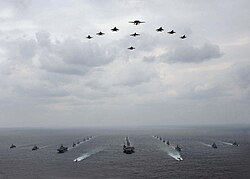
Task Forces and Joint Operations
A task force is a temporary grouping created for a specific mission. Examples include the German Kampfgruppe or the U.S. Combat Team. Within NATO, these are further categorized by their composition:
- Joint Task Force (JTF): Includes elements from more than one armed service.
- Combined Task Force (CTF): Includes elements from more than one nation.
- Combined Joint Task Force (CJTF): Includes elements from multiple services and multiple nations.
Frequently Asked Questions
What is the difference between a unit and a formation?
Generally, a unit is a homogeneous organization (like a battalion) that is self-contained in its command and administration. A formation is a larger grouping of these units, such as a brigade or division. However, terminology varies; in the U.S., the terms are sometimes used synonymously, while in Commonwealth countries, the distinction is more rigid.
How does civilian control of the military work in a presidential system?
In a presidential system, such as that of the United States, the President serves as the commander-in-chief. The defense minister (Secretary of Defense) acts as the second-in-command and manages the military through a cabinet-level department.
What is a Joint Task Force?
A Joint Task Force (JTF) is a temporary military grouping created for a specific operational purpose that integrates personnel and assets from two or more different branches of the military (e.g., Army and Navy).
What is a Table of Organization and Equipment (TOE)?
A TOE is a standardized document used by the U.S. Army to prescribe the required manning, equipment, and structural organization for specific types of units, ensuring consistency across the entire branch.
Why do some countries have gendarmeries instead of civil police?
Gendarmeries are military-style internal security forces. They are common in many parts of the world but rare in countries with English common law histories, where there is a strong tradition of separating civil law enforcement from military power.