Arthur "Big Boy" Crudup: The Delta Blues Pioneer and Father of Rock and Roll
Arthur William "Big Boy" Crudup was a powerhouse of the Delta blues—a raw, rural style of blues music originating from the Mississippi Delta. As a singer, songwriter, and guitarist, Crudup created a driving sound that bridged the gap between traditional blues and the birth of rock and roll. While he may not have achieved the global fame of those who covered his work, his influence on 20th-century music is immeasurable.
Key Facts
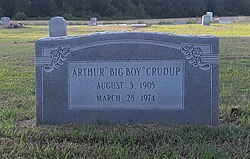
- Born: August 24, 1905, in Forest, Mississippi.
- Died: March 28, 1974, in Nassawadox, Virginia.
- Defining Songs: "That's All Right," "My Baby Left Me," and "So Glad You're Mine."
- Major Influence: His style and songs were pivotal to the early career of Elvis Presley.
- Industry Struggle: Spent much of his later life fighting for unpaid royalties.
Early Life and Musical Roots
Born into a family of migrant workers, Crudup spent his early years traveling through the American South and Midwest. After returning to Mississippi in 1926, he immersed himself in gospel music and began studying the blues under a local musician named Papa Harvey. This training allowed him to find work performing in cafes and dance halls around Forest, Mississippi, before he eventually migrated to Chicago around 1940.
The Rise of "Big Boy" Crudup
Crudup's professional journey began in Clarksdale, Mississippi, and included a stint with the group Harmonizing Four. However, his early days in Chicago were lean; he struggled as a street singer, at one point living in a packing crate. His fortunes shifted when producer Lester Melrose discovered him and introduced him to Hudson Whittaker (known as Tampa Red), leading to a recording contract with RCA Victor's Bluebird label.
Throughout the late 1940s and early 1950s, Crudup recorded for several labels, including Ace, Checker, and Trumpet. He toured the South, collaborating with legendary figures like Elmore James and Sonny Boy Williamson II. During this era, he occasionally recorded under the pseudonyms "Elmer James" and "Percy Lee Crudup."
The Bridge to Rock and Roll
Crudup's music featured a raucous, driving rhythm that predated the mainstream explosion of rock and roll. His 1946 track "That's All Right" is cited by some historians, including Joseph Burns of Southeastern Louisiana University, as the first rock and roll song, potentially containing the first-ever guitar solo break.
This sound caught the ear of a young Elvis Presley. Presley later admitted, "If I had any ambition, it was to be as good as Arthur Crudup." Presley recorded three of Crudup's songs, helping to propel the "Big Boy" sound into the white mainstream, though this success did not initially translate into financial security for Crudup himself.
Industry Exploitation and Later Years
Despite the popularity of his music, Crudup became a victim of systemic music industry exploitation. Frustrated by royalty disputes, he stopped recording in the 1950s, famously stating, "I realised I was making everybody rich, and here I was poor."
To survive, Crudup returned to Mississippi to engage in bootlegging before eventually settling in Virginia. There, he worked as a field laborer and occasionally performed in local drinking establishments, such as the Do Drop Inn in Franktown.
In the late 1960s and early 1970s, promoters and activists attempted to recover his lost royalties. While he eventually collected over $10,000 through the Songwriters Guild of America, a larger $60,000 settlement fell through when Hill and Range Songs refused to sign the legal documents. Despite a brief return to recording in 1965 and a 1970 trip to the UK to record "Roebuck Man," Crudup remained financially strained until his death.
Death and Lasting Legacy
Arthur Crudup passed away on March 28, 1974, due to complications from diabetes and heart disease. Today, he is honored with a marker on the Mississippi Blues Trail in Forest.
While he was sometimes called "The Father of Rock and Roll"—a title he viewed with bemusement—his true legacy lies in his role as a foundational architect of American popular music. His work proved that the driving energy of the Delta blues was the essential spark for the rock revolution.
| Category | Details |
|---|---|
| Active Years | 1939–1973 |
| Primary Instruments | Guitar, Vocals |
| Key Labels | Bluebird, Delmark, Fire, RCA |
| Notable Collaborators | Bonnie Raitt, Willie Dixon, Ransom Knowling |
| Key Contributions | Pioneered the driving rhythm that influenced early Rock and Roll |
Frequently Asked Questions
Why is Arthur Crudup called the "Father of Rock and Roll"?
He is given this title because his driving, raucous style of Delta blues and songs like "That's All Right" provided the musical blueprint for early rock and roll artists, most notably Elvis Presley.
Which famous artists covered Arthur Crudup's songs?
Beyond Elvis Presley, his music has been recorded by artists such as Elton John, Rod Stewart, and Slade.
What happened to Crudup's royalties?
Crudup suffered significant financial loss due to industry exploitation. Although he recovered some funds through the Songwriters Guild of America and the help of activists, a major $60,000 settlement was blocked by Hill and Range Songs.
Where can you find a memorial for Arthur Crudup?
He is honored with a marker on the Mississippi Blues Trail located in Forest, Mississippi.
What were Crudup's last professional engagements?
His final professional performances were conducted alongside musician Bonnie Raitt.