Armstrong Secret 9: The Jazz Legend's Baseball Legacy
During the vibrant era of the Jazz Age, the intersection of music and athletics created a unique cultural phenomenon. For many American entertainers, sports provided a powerful medium for self-promotion and community engagement. Among the most notable examples was the Armstrong Secret 9, a semi-professional Negro league baseball team sponsored by the legendary jazz musician Louis Armstrong in his hometown of New Orleans, Louisiana.
The team represented more than just a hobby; it was part of a broader trend where big-name bandleaders—including Count Basie, Benny Goodman, Harry James, and Tommy Dorsey—formed their own baseball or softball teams. These ventures allowed musicians and athletes to evolve their crafts on a larger scale, performing and competing before massive audiences.
Key Facts
- Sponsor: Jazz musician Louis Armstrong.
- Location: New Orleans, Louisiana.
- Active Period: 1931 (possibly into 1932).
- Original Name: The Raggedy 9.
- League Status: Independent semi-pro Negro league team.
- Notable Opponent: Melpomene White Sox.
From the Raggedy 9 to the Secret 9
The team began its journey under the name the Raggedy 9, a title inspired by the poor quality of their initial uniforms. As an avid baseball fan, Armstrong sponsored the New Orleans-based club, which competed against various local amateur and semi-professional African American teams during a three-month stay in the city.
Impressed by the players' talent and driven by his affection for the team, Armstrong decided to upgrade their image. He purchased high-quality white cotton uniforms featuring his name in a bold font on the chest and player numbers on the back. With this transformation, the team was renamed Armstrong's Secret 9 (and was also known as the Smart 9).
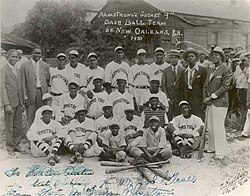
The 1931 Homecoming Tour
Upon returning from his professional music tours, Armstrong led the Secret 9 on a three-month homecoming tour across southern Louisiana. The team engaged in scrimmages with other Black baseball teams, college squads, and even prison teams. While Armstrong did not play a position on the field—famously clarifying to an interviewer that his "position" referred to his musical instruments—he remained an active participant by throwing out the first pitch at every game.
One of the tour's highlights was a game against the Melpomene White Sox at St. Raymond Park. The event drew 1,500 fans and sparked significant community interest, particularly after the Louisiana Weekly published an article about the team's activities.
Roster and Equipment
Although no official rosters have survived, it is alleged that the team was composed of members from the Zulu Social Aid and Pleasure Club, a historic New Orleans organization.
The transition from tattered gear to professional equipment had a psychological impact on the players, initially boosting their confidence. By August 1931, the Louisiana Weekly noted that the team was fully equipped, from their caps down to the mascot's water bucket. However, this new professionalism came with a drawback: the players became so protective of their "Sunday Go To Meetings" (pristine) uniforms that they were reluctant to slide in the dirt, leading some observers to wonder if they were too well-dressed to play aggressively.
| Category | Details |
|---|---|
| Original Name | Raggedy 9 |
| Final Name | Armstrong Secret 9 / Smart 9 |
| Primary Sponsor | Louis Armstrong |
| Home Base | New Orleans, Louisiana |
| Active Year | 1931 |
| Uniform Style | White cotton with "Armstrong" on chest |
Frequently Asked Questions
Why was the team originally called the Raggedy 9?
The team was named the Raggedy 9 because of the poor, tattered quality of their original uniforms and busted cleats.
Did Louis Armstrong actually play in the games?
No, Louis Armstrong did not play a position on the field. He served as the sponsor and would throw out the first pitch at each game.
Who were the players on the Armstrong Secret 9?
While no official rosters exist, the team was allegedly made up of members of the Zulu Social Aid and Pleasure Club.
How did the new uniforms affect the team's play?
While the new uniforms boosted the players' confidence, they also made the players hesitant to slide in the dirt to avoid ruining the expensive white cotton fabric.
When did the team stop playing?
The team toured in the summer of 1931 and possibly played into 1932, after which news coverage of the team disappeared.