Armored Cars: Evolution and Impact of Wheeled Fighting Vehicles
An armored car is a wheeled armored fighting vehicle (AFV) designed for a variety of military roles, including reconnaissance, internal security, and armed escort. Historically, these vehicles emerged to fill the void left by the decline of mounted cavalry, providing the speed and flexibility required for light cavalry duties in a mechanized age.
While the invention of the tank introduced tracked mobility for heavy combat, armored cars remained essential due to their higher road speeds, simpler maintenance, and lower production costs. This made them particularly attractive for colonial armies operating in underdeveloped regions. Throughout their history, they have evolved from simple improvised shields on petrol engines to sophisticated platforms capable of carrying tank-grade weaponry.
Key Facts
- Primary Roles: Reconnaissance, passive observation, communications, and internal security.
- Key Advantage: Faster road speed and lower cost compared to tracked tanks.
- Evolution: Transitioned from basic "armed cars" to specialized scout cars and multipurpose personnel carriers.
- Modern Capability: Some modern variants can mount large cannons capable of threatening main battle tanks.
- Limitation: Higher turning radius and lower off-road capability compared to tracked vehicles.
The Dawn of Mechanized Armor
Early Armed Cars
Before the true armored car existed, inventors experimented with "armed cars." In 1898, F.R. Simms created the Motor Scout, the first petrol-powered vehicle designed for combat. It was essentially a De Dion-Bouton quadricycle equipped with a Maxim machine gun and a simple iron shield to protect the driver.
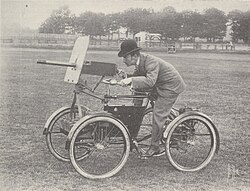
Similarly, Royal Page Davidson developed the Davidson-Duryea gun carriage and a battery-powered armored car in 1898. While innovative, these early designs provided minimal protection from enemy fire and did not meet the modern definition of an armored vehicle.
The First True Armored Cars
The transition to genuine armor occurred at the turn of the 20th century. The Simms' Motor War Car, completed in 1902, is recognized as the first armored car. Built on a Daimler chassis with 6 mm thick Vickers armor, it featured two turrets with 360° traverse and two Maxim guns.
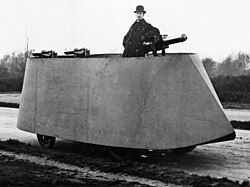
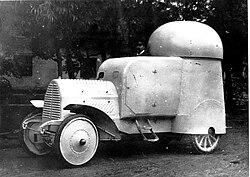
Other early pioneers included the French Charron, Girardot et Voigt (1902) and the 1904 Austro-Daimler Panzerwagen. The Austro-Daimler was particularly significant as one of the first operational vehicles to feature four-wheel drive (4x4) and a rotating turret.
Combat in the World Wars
World War I: From Scouting to Specialized Units
During the Great War, armored cars were used for independent scouting and as mobile anti-aircraft platforms. The Belgian Army achieved early success in 1914 using Minerva Armored Cars, which consisted of touring cars modified with Cockerill armor and Hotchkiss machine guns.
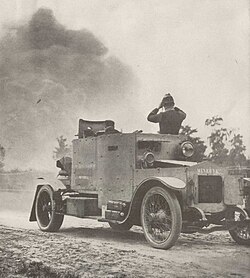
The British also deployed various chassis, most notably the Rolls-Royce armored cars. A major tactical milestone was the creation of the Canadian Automobile Machine Gun Brigade in 1914, the first fully mechanized unit in history. As the Western Front devolved into static trench warfare—which was unsuitable for wheeled vehicles—many armored cars were redeployed to the Middle East, Africa, and the Eastern Front.
World War II: Reconnaissance and Specialization
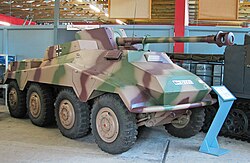
By World War II, armored cars were primarily engineered for passive observation and communications. The German army utilized highly effective reconnaissance vehicles like the Schwerer Panzerspähwagen, while the Soviets developed the BA-64.
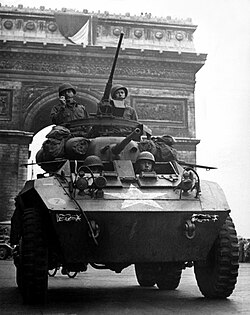
Allied forces deployed vehicles like the American M8 Greyhound and the British Daimler. These vehicles prioritized speed and stealth over heavy armor, allowing them to perform flanking maneuvers and pursuit operations, particularly during the North African campaign.
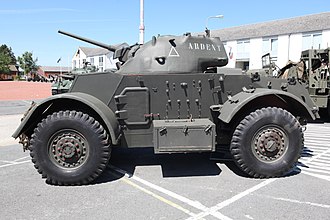
Other notable vehicles of the era included the U.S. T17E1 Staghound, which provided a balance of protection and mobility for reconnaissance tasks.
Modern Applications and Classifications
Military Utility and Design
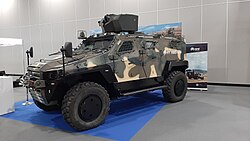
Modern armored cars are often preferred for peacekeeping and internal security because they appear less threatening than tanks and are more maneuverable in tight urban environments. However, they remain vulnerable to heavy weaponry and struggle with steep obstacles compared to tracked vehicles.
Scout Cars vs. Armored Cars
In the 1930s, the U.S. introduced the scout car. Unlike heavy armored cars, scout cars are compact, lightly armed (or unarmed), and designed strictly for passive intelligence gathering. Examples include the British Ferret and the Soviet BRDM series.
Improvised Fighting Vehicles
In many regional conflicts, civilian vehicles are modified into improvised armored cars. These are often referred to as "technicals"—civilian pickups or trucks fitted with scrounged weapons and makeshift armor.
Summary of Armored Vehicle Evolution
| Type | Primary Purpose | Typical Armament | Key Characteristic |
|---|---|---|---|
| Armed Car (Early) | Experimental Combat | Single Machine Gun | Minimal protection/shields |
| Armored Car (Classic) | Reconnaissance/Escort | Machine Guns/Light Cannons | Full hull armor, wheeled |
| Scout Car | Passive Observation | Unarmed or Light MG | Compact and stealthy |
| Modern AFV | Multipurpose/Security | Autocannons/Large Guns | High tech, urban compatible |
Frequently Asked Questions
What is the difference between an armored car and a tank?
The primary difference is the propulsion system; armored cars use wheels, while tanks use tracks. This makes armored cars faster on roads and cheaper to maintain, but tanks are superior in off-road terrain and generally possess heavier armor and firepower.
What is a "technical" in military terms?
A technical is an improvised armored fighting vehicle created by adding weapons and armor to a civilian vehicle, commonly used by militias and irregular forces.
Why were armored cars used in colonial regions?
They were favored in underdeveloped regions because they were significantly cheaper to produce and operate than tracked vehicles, while still providing necessary protection and mobility.
What was the role of the scout car?
Scout cars were designed for passive observation and intelligence gathering. Unlike standard armored cars, they avoided direct combat and typically carried only light weapons for self-defense.
Can modern armored cars destroy tanks?
Yes, some modern armored cars, such as the B1 Centauro or the M1128 mobile gun system, are equipped with large-caliber cannons capable of threatening or destroying main battle tanks.