Armistice of Salonica: The End of Bulgaria's Role in World War I
The Armistice of Salonica (also known as the Armistice of Thessalonica) marked a pivotal turning point in the final stages of World War I. Signed at 10:50 p.m. on September 29, 1918, this agreement between the Kingdom of Bulgaria and the Allied Powers effectively removed Bulgaria from the conflict, destabilizing the Central Powers and accelerating the end of the war in Europe.
The agreement was finalized at the General Headquarters of the Allied Army of the Orient in Thessaloniki and officially came into force at noon on September 30, 1918. It served as a temporary ceasefire that remained in effect until the formal peace treaty, the Treaty of Neuilly-sur-Seine, was concluded in November 1919.
The Path to Surrender
Bulgaria had entered World War I on October 14, 1915, aligning itself with the Central Powers to invade and occupy portions of Serbia. However, by late 1918, the tide of war shifted. In September 1918, the Allies launched the Vardar offensive, a major military operation that led to the collapse of parts of the Bulgarian Army.
The military failure triggered internal chaos, including an open mutiny by rebellious troops who proclaimed a republic at Radomir. Facing total collapse, the Bulgarian government requested a ceasefire on September 24, 1918.
Key Facts
- Date Signed: September 29, 1918, at 10:50 p.m.
- Effective Date: September 30, 1918, at noon.
- Primary Signatories: French General Louis Franchet d'Espérey (Allies) and a Bulgarian commission.
- Outcome: Immediate demobilization of Bulgarian forces and evacuation of occupied territories.
- Final Settlement: Superseded by the Treaty of Neuilly-sur-Seine in November 1919.
The Signatories and Diplomatic Impact
The armistice was signed on behalf of the Allies by General Louis Franchet d'Espérey, the commander of the Allied Army of the Orient. The Bulgarian government was represented by a commission consisting of General Ivan Lukov of the army headquarters, cabinet member Andrey Lyapchev, and diplomat Simeon Radev.
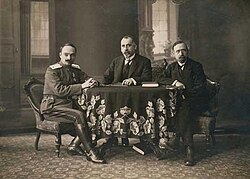
The surrender sent shockwaves through the remaining Central Powers. German Emperor Wilhelm II expressed his frustration in a telegram to Bulgarian Tsar Ferdinand I, calling the event "disgraceful" and noting that 62,000 Serbs had decided the war. This collapse signaled a hopeless military situation for Germany, which was informed of the reality by the Oberste Heeresleitung (German Supreme Army Command) on September 29. Shortly thereafter, the Austro-Hungarian Empire and the Ottoman Empire also sought armistices.
Terms of the Armistice
The terms of the agreement were stringent, focusing on the total neutralization of Bulgaria's military capabilities and the liberation of occupied lands.
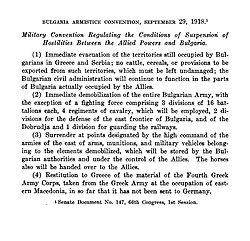
Military and Territorial Requirements
- Demobilization: All Bulgarian military activities were to cease immediately, and the majority of the army was demobilized.
- Evacuation: Bulgarian forces were required to evacuate occupied Greek and Serbian territories.
- Equipment: Bulgaria had to return military equipment seized from the Greek Fourth Army Corps during the 1916 occupation of Eastern Macedonia.
- Foreign Troops: German and Austro-Hungarian troops were mandated to leave Bulgarian soil within four weeks.
Strategic Controls and Hostages
While the Allies agreed not to occupy Sofia or Bulgaria as a whole, they reserved the right to temporarily occupy strategic points and move troops across Bulgarian territory. Most notably, Article 5 of the armistice required approximately 150,000 Bulgarian soldiers located west of the Skopje meridian to be delivered to the Entente as hostages.
Following the armistice, French troops were deployed to Romania, while British and Greek forces moved into European Turkey, which remained at war with the Allies.
Summary of the Armistice of Salonica
| Category | Details |
|---|---|
| Location | Thessaloniki, Greece |
| Allied Representative | General Louis Franchet d'Espérey |
| Bulgarian Representatives | Ivan Lukov, Andrey Lyapchev, Simeon Radev |
| Key Military Term | Demobilization and evacuation of Serbia and Greece |
| Hostage Requirement | 150,000 soldiers west of the Skopje meridian |
| Final Peace Treaty | Treaty of Neuilly-sur-Seine (Nov 1919) |
Frequently Asked Questions
What was the primary cause of Bulgaria's surrender?
The surrender was primarily caused by the Allied Vardar offensive in September 1918, which led to the collapse of the Bulgarian Army and sparked internal military mutinies, including the proclamation of a republic at Radomir.
Who were the main signatories of the Armistice of Salonica?
The Allies were represented by French General Louis Franchet d'Espérey. Bulgaria was represented by a commission including General Ivan Lukov, Andrey Lyapchev, and Simeon Radev.
Did the Allies occupy the Bulgarian capital?
No, the terms specifically stated that Bulgaria and Sofia were not to be occupied, although the Allies maintained the right to occupy strategic points temporarily and transfer troops through the territory.
What happened to the Bulgarian soldiers west of the Skopje meridian?
Under Article 5 of the armistice, approximately 150,000 Bulgarian soldiers in that region were to be delivered to the Entente to serve as hostages.
How did this armistice affect other Central Powers?
It severely weakened the Central Powers' position. Shortly after Bulgaria's surrender, the Austro-Hungarian Empire requested an armistice on October 14, and the Ottoman Empire sought terms on October 15.