Armenian Language: History, Dialects, and Linguistic Structure
The Armenian language (հայերեն) is a unique and ancient member of the Indo-European language family. Spoken primarily by Armenians, it serves as the official language of Armenia and is a recognized minority language in several countries, including Cyprus, Bulgaria, Iraq, Poland, Romania, and Turkey. With approximately 5.3 million native speakers (as of 2013–2021), Armenian is a vital link to the cultural and historical heritage of the Southern Caucasus.
The language is characterized by its own distinct writing system, the Armenian alphabet, and a rich evolutionary history that spans from Proto-Indo-European roots to the modern standard forms used today.
Key Facts
- Language Family: Indo-European (Armenian branch).
- Native Speakers: Approximately 5.3 million.
- Official Status: Official language of Armenia and the Eurasian Economic Union.
- Standard Forms: Divided into Eastern Armenian and Western Armenian.
- Writing System: The unique Armenian alphabet and Armenian Braille.
- Regulatory Bodies: The Armenian National Academy of Sciences and Language Committee (Armenia) and the Calouste Gulbenkian Foundation (de facto for Western Armenian).
Evolution and Classification
Armenian occupies a distinct position within the Indo-European family. Its lineage progressed from Proto-Indo-European to Proto-Armenian, eventually evolving into Classical Armenian (also known as Grabar) and later Middle Armenian. These early forms laid the foundation for the two primary standard varieties spoken today: Eastern and Western Armenian.
The language's development has been influenced by its geographic position, leading to various hypotheses regarding its early contacts, including the Graeco-Armenian and Greco-Armeno-Aryan hypotheses.

Geographic Distribution and Dialects
Armenian is spoken across several countries, with the highest concentration in Armenia and Russia. The distribution is largely split between the two main standard varieties.
| Country | Approx. Speakers | Main Variety |
|---|---|---|
| Armenia | 3,000,000 | Eastern |
| Russia | 510,000 | Eastern |
| Lebanon | 340,000 | Western |
| United States | 240,000 | Western |
| Argentina | 150,000 | Western |
| Georgia | 150,000 | Eastern |
| Azerbaijan | 120,000 | Eastern |
| Iran | 110,000 | Eastern |
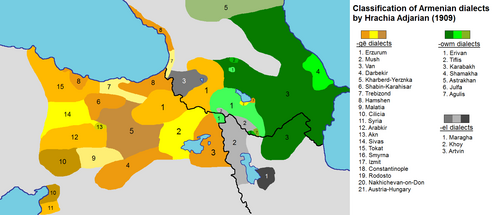
Beyond the standard forms, numerous dialects exist, including Yerevan, Homshetsi, Karabakh, Karin, Mush, and others such as Kharberd–Yerznka and Shabin–Karahisar.
Linguistic Structure
Phonology and Writing
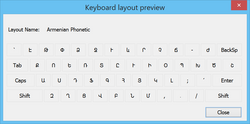
The Armenian sound system includes a complex array of consonants, featuring voiced, voiceless, and aspirated plosives and affricates. The vowel system consists of front, central, and back vowels. These sounds are represented by the Armenian alphabet, a writing system specifically designed for the language.
Morphology and Grammar
Armenian is a highly inflected language. Nouns are declined through several cases to indicate their grammatical role in a sentence. In Eastern Armenian, these include the Nominative/Accusative, Genitive/Dative, Ablative, Instrumental, and Locative cases.
Indo-European Cognates
As an Indo-European language, Armenian shares many cognates (words with a common etymological origin) with English, Latin, Greek, and Sanskrit. For example, the Armenian word for mother, mayr, is closely related to the English mother, Latin māter, and Sanskrit mātṛ.
Frequently Asked Questions
What is the difference between Eastern and Western Armenian?
Eastern Armenian is the official language of the Republic of Armenia and is spoken primarily in Armenia, Russia, and Iran. Western Armenian is spoken mainly by the diaspora in countries like Lebanon, the US, and France. They differ in pronunciation, grammar, and some vocabulary.
What is Classical Armenian?
Classical Armenian, or Grabar, is the earliest form of the language. It was used primarily for religious and literary texts and serves as the liturgical language of the Armenian Apostolic Church.
Is the Armenian alphabet unique?
Yes, the Armenian alphabet is a distinct writing system created specifically to transcribe the Armenian language, allowing for the preservation of its unique phonology.
How many people speak Armenian worldwide?
Based on data from 2013 to 2021, there are approximately 5.3 million native speakers, though some sources suggest the total number of speakers worldwide may be higher.