Argentine Army
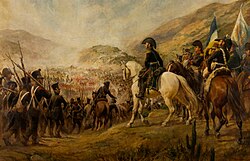
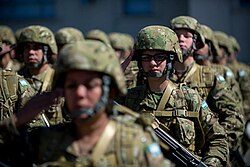
The Argentine Army (Ejército Argentino) is the land warfare branch of the Argentine Armed Forces. Founded on May 29, 1810, the Army has played a central role in the formation and political evolution of the Argentine Republic. With a motto that reads "Born with the Fatherland in May 1810," the force has transitioned from a revolutionary army to a modern professional military organization.
Throughout its history, the Army has been involved in numerous conflicts, ranging from the Argentine War of Independence and the Paraguayan War to the more recent Falklands War. Its trajectory is marked by periods of professional military service interspersed with significant political interventions during the 20th century.
Key Facts
- Founded: May 29, 1810.
- Active Personnel: Approximately 108,000 soldiers (as of 2023).
- Commander-in-Chief: President Javier Milei.
- Chief of General Staff: Division General Oscar Zarich.
- Primary Equipment: 350 medium and light tanks, 800 armored fighting vehicles, and 460 artillery pieces (combined towed, self-propelled, and rocket).
- Official Colors: Garnet and gold.
Historical Evolution
Early 20th Century and Political Intervention
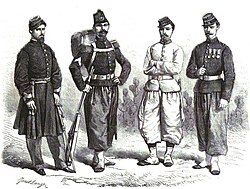
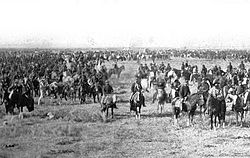
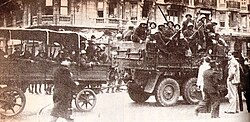
In the early 1900s, the Army was occasionally used for internal security. Between 1920 and 1922, the 10th Cavalry Regiment suppressed rural worker uprisings in Santa Cruz Province. By 1930, the military began a trend of political intervention when a small group of troops deposed President Hipólito Yrigoyen.
This pattern continued into the 1940s, with a 1943 coup bringing Colonel Juan Perón to prominence. While Perón initially held military support, his repressive governance eventually led to his overthrow by a military uprising in September 1955. Between 1955 and 1973, the Army remained vigilant against the return of Peronism, resulting in further coups in 1962 and 1966.
The Military Junta and the "Dirty War"
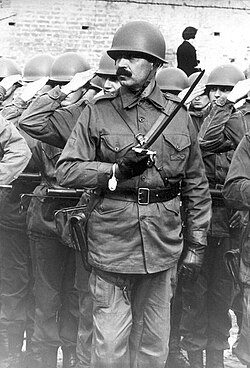
From 1966 to 1973, the military government ruled Argentina. This era saw the rise of guerrilla groups such as the Montoneros and the ERP (People's Revolutionary Army). Following the 1973 Ezeiza massacre, political instability grew, leading to the 1976 coup that installed a military junta known as the Proceso de Reorganización Nacional (PRN).
The PRN initiated a period of state terror known as the "Dirty War," characterized by the systematic disappearance and killing of perceived political rivals. The Batallón de Inteligencia 601 (601st Intelligence Battalion) became a notorious unit during this time, coordinating infiltrations and abuses as part of Operation Condor.
Annihilation Decrees and Internal Conflict
In February 1975, secret presidential decree 261 ordered the Army to "neutralize and/or annihilate" insurgency in Tucumán through Operativo Independencia. The Fifth Brigade was deployed to eradicate the ERP support network. Despite the use of US-made Bell UH-1H Huey helicopters for counter-insurgency, the Army faced sophisticated attacks, most notably Operation Primicia, where guerrillas hijacked a Boeing 737 to attack the 29th Infantry Regiment.
Violence peaked in late 1975 with the battle at Monte Chingolo, where ERP fighters attacked the 601st Arsenal Battalion. By 1976, the insurgency reached its deadliest point, with 156 members of the Armed Forces killed in a single year.
The Falklands War and Return to Democracy
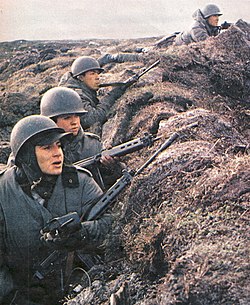
On April 2, 1982, the military government under Leopoldo Galtieri launched Operation Rosario to invade the Falkland Islands. The Argentine Army engaged British forces at San Carlos Water, Goose Green, and Port Stanley. The conflict ended in surrender on June 14, 1982.
The war resulted in 194 Argentine soldiers killed and 1,308 wounded. The defeat, combined with the legacy of the Dirty War, severely weakened the military's moral and political standing, precipitating the fall of the junta and the return to democratic rule in 1983.
Organizational Structure and Equipment
Command and Administration
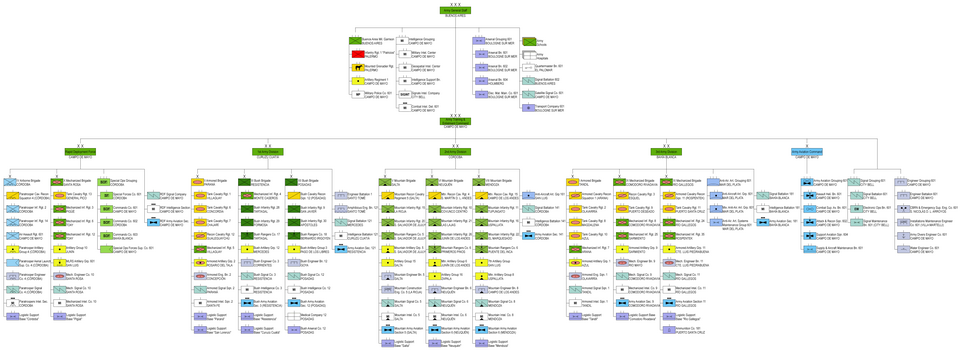
The Army is managed by the Army General Staff, which oversees various specialized directorates including Intelligence, Personnel and Welfare, Health, and Research and Development.
Field Organization
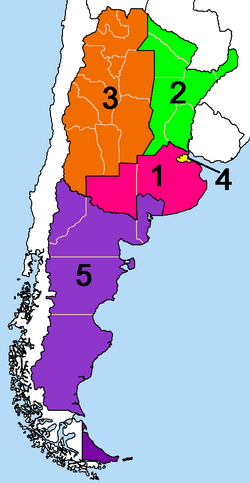
As of 2011, the Argentine Army is organized into eleven brigades:
- Armored: 1st and 2nd Brigades.
- Mechanized: 9th, 10th, and 11th Brigades.
- Mountain: 5th, 6th, and 8th Brigades.
- Paratrooper: 4th Brigade.
Equipment and Assets
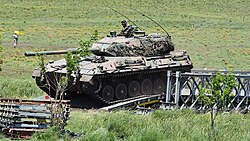
The Army utilizes a mix of armored vehicles and artillery to maintain national security. A centerpiece of its armored capability is the TAM tank (Tanque Argentino Mediano), used in various field exercises to maintain operational readiness.
| Category | Details |
|---|---|
| Active Personnel | 108,000 (2023) |
| Tanks | 350 (Medium & Light) |
| Armored Fighting Vehicles | 800 |
| Artillery | 60 Self-propelled, 400 Towed, 30 Rocket |
| Key Brigades | Armored, Mechanized, Mountain, Paratrooper |
Frequently Asked Questions
When was the Argentine Army founded?
The Argentine Army was founded on May 29, 1810, coinciding with the early movements for independence from Spain.
What was the "Dirty War"?
The "Dirty War" refers to a period of state terror under the military junta (1976–1983), during which the military and police targeted and "disappeared" suspected political dissidents and guerrillas.
What was the outcome of the Falklands War for the Army?
The Army suffered 194 deaths and 1,308 wounded. The defeat led to a loss of regional supremacy and contributed to the collapse of the military junta.
How is the Argentine Army currently structured?
The Army consists of eleven brigades, including specialized armored, mechanized, mountain, and paratrooper units, managed by the Army General Staff.
Who is the current Commander-in-Chief?
The President of the Argentine Republic, Javier Milei, serves as the Commander-in-Chief.