Aprakos: The Liturgical Gospel of the Eastern Orthodox Church
In the tradition of the Eastern Orthodox Church, the presentation of sacred texts often follows the rhythm of the liturgical year rather than a linear narrative. One of the most significant examples of this is the Aprakos, a specialized type of Gospel or Acts of the Apostles book designed specifically for church services.
Unlike a standard Bible, an Aprakos is a service Gospel. Its primary purpose is to provide the clergy with the specific readings required for each week of the ecclesiastical calendar, ensuring that the scripture aligns with the spiritual themes of the church's seasonal celebrations.
The Structure of the Aprakos
The defining characteristic of an Aprakos is its organization. While a standard Tetra-Gospel (a book containing all four Gospels) follows the natural order of the biblical books, the Aprakos organizes text according to weekly church readings. This sequence begins with Holy Week, the period leading up to Easter.
This structural difference is most evident in the opening pages. A regular Gospel typically begins with the Gospel according to Matthew. In contrast, the text of an Aprakos-Gospel begins with the first chapter of the Gospel according to John, starting with the famous phrase, "In the beginning was the Word..."
Historical Significance and Slavic Manuscripts
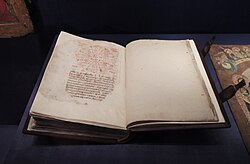
The Aprakos format was widely adopted in early Slavic Christianity. Consequently, many of the oldest and most precious Slavic manuscripts are categorized as aprakoses. These texts serve as vital historical records of early liturgical practices and linguistic development.
Notable examples of these ancient manuscripts include:
Comparative Liturgical Books
While the Aprakos is central to the Eastern tradition, Western Christianity (including the Catholic Church) utilizes similar tools for liturgical readings. These are generally referred to as Lectionaries, a term with a broader meaning that can encompass various types of readings.
When specifically referring to books containing only the Gospel readings in the Western tradition, the terms Evangeliarium or Evangelistarium are used.
| Feature | Aprakos (Eastern) | Tetra-Gospel (Standard) | Lectionary/Evangeliarium (Western) |
|---|---|---|---|
| Organization | Weekly church readings | Natural book order | Liturgical sequence |
| Starting Point | Gospel of John (Holy Week) | Gospel of Matthew | Varies by calendar |
| Primary Use | Church services | Study and reading | Church services |
Key Facts
- The Aprakos is a service Gospel organized by weekly church readings.
- It begins its sequence with Holy Week.
- Unlike Tetra-Gospels, the Aprakos starts with the Gospel of John.
- Many ancient Slavic manuscripts, such as the Ostromir Gospels, are aprakoses.
- The Western equivalent is known as a Lectionary, Evangeliarium, or Evangelistarium.
Frequently Asked Questions
How does an Aprakos differ from a Tetra-Gospel?
A Tetra-Gospel follows the natural order of the four biblical Gospels, starting with Matthew. An Aprakos is organized by the weekly liturgical calendar of the Eastern Orthodox Church and begins with the Gospel of John.
Which Gospel does the Aprakos begin with?
The Aprakos begins with the first chapter of the Gospel according to John, coinciding with the readings for Holy Week.
What are some famous examples of Aprakos manuscripts?
Some of the most significant early Slavic manuscripts that are aprakoses include the Codex Assemanius, the Ostromir Gospels, and Vukan's Gospel.
What is the Western equivalent of an Aprakos?
In Western Christianity, similar books are called Lectionaries. When they contain only Gospel readings, they are specifically called an Evangeliarium or Evangelistarium.
Why is the Aprakos organized this way?
It is organized to facilitate the weekly readings used during church services in the Eastern Orthodox tradition, ensuring the scripture matches the liturgical season.