Anti-Catholicism: History, Forms, and Global Impact
Anti-Catholicism is defined as prejudice or discrimination directed toward Catholics. This sentiment encompasses opposition to the Catholic Church as an institution, its clergy, the authority of the pope, and the individual adherents of the faith. Throughout history, this prejudice has manifested in various forms, ranging from social ostracization and political legislation to violent persecution.
To understand the complexity of this phenomenon, scholars generally categorize anti-Catholicism into four primary types:
- Political: Concerns regarding whether Catholics can be loyal citizens of a state while owing allegiance to the pope.
- Theological: Rooted in fundamental disagreements with Catholic doctrines and teachings.
- Popular: Driven by fears, myths, and accusations that Catholics are heretics or potential traitors.
- Sociocultural: Based on claims that the Church encourages or enables immoral behavior.
Key Facts
![From a series of woodcuts (1545) usually referred to as the Papstspotbilder or Papstspottbilder,[9] by Lucas Cranach, commissioned by Martin Luther.[10] "Kissing the Pope's feet";[11] German peasants respond to a papal bull of Pope Paul III. Caption reads: "Don't frighten us Pope, with your ban, and don't be such a furious man. Otherwise we shall turn around and show you our rears".[12][13]](/images/27/64/27643b060510d7f1dea3cda560113cb6b9a335a5277f906cb34acca01058a1ec.jpg)
- Anti-Catholicism often involves anti-clericalism (opposition to clergy) and anti-papalism (opposition to the pope).
- The Protestant Reformation served as a major catalyst for anti-Catholic rhetoric in Europe and the Americas.
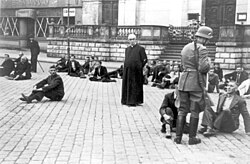
- In Nazi-occupied Poland, approximately 18% of the Catholic clergy (2,935 members) were killed in concentration camps between 1939 and 1945.
- Modern instances of persecution continue globally, including recent arrests and exiles of priests in Nicaragua.
- Anti-Catholic sentiment has appeared in both primarily Protestant nations and within primarily Catholic or Orthodox countries.
Anti-Catholicism in Protestant-Majority Nations
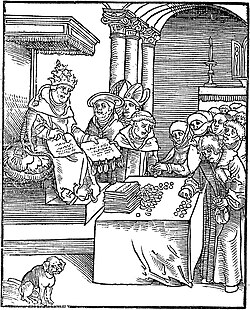
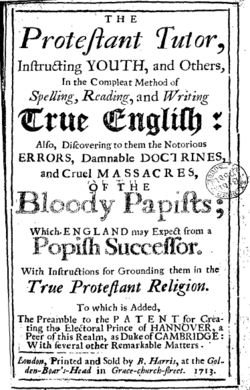
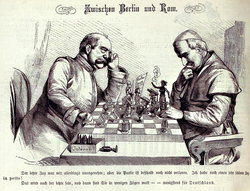
Following the Reformation, several states—including England, Scotland, Prussia, Germany, and the United States—integrated anti-Catholic policies into their governance. This often included the mockery of rituals and systemic religious discrimination.
The British Empire and Ireland
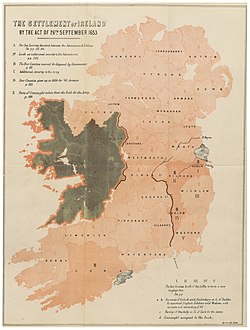
In Great Britain and Ireland, anti-Catholicism was deeply entwined with political power. In Ireland, the Cromwellian conquest led to the confiscation of vast land areas and the banishment of Catholics to Connacht.
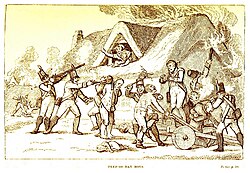
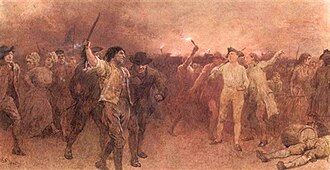
Tensions often escalated into violence, such as the Gordon Riots of 1780 in England and the activities of the Peep o' Day Boys in Ireland.
The United States and Canada
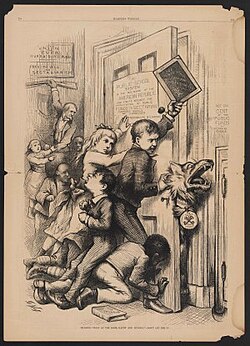
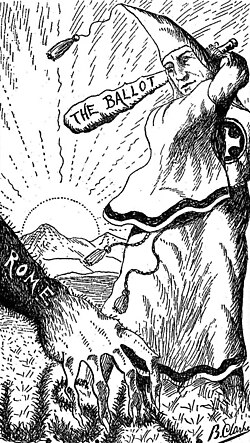
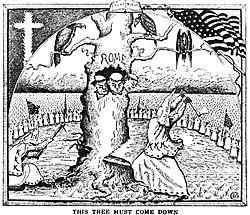
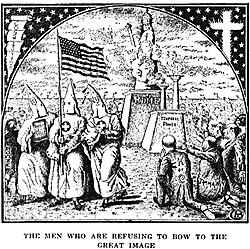
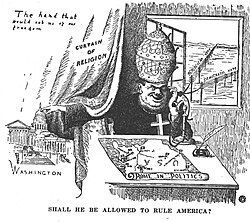
In the United States, anti-Catholic sentiment was prominent from the colonial era through the 20th century. During the 19th century, "nativist" movements viewed Catholics as a threat to American values and public institutions. This was often visualized in media, portraying the Church as an enemy of public education.
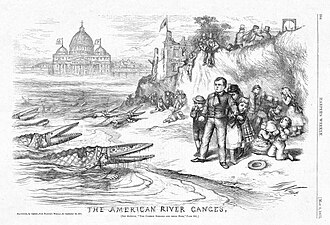
Similar themes appeared in later political cartoons, suggesting that the election of certain candidates would leave the public school system endangered by the Roman Catholic Church.
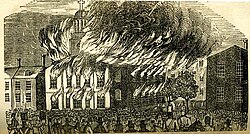
Violence also broke out, such as the 1844 Philadelphia nativist riots, which saw the burning of St. Augustine Church.
In Canada, anti-Catholicism often intersected with linguistic tensions, particularly regarding French-language schools.
Persecution in Other Global Contexts
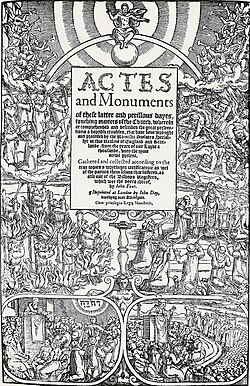
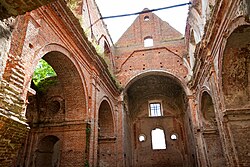
Anti-Catholicism is not limited to Protestant regions. It has occurred in Catholic-majority countries through political suppression and in Orthodox or non-Christian nations through state or militant action.
Europe and the Americas
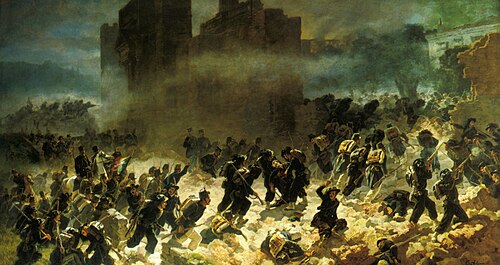
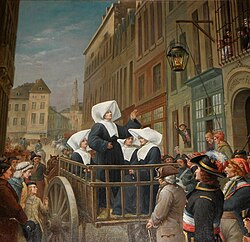
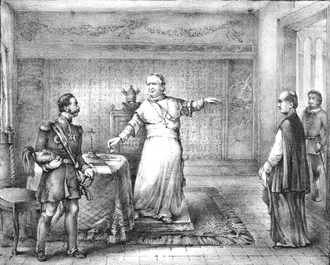
In France, the Reign of Terror saw nuns sent to the guillotine, while later periods were marked by the suppression of religious orders. In Italy, the capture of Rome in 1870 led Pope Pius IX to declare himself a "Prisoner in the Vatican." In Nicaragua, the government has recently targeted the Church, with at least 46 priests arrested in 2023.
Eastern Europe and Asia
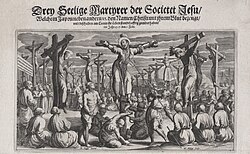
The Catholic Church faced violent suppression in Nazi-occupied Poland, particularly in the General Government and Reichsgau Wartheland. Figures like Maximilian Kolbe were among the victims. In Japan, historical persecution culminated in events such as the execution of the 26 Martyrs at Nagasaki in 1628.
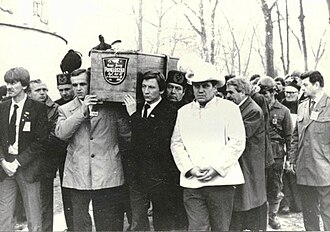
In non-Christian nations, attacks have been carried out by militant groups. For example, in Burkina Faso in 2019, gunmen attacked a church in Dablo and a religious procession in Zimtenga, killing ten people in total.
Summary of Anti-Catholic Manifestations
| Category | Primary Drivers | Common Examples |
|---|---|---|
| Political | State loyalty, National identity | Cromwellian land confiscations, Nativist riots in USA |
| Theological | Doctrinal disputes | Reformation-era polemics, Anti-papalism |
| State Suppression | Totalitarianism, Secularism | Nazi persecution in Poland, French Revolution |
| Militant Violence | Religious extremism | Attacks in Burkina Faso, 17th-century Japan |
Frequently Asked Questions
What is the difference between anti-clericalism and anti-Catholicism?
While anti-Catholicism is a broad prejudice against the faith and its followers, anti-clericalism specifically refers to opposition to the clergy and the institutional power of the church hierarchy.
How did the Protestant Reformation influence anti-Catholicism?
The Reformation created a theological and political schism in Europe, leading many Protestant states to adopt rhetoric and laws that marginalized Catholics and rejected the authority of the pope.
What were the "Nativist" riots in the United States?
Nativist riots were violent outbursts by native-born Protestants who feared the influence of Catholic immigrants, particularly the Irish, leading to events like the burning of churches in Philadelphia in 1844.
Has anti-Catholicism occurred in Catholic-majority countries?
Yes. In countries like France and Italy, anti-Catholicism often took the form of political anti-clericalism, where the state sought to reduce the Church's influence over public life and government.
What happened to the Polish clergy during World War II?
Under Nazi occupation, the Catholic Church was violently suppressed. Approximately 2,935 Polish clergy members were killed in concentration camps, representing about 18% of the clergy.