Understanding the Antarctic Circle: Geography, Light, and Motion
The Antarctic Circle represents one of the most significant boundaries on our planet. As the most southerly of the five major circles of latitude, it serves as the gateway to the Antarctic, the vast and frozen region located at the bottom of the world. To its north lies the Southern Temperate Zone, a transition area between the polar extremes and the warmer latitudes.

The Science of Latitude and Axial Tilt
The position of the Antarctic Circle is not a static line. Currently, it sits at approximately 66°33′51.0″ south of the Equator. However, this measurement is subject to subtle astronomical shifts. For instance, nutation—a small, periodic oscillation in the Earth's axis—can affect this figure by up to 10″.
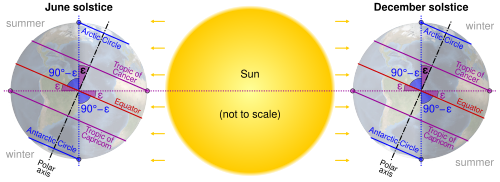
The circle's location is primarily determined by the Earth's axial tilt (the angle at which the Earth's axis is inclined relative to its orbital plane). This tilt is not constant; due to tidal forces exerted by the Moon's orbit, the tilt fluctuates by more than 2° over a 41,000-year cycle. Because of these ongoing celestial mechanics, the Antarctic Circle is currently drifting southward at a rate of roughly 14.5 meters (48 feet) per year.
Extreme Light: The Midnight Sun and Polar Night
The most dramatic characteristic of the Antarctic Circle is its relationship with sunlight. It marks the northernmost latitude in the Southern Hemisphere where the center of the sun can remain above the horizon for 24 continuous hours. This phenomenon results in two distinct extremes:
- The Midnight Sun: At least once a year, the sun is visible at local midnight.
- The Polar Night: At least once a year, the center of the sun remains below the horizon for 24 continuous hours, meaning it is not visible at local noon.
On the Antarctic Circle itself, these events occur during the June and December solstices. However, environmental factors can extend these periods. Due to atmospheric refraction (the bending of light as it passes through the atmosphere) and the fact that the sun appears as a disk rather than a single point, the sun may be visible even when it is technically below the horizon. At sea level, the midnight sun can be seen up to 50 minutes (90 km) north of the circle, while the polar night can extend up to 50 minutes south of the circle.
In the Antarctic, these effects are often amplified by spectacular mirages, which can create the illusion of multiple sunrises and sunsets even when the sun remains below the horizon.

Geography and Human Presence
The scale of the region defined by the Antarctic Circle is immense. The circle itself has a circumference of approximately 16,000 kilometers (9,900 miles). The area south of this line covers about 20,000,000 km² (7,700,000 sq mi), accounting for roughly 4% of the Earth's total surface area. Most of the continent of Antarctica falls within these bounds.
While the region is characterized by extreme conditions, it is not entirely devoid of human activity. There is no permanent human population south of the circle; however, various nations operate research stations inhabited by rotating teams of scientists. Historically, the region saw semi-permanent whaling stations where whalers lived for a year or more. Interestingly, while at least eleven children have been born in Antarctica, they were all born in stations located north of the Antarctic Circle.
Key Facts
- Current Latitude: Approximately 66°33′51.0″ south.
- Drift Rate: Moving south at about 14.5 meters (48 feet) per year.
- Surface Area: The region south of the circle covers about 4% of Earth's surface.
- Light Phenomena: Features both the midnight sun and the polar night.
- Human Habitation: No permanent residents; inhabited only by seasonal scientific teams.
Summary of Antarctic Circle Geography
| Feature | Measurement/Detail |
|---|---|
| Approximate Latitude | 66°33′51.0″ S |
| Circumference | ~16,000 km (9,900 mi) |
| Area South of Circle | ~20,000,000 km² |
| Percentage of Earth's Surface | ~4% |
| Annual Southward Drift | ~14.5 m (48 ft) |
Frequently Asked Questions
What causes the Antarctic Circle to move?
The position of the circle changes because of fluctuations in the Earth's axial tilt. This tilt is influenced by tidal forces from the Moon's orbit, causing the circle to drift southward at about 14.5 meters per year.
Can you see the sun at midnight inside the Antarctic Circle?
Yes. At least once a year, the center of the sun remains above the horizon for 24 hours, making it visible at local midnight. Due to atmospheric refraction, this can even be seen slightly north of the actual circle.
Are there any permanent residents in Antarctica?
No, there is no permanent human population south of the Antarctic Circle. The area is inhabited only by scientists who rotate through various research stations on a seasonal basis.
How large is the area south of the Antarctic Circle?
The area south of the circle is approximately 20,000,000 km², which represents about 4% of the Earth's total surface area.
What is the difference between the Antarctic Circle and the Antarctic?
The Antarctic Circle is a specific line of latitude (66°33′51.0″ S). The "Antarctic" refers to the entire geographic region located south of that circle.