Angular Momentum: Principles of Rotational Motion and Quantum Spin
From the steady spin of a gyroscope to the vast orbits of planets, angular momentum is the fundamental physical quantity that governs how objects rotate and revolve. While linear momentum describes an object's motion in a straight line, angular momentum describes the "quantity of rotation" an object possesses, determining its stability and how it responds to external forces.
In its simplest form, angular momentum is the rotational analog of linear momentum. It depends on how fast an object is spinning, its mass, and how that mass is distributed relative to the axis of rotation.
Key Facts
- SI Unit: Measured in Joule-seconds (J⋅s) or kg⋅m²/s.
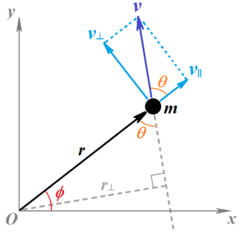
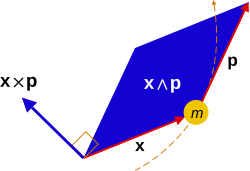
- Core Formula: Defined as the cross product of the position vector and linear momentum (L = r × p) or the product of moment of inertia and angular velocity (L = Iω).
- Conservation: In the absence of external torque, the total angular momentum of a system remains constant.
- Quantum Nature: In quantum mechanics, angular momentum is quantized and includes an intrinsic property called spin.
- Cosmic Impact: Tidal torques between the Earth and Moon cause the Moon's orbit to expand by approximately 3.82 centimeters per year.
Classical Mechanics of Angular Momentum
Orbital and Rotational Motion
In classical physics, we distinguish between orbital angular momentum—where a particle moves around a center of mass—and rotational angular momentum, where a solid body spins on its own axis. For a single particle in circular motion, the angular momentum is proportional to the perpendicular distance from the origin and the perpendicular component of its velocity.
The Role of Moment of Inertia
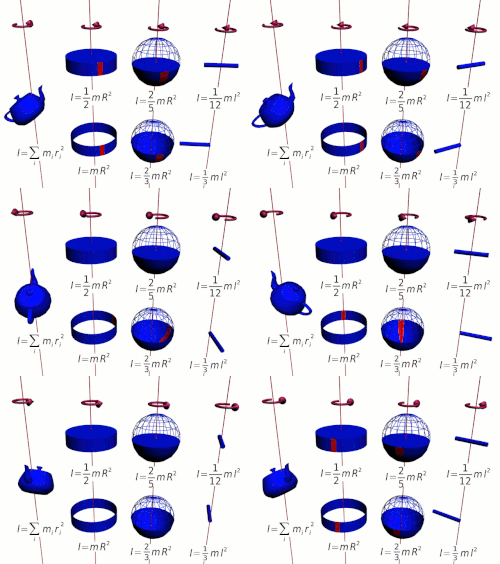
The moment of inertia (I) represents an object's resistance to rotational acceleration. Unlike mass in linear motion, the moment of inertia depends on the distribution of mass. A mass concentrated far from the axis of rotation creates a higher moment of inertia than the same mass concentrated near the axis.
This principle is famously demonstrated by figure skaters. By drawing their arms and legs inward, they decrease their moment of inertia, which, due to the conservation of angular momentum, forces their rotational speed to increase.

Torque and the Change in Momentum
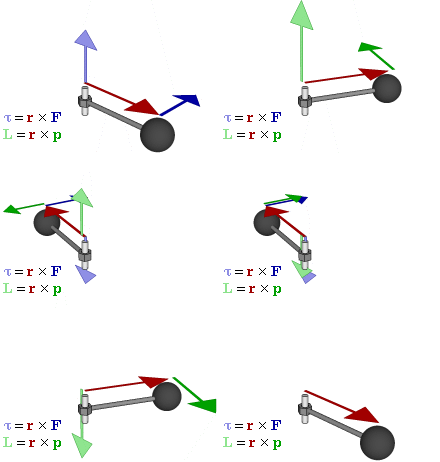
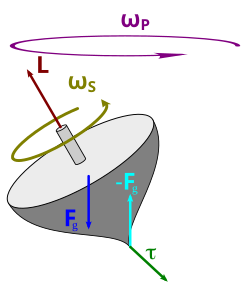
Just as a force changes linear momentum, a torque (a twisting force) changes angular momentum. Torque is defined as the time derivative of angular momentum. This relationship explains phenomena such as precession, where a spinning top tilts and rotates around a vertical axis because of the torque exerted by gravity.
Complex Systems and Orbital Mechanics
Collections of Particles
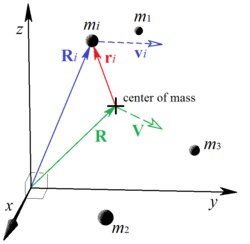
For a system consisting of multiple particles, the total angular momentum is the sum of the orbital angular momentum of the center of mass plus the angular momentum of the particles relative to that center of mass.
Celestial Dynamics
In the cosmos, angular momentum is often exchanged between bodies. In the Earth-Moon system, tidal torques exert a force that transfers angular momentum from the Earth to the Moon. This results in the Earth's rotation slowing down by approximately 65.7 nanoseconds per day, while the Moon gradually moves further away from Earth.
Angular Momentum in Quantum Mechanics
Quantization and Spin
In the quantum realm, angular momentum behaves differently. It is quantized, meaning it can only take on specific, discrete values rather than any continuous value. This is analogous to a standing wave on a circular string, which must consist of an integer number of wavelengths to remain stable.

Furthermore, quantum particles possess spin angular momentum (S). Unlike classical rotation, spin is an intrinsic property of the particle and does not involve physical rotation in space. For example, electrons have a spin of 1/2, while photons have a spin of 1. The Higgs boson is unique among elementary particles for having a spin of 0.
![Angular momenta of a classical object.Left: "spin" angular momentum S is really orbital angular momentum of the object at every point.Right: extrinsic orbital angular momentum L about an axis.Top: the moment of inertia tensor I and angular velocity ω (L is not always parallel to ω).[36]Bottom: momentum p and its radial position r from the axis. The total angular momentum (spin plus orbital) is J. For a quantum particle the interpretations are different; particle spin does not have the above interpretation.](/images/16/86/1686e2ff2312784f9d801206e7d7815eb2c7a593616031394b126694757bed9b.webp)
Summary of Angular Momentum Properties
| Feature | Linear Momentum | Angular Momentum |
|---|---|---|
| Symbol | p | L (or J for total) |
| Basic Formula | p = mv | L = Iω or L = r × p |
| Cause of Change | Force (F) | Torque (τ) |
| Resistance Factor | Mass (m) | Moment of Inertia (I) |
| SI Unit | kg⋅m/s | J⋅s (kg⋅m²/s) |
Historical Development
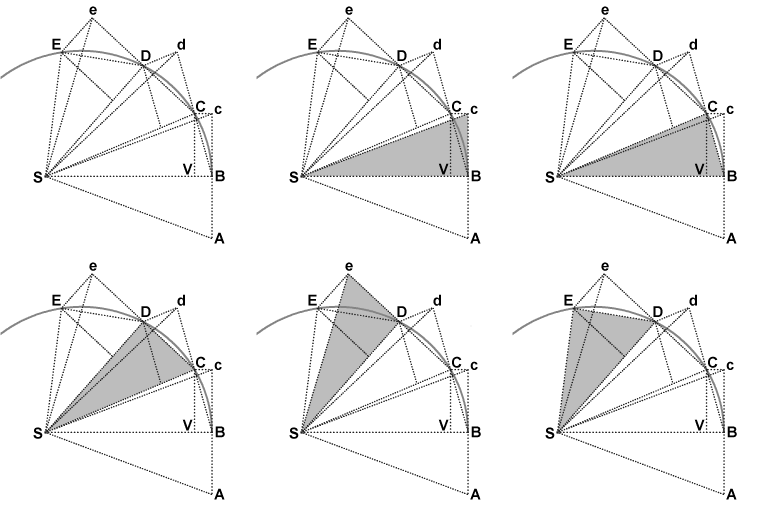
The conceptual foundation of angular momentum began with Isaac Newton, who hinted at the concept in the Principia through his law of areas, which describes how a line joining a planet and the Sun sweeps out equal areas in equal times.
Later, Leonhard Euler and Daniel Bernoulli contributed to the mathematical framework. The modern term "angular momentum" was popularized in the 19th century, notably through the work of William J. M. Rankine and R.B. Hayward, replacing the older English term "momentum of rotation."
Frequently Asked Questions
What is the difference between orbital and spin angular momentum?
Orbital angular momentum refers to the motion of an object around an external point or axis. Spin angular momentum, in quantum mechanics, is an intrinsic property of a particle that does not depend on its motion through space.
How does the conservation of angular momentum work?
If no external torque acts on a system, the total angular momentum remains constant. If the object's shape changes (altering its moment of inertia), its rotational speed must change inversely to keep the total momentum the same.
Why does a spinning top precess instead of falling over?
Precession occurs because the torque exerted by gravity acts perpendicular to the angular momentum vector of the spinning top. This causes the axis of rotation to move in a circle rather than simply tipping over.
What does it mean for angular momentum to be quantized?
Quantization means that at the atomic and subatomic scale, angular momentum cannot be any arbitrary value; it can only exist in specific, discrete increments, typically related to the reduced Planck constant (ħ).