Einstein–de Haas Effect: The Link Between Magnetism and Rotation
The Einstein–de Haas effect is a fascinating physical phenomenon where a change in the magnetic moment of a free-standing body causes that body to rotate. At its core, this effect is a direct manifestation of the conservation of angular momentum, proving that magnetism is not just an abstract field but is deeply tied to the physical motion of particles within a material.
This effect is most observable in ferromagnetic materials—substances like iron that can be permanently magnetized. By observing this rotation, scientists were able to demonstrate that magnetization occurs when the angular momenta of electrons align along a specific axis, a process known as polarization.
Key Facts
- Core Principle: A change in magnetization leads to a proportional change in the body's mechanical rotation.
- Scientific Significance: It proves the link between classical angular momentum and quantum mechanical spin.
- Discovery: Predicted by O. W. Richardson in 1908; experimentally observed by Albert Einstein and Wander Johannes de Haas in 1915.
- Material Insight: In pure iron, approximately 96% of magnetization comes from electron spin and 4% from orbital motion.
- Inverse Effect: The Barnett effect is the opposite phenomenon, where rotating a body induces magnetization.
The Physics of Magnetization and Rotation
To understand the Einstein–de Haas effect, one must look at the electron. An electron moving in an orbital path around an axis creates a magnetic dipole. This orbital motion produces a magnetic moment proportional to the electron's angular momentum. Additionally, electrons possess an intrinsic property called spin, which also contributes to the total magnetic moment.
When a material becomes magnetized, the total orbital and spin angular momenta of its electrons align. If the magnetization of a free body is changed, the angular momentum of the electrons changes accordingly. Because there is no external torque acting on the body, the law of conservation of angular momentum dictates that the rest of the body's mass must rotate to compensate for this internal change.
Experimental Setup and Challenges
The standard experiment utilizes a cylinder of ferromagnetic material suspended by a thin string. This cylinder is placed inside a coil that generates an axial magnetic field. When the electric current in the coil is altered, the magnetic field changes, shifting the cylinder's magnetization and causing it to rotate.
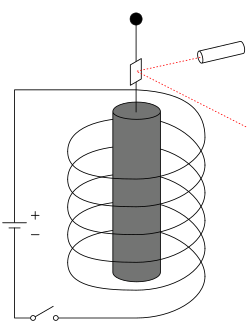
Despite the simple concept, these experiments are notoriously difficult. The change in angular momentum is incredibly small, and ambient magnetic fields—including the Earth's own magnetic field—can exert a mechanical impact 10 to 100 times stronger than the effect being measured. Modern experiments use a torsion pendulum and active compensation to neutralize ambient fields, allowing researchers to measure the gyromagnetic ratio (the ratio of the angular momentum to the magnetic moment).
Historical Development
The effect was first predicted by Owen Willans Richardson in 1908. At the time, the concept of electron spin had not yet been discovered (which happened in 1925), so Richardson focused solely on orbital motion. In 1909, Samuel Jackson Barnett proposed the inverse—that rotation could cause magnetization—which later became known as the Barnett effect.
In 1915, Albert Einstein and Wander Johannes de Haas published their experimental results. While their findings were close to the expected values of the time, they underestimated their experimental uncertainties. It was only after the discovery of spin and the introduction of the Dirac equation in 1928 that the "gyromagnetic anomaly"—the discrepancy between predicted and observed ratios—was fully explained.
Interestingly, the original equipment used by Einstein and de Haas was donated to the Ampère Museum in Lyon, France, in 1961. After being lost for decades, the apparatus was rediscovered in 2023.
Comparing Spin and Orbital Contributions
The Einstein–de Haas effect allows scientists to separate the two different contributions to a material's magnetization: the spin of the electrons and their orbital motion. By measuring the g-factor (a dimensionless quantity characterizing the magnetic moment), researchers can determine exactly how much each component contributes.
| Contribution Source | Percentage of Total Magnetization | Physical Origin |
|---|---|---|
| Electron Spin | 96% | Intrinsic angular momentum |
| Orbital Motion | 4% | Movement of electrons around the nucleus |
Frequently Asked Questions
What is the main difference between the Einstein–de Haas and Barnett effects?
The Einstein–de Haas effect occurs when a change in magnetization causes a body to rotate. The Barnett effect is the inverse: when a body is rotated, it becomes magnetized.
Why is the effect so difficult to measure?
The mechanical rotation produced is extremely small, and external interference, such as the Earth's magnetic field, can easily overwhelm the signal, requiring highly shielded environments.
What does this effect prove about electrons?
It proves that magnetization is caused by the alignment of the angular momenta of electrons, confirming the link between the magnetic properties of a material and the quantum mechanical properties of its electrons.
How does the g-factor relate to this effect?
The g-factor is a dimensionless value that helps scientists determine the relative contributions of electron spin versus orbital motion to the overall magnetization of a material.
Who first predicted the effect?
The effect was first predicted by O. W. Richardson in 1908, several years before Einstein and de Haas provided the first experimental observations in 1915.