Andrew Jackson7th US PresidentBattle of New OrleansIndian Removal ActBank War

Andrew Jackson: The Life and Presidency of Old Hickory

Andrew Jackson: The Life and Presidency of Old Hickory Andrew Jackson remains one of the most complex and polarizing figures in American history. From his humble beginnings in the Waxhaws...

Andrew Jackson: The Life and Presidency of Old Hickory

Andrew Jackson remains one of the most complex and polarizing figures in American history. From his humble beginnings in the Waxhaws to his ascent as the 7th President of the United States, Jackson's life was defined by a fierce temperament, military brilliance, and a commitment to a populist vision of democracy. Known as "Old Hickory" for his toughness, he reshaped the American presidency and the nation's relationship with its indigenous peoples and financial institutions.
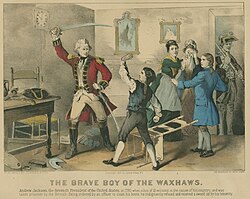
Sketch of an officer preparing to strike a boy with a sword. The boy holds out his arm in self-defense.
The Brave Boy of the Waxhaws, an 1876 Currier and Ives lithograph depicting the story of a young Andrew Jackson defending himself from a British officer during the American Revolutionary War

Key Facts

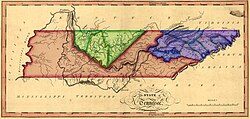
Map of Tennessee
Tennessee c. 1810. The eastern counties shaded in blue, the Mero District in green, and Native American lands in red. The Natchez Trace from its northern terminus to Chickasaw Crossing where it leaves the state is shaded in gray.
  • Presidency: Served as the 7th U.S. President from 1829 to 1837.
  • Military Rank: Major General in the U.S. Army, Tennessee Militia, and U.S. Volunteers.
  • Major Victory: Led American forces to a decisive victory at the Battle of New Orleans during the War of 1812.
  • Political Legacy: A central figure in the formation of the modern Democratic Party.
  • Controversial Policies: Architect of the Indian Removal Act and the "Bank War" against the Second Bank of the United States.

Early Life and Rise to Prominence
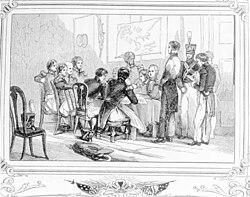
Two soldiers stand trial. Several other men gather around.
An 1846 wood engraving by William Croome of the trial of Robert Ambrister in Pictorial Life of Andrew Jackson by John Frost

Born on March 15, 1767, in the Waxhaws settlement between North Carolina and South Carolina, Jackson's early years were marked by hardship. He entered the American Revolutionary War as a youth, developing a reputation for bravery and resilience. Following the war, he pursued a legal career and eventually settled in Tennessee, where he became a successful planter and lawyer.
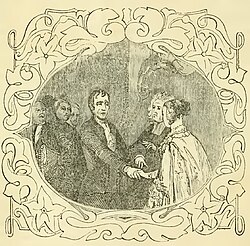
Black-and-white illustration showing a Protestant minister wearing in a cassockstanding between Andrew Jackson on the left and Rachel Donelson on the right. The two of them hold hands between then, showing the minister marrying them. An audience stands to the left, at the edge of the image.
An 1846 wood engraving by William Croome depicting Jackson's marriage to Rachel Donelson in the 1847 Pictorial History of Andrew Jackson by John Frost

Jackson's early public career was diverse. He served as a Justice of the Tennessee Superior Court from 1798 to 1804 and represented Tennessee in the U.S. House of Representatives. His personal life was equally turbulent, characterized by a volatile temperament that led to high-profile duels, including a famous confrontation with Charles Dickinson.
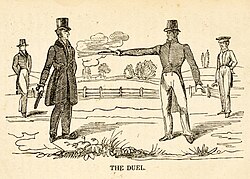
Four men in tophats, two in the foreground. The man on the right is shooting a pistol at the one on the left.
An 1834 woodcut depicting Jackson's duel with Charles Dickinson from the satirical Major Jack Downing's Life of Andrew Jackson.[64] Downing was a fictional character created by Seba Smith to parody Jackson.[65]

As a planter, Jackson's wealth was built on the labor of enslaved people at his estate, The Hermitage, in Nashville. This aspect of his life reflects the deep contradictions of a man who championed the "common man" while maintaining a system of human bondage.
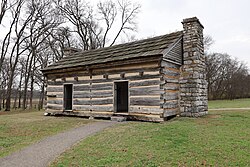
 Two-door wooden cabin with stone fireplace and no windows
One of the original slave quarters at the Hermitage

Military Career and National Fame

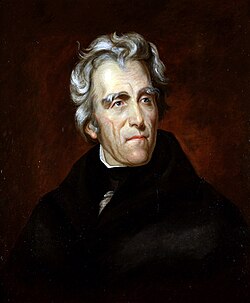
A man with wavy gray hair in white shirt, black bowtie, and black coat. Faces left.
Painting of Jackson based on an 1824 portrait, c. 1857 attributed to Thomas Sully now housed at the U. S. Senate Collection[151]

Jackson's rise to national stardom was forged on the battlefield. He played pivotal roles in several major conflicts, including the Creek War, where he won a significant victory at the Battle of Horseshoe Bend. However, it was the War of 1812 that cemented his legacy.
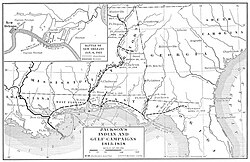
Andrew Jackson's Indian and Gulf campaigns, 1813–1818 (The American Nation, 1907)

In 1815, Jackson led the defense of New Orleans, achieving a stunning victory against British forces. This triumph transformed him into a national hero and a viable candidate for the presidency. He later served as the Military Governor of Florida in 1821 following campaigns during the First Seminole War.
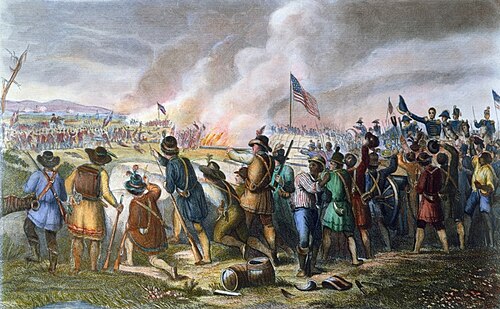
diverse men in frontier outfits with their backs to the viewer, facing ranks of British soldiers marching towards them.
Colored wood engraving of Jackson rallying the troops, from Ballou's Pictorial Drawing Room Companion, 1856 (Historic New Orleans Collection)

The Path to the White House

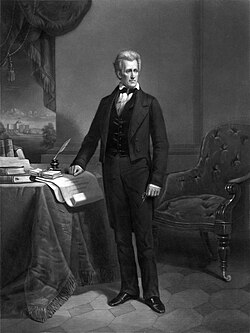
Man stands in white shirt and black pants and coat with right hand on desk and left hand at his side.
Engraving of President Jackson by A. H. Ritchie based on Dennis Malone Carter's portrait, c. 1860

Jackson's political journey was not without obstacles. In the election of 1824, he received a plurality of the Electoral College votes but was denied the presidency in a contingent election that favored John Quincy Adams. This perceived injustice fueled the rise of Jacksonian Democracy, a movement emphasizing the will of the common citizen over the established elite.
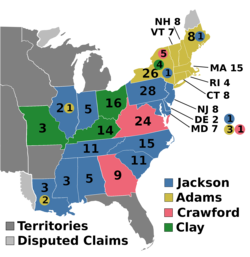
Refer to caption
The 1824 U.S. presidential election results in which Jackson received a plurality of Electoral College votes. Subsequently, John Quincy Adams was elected the sixth president of the United States in a contingent election.

In 1828, Jackson won a landslide victory, becoming the 7th President. This period was marked by personal tragedy, as his beloved wife, Rachel Donelson, passed away shortly before his inauguration.
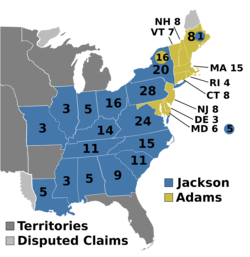
Refer to caption
The 1828 United States presidential election results

The Presidency (1829–1837)

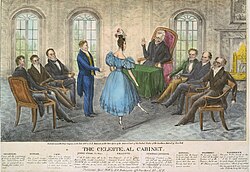
 Jackson faces a woman dancing, flanked by three seated men on right; three seated men on left and one man standing behind the woman
A lithograph cartoon, The Celeste-al Cabinet, by Albert A. Hoffay, published by Henry R. Robinson in 1836, depicting Jackson's cabinet during the Petticoat Affair; "Celeste" is Margaret Eaton.

Jackson's presidency was characterized by bold actions and intense conflict. He implemented a policy of rotation in office, replacing long-serving government officials with new appointees to prevent the formation of a permanent political class.

The Indian Removal Act

One of the most enduring and controversial legacies of his administration was the Indian Removal Act of 1830. This policy led to the forced displacement of major Southeastern tribes from their ancestral lands to territories west of the Mississippi River.
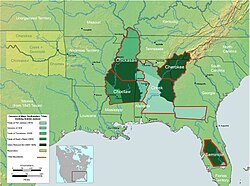
Map of the southern United States showing in dark green areas ceded by Indians.
The Indian Removal Act and treaties involving Jackson before his presidency displaced most of the major tribes of the Southeast from their traditional territories east of the Mississippi River.

The Nullification Crisis

Jackson faced a severe challenge to federal authority during the Nullification Crisis, when South Carolina attempted to declare federal tariffs null and void. Jackson took a firm stand for the Union, asserting that nullification was treasonous.
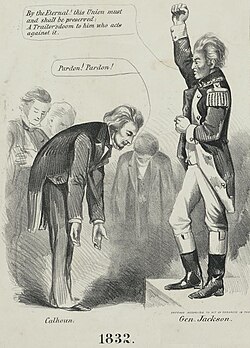
Jackson stands looking right with right arm raised; Calhoun faces left bowing before Jackson with hands down.
A Civil War–era lithograph cartoon of John C. Calhoun bowing before Jackson during the nullification crisis by Pendleton's Lithography and published by L. Prang & Co. in 1864

The Bank War

Jackson engaged in a fierce struggle with the Second Bank of the United States, which he viewed as an unconstitutional monopoly that favored the wealthy. He vetoed the bank's charter and removed federal deposits, a move that contributed to the economic instability leading to the Panic of 1837.
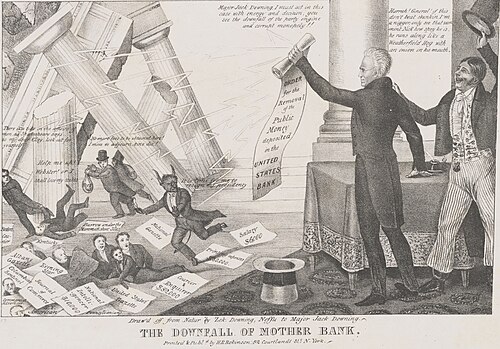
Jackson holds up document towards a devil and other people who flee while columns tumble around them.
An 1833 lithograph cartoon of Jackson destroying the Second Bank of the United States with his "Removal Notice" by Zachariah Downing, published by Henry R. Robinson; Nicholas Biddle is portrayed as the devil.

Later Years and Legacy

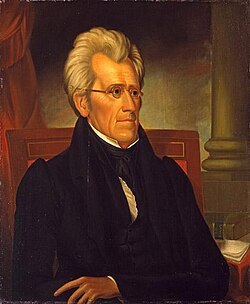
Portrait of President Andrew Jackson, c. 1830–1832 by Ralph Eleaser Whiteside Earl now housed at the North Carolina Museum of Art

Jackson's term was not without physical danger; he survived an assassination attempt in 1835. After leaving office in 1837, he retired to The Hermitage. He died on June 8, 1845, at the age of 78.
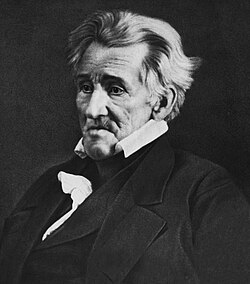
A mezzotint after a daguerreotype of Jackson in 1845

Today, Andrew Jackson is remembered as a figure of immense contradictions: a champion of the common man who owned slaves, and a defender of the Union who oversaw the forced removal of Native Americans.
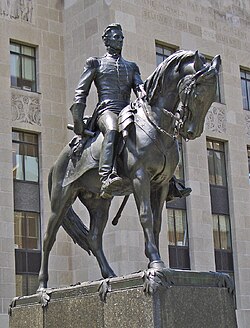
The equestrian statue of Jackson commissioned by Judge Harry S. Truman and developed by Charles Keck in 1934 on display in front of the Jackson County Courthouse in Kansas City, Missouri

Role Period Key Achievement/Event
Major General 1812–1821 Victory at Battle of New Orleans
U.S. Senator 1823–1825 Represented Tennessee
7th U.S. President 1829–1837 Indian Removal Act, Bank War
Military Governor 1821 Governed Florida

Frequently Asked Questions

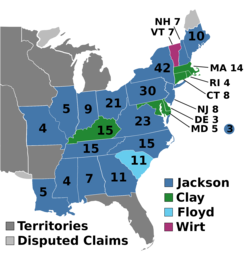
A map of the 1832 presidential election. Blue states were won by Jackson.
1832 presidential election results
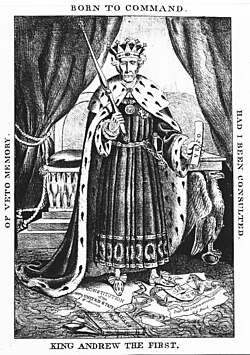
Jackson dressed as king with robe and crown, veto in hand and stepping on the Constitution
An 1832 lithograph cartoon satirizing Jackson as "King Andrew the First" by an anonymous artist
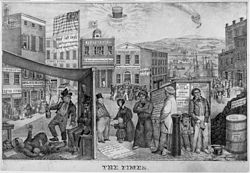
Political cartoon showing people suffering from economic trouble
A lithograph cartoon of the Panic of 1837 published by Henry R. Robinson in 1837; Jackson is symbolized by "glory" in the sky with top hat, spectacles, and pipe.
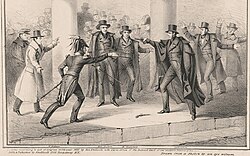
Several people in a crowd, man aims a gun at Jackson
An 1835 lithograph of the attempted assassination of Andrew Jackson, published by Endicott & Co.
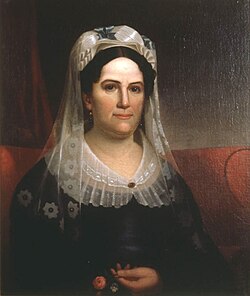
Woman in black with white bonnet and lace collar looking forward
Posthumous portrait of Jackson's wife Rachel, by Ralph Eleaser Whiteside Earl now housed at The Hermitage in Nashville
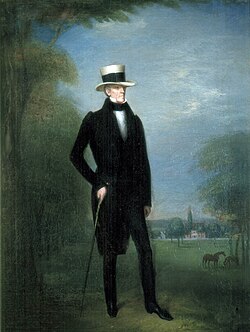
Painting of a man with a tall white hat, cane, black pants and coat, and a white shirt. He is standing on grass beside a tree.
Jackson depicted in 1831 as a Tennessee Gentleman by Ralph Eleaser Whiteside Earl, now housed at The Hermitage in Nashville

Why was Andrew Jackson called "Old Hickory"?

He earned the nickname during his military service, specifically during the War of 1812, due to his perceived toughness and resilience, which were compared to the hardness of hickory wood.

What was the "Bank War"?

The Bank War was Jackson's political and economic struggle against the Second Bank of the United States. He believed the bank was an instrument of corruption and concentrated too much power in the hands of a few wealthy individuals.

What was the impact of the Indian Removal Act?

The Act authorized the forced relocation of Native American tribes from the Southeastern United States to lands west of the Mississippi River, resulting in massive displacement and loss of life.

How did Jackson handle the Nullification Crisis?

Jackson opposed South Carolina's attempt to nullify federal tariffs, viewing it as a threat to the stability of the Union. He threatened to use military force to ensure federal laws were obeyed.

Who succeeded Andrew Jackson as President?

Andrew Jackson was succeeded by Martin Van Buren, who had served as his Vice President from 1833 to 1837.

References

  1. Vice President Calhoun resigned from office. As this was prior to the adoption of the Twenty-fifth Amendment in 1967, a vacancy in the office of vice president was not filled until the next ensuing election and inauguration.
  2. Remini 1977, p. 2.
  3. Brands 2005, pp. 11–15.
  4. Nowlan 2012, p. 257.
  5. Meacham 2008, p. 11.