Anatinae: The Biology and Systematics of Dabbling Ducks
The Anatinae are a subfamily of waterfowl within the family Anatidae, which encompasses swans, geese, and ducks. Most commonly known as dabbling ducks (or "puddle ducks"), these birds are distinguished by their unique feeding habits and physical adaptations that separate them from their diving counterparts.
Unlike diving ducks, dabbling ducks primarily feed at the water's surface. They are typically gregarious birds found in freshwater environments or estuaries. Many species are strong fliers, and those residing in northern regions are known to be highly migratory.
Key Facts
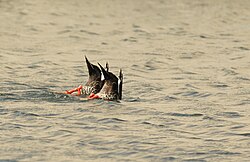
- Feeding Style: They feed by "upending" (tipping forward in shallow water) or grazing on land, rather than diving deep.
- Physical Traits: Their legs are positioned more centrally on their bodies, allowing them to walk more effectively on land.
- Flight Pattern: Dabbling ducks can spring vertically from the water into flight, whereas diving ducks must run across the surface to gain momentum.
- Foot Size: They generally have smaller feet than diving ducks because they do not require the same level of propulsion for deep diving.
- Type Species: The Mallard (Anas platyrhynchos) serves as the type species for this group.
Systematics and Classification
The classification of Anatinae is a subject of ongoing scientific debate. Some taxonomic authorities limit the subfamily to dabbling ducks and their extinct relatives, the moa-nalo. Others suggest a broader definition that includes most "ducks," placing the dabbling ducks into a specific tribe called Anatini.
The Evolution of Dabbling Ducks
A 1986 study delimited the dabbling duck group to include approximately 50–60 living species across eight genera. However, molecular data has refined this understanding. For example, mtDNA (mitochondrial DNA) sequence data for cytochrome b and NADH dehydrogenase subunit 2 indicates that diving ducks are genetically distant from dabbling ducks. The physical similarities between the two are the result of convergent evolution—where unrelated species evolve similar traits independently to adapt to similar environments.
The Moa-nalo and Extinct Lineages
The Anatinae subfamily also includes the extinct moa-nalo, a highly apomorphic (derived) lineage from the Hawaiian Islands that became extinct around 1000 AD. These birds evolved from dabbling ducks, possibly a close ancestor of the mallard. Other extinct anomalies include Bambolinetta from the Late Miocene of Tuscana, which adapted for wing-propelled diving, similar to penguins.
Comparative Anatomy: Puddle Ducks vs. Divers
The distinction between "puddle ducks" and diving ducks is rooted in their morphology. Because puddle ducks forage on the surface or in very shallow bottoms, they lack the specialized equipment needed to dive several feet deep. This is most evident in their foot size and leg placement, which favors terrestrial movement and surface stability over deep-water propulsion.
| Feature | Dabbling Ducks (Anatinae) | Diving Ducks |
|---|---|---|
| Feeding Method | Upending, grazing, surface feeding | Deep diving |
| Take-off Style | Spring straight up from water | Run across water to gain speed |
| Leg Position | More central (better for walking) | Further back (better for swimming) |
| Foot Size | Generally smaller | Larger for propulsion |
Genera and Taxonomic Uncertainty
While several genera are unequivocally classified as dabbling ducks, others remain uncertain. The following list outlines the current taxonomic landscape:
Confirmed Dabbling Duck Genera
- Anas (including the Mallard and Philippine duck)
- Spatula
- Mareca
- Sibirionetta (Baikal teal)
- Lophonetta (crested duck)
- Speculanas (bronze-winged duck)
- Amazonetta (status mostly resolved as dabbling)
Genera with Uncertain Affiliation
Certain groups, such as the stiff-tailed ducks (Oxyurini) and the black-headed duck (Heteronetta), are frequently placed in Anatinae, but their exact relationships are still being studied. Additionally, some species traditionally assigned to the Tadorninae subfamily, such as Sarkidiornis and Tachyeres, may actually be dabbling ducks.
Frequently Asked Questions
What is the main difference between a dabbling duck and a diving duck?
The primary difference is how they feed; dabbling ducks feed on the surface or by tipping forward in shallow water, while diving ducks submerge completely to find food. They also differ in their take-off method and leg placement.
What are moa-nalo?
Moa-nalo were a lineage of extinct, flightless ducks from the Hawaiian Islands that derived from dabbling ducks. They became extinct around 1000 AD.
Why do dabbling ducks walk better on land than diving ducks?
Dabbling ducks have legs located more toward the center of their bodies, providing better balance and mobility on land compared to the rear-set legs of diving ducks.
Is the Mallard a dabbling duck?
Yes, the Mallard (Anas platyrhynchos) is not only a dabbling duck but is the type species for the subfamily Anatinae.
What is convergent evolution in the context of ducks?
Convergent evolution occurs when dabbling ducks and diving ducks develop similar physical traits because they live in similar aquatic environments, even though they are genetically distant lineages.