Spur-winged Goose: The Giant Waterbird of Sub-Saharan Africa
The spur-winged goose (Plectropterus gambensis) is one of the most imposing waterbirds found across Sub-Saharan Africa. A member of the family Anatidae—which encompasses ducks, geese, and shelducks—this species is so distinct in its anatomical adaptations that it is classified in its own unique subfamily, the Plectropterinae. While they share similarities with shelducks, they stand out as some of the largest waterfowl on the continent.
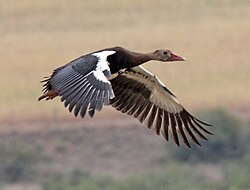
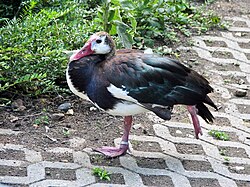
These birds are primarily recognized by their striking black plumage, contrasted by white faces and large white patches on their wings. Their long, pinkish-red legs and powerful build make them a dominant presence in the African wetlands they call home.
Key Facts
- Scientific Name: Plectropterus gambensis
- Conservation Status: Least Concern (IUCN 3.1)
- Size: Adults range from 75 to 115 cm in length.
- Weight: Typically between 4 and 6.8 kg, though some can reach 10 kg.
- Diet: Primarily herbivorous, grazing on grasses, seeds, and aquatic plants.
- Unique Feature: Possesses a spur on the bend of the wing used for fighting during breeding season.
Physical Characteristics and Subspecies
The spur-winged goose is a massive bird, with a wingspan reaching between 150 and 200 cm. There is a noticeable size difference between the sexes; ganders (males) are generally larger and heavier than the females. Males are further distinguished by a knob at the base of the upper mandible and a larger red facial patch that extends from the bill.
Subspecies Variations
The species is divided into two primary subspecies based on their distribution and appearance:
- P. g. gambensis: The nominate race, found from Gambia to Ethiopia and south to Angola and the Zambezi River. It is smaller in body size but features extensive white on the flanks and belly.
- P. g. niger: Found south of the Zambezi River, spanning from Namibia and Zimbabwe to the Cape Provinces. This subspecies has a much smaller white belly patch and can appear almost entirely black from a distance.
Habitat and Ecology
These geese are gregarious, meaning they prefer the company of others, often gathering in small flocks of up to 50 birds. They thrive in open grasslands featuring lakes, rivers, swamps, and river deltas. While they can be found at elevations up to 3,000 meters in eastern Africa, they generally avoid arid zones and saline lakes.
Diet and Feeding Habits
The spur-winged goose is primarily a grazer. Its diet consists of:
- Vegetative parts and seeds of grasses and sedges.
- Aquatic plants and tuberous crops.
- Agricultural grains and fruits, such as figs.
- Occasional small fish or insects.
Breeding and Aggression
Breeding seasons vary by region: August to December in the north, January to June in eastern Africa, and August to May in southern Africa. During this period, the species becomes highly aggressive. Males, in particular, may use the spurs on their wings to engage in violent conflicts with other waterfowl.
Their nesting habits are remarkably diverse. While they prefer quiet riverbanks, they have been known to nest in tree holes, rock cavities, termite mounds, aardvark burrows, or the abandoned nests of other birds like the African fish eagle or social weaver.
Toxicity Warning
A fascinating and dangerous aspect of the spur-winged goose is its potential for toxicity. In populations where the birds consume significant quantities of blister beetles, they accumulate a poison called cantharidin in their tissues. This toxin remains in the meat even after cooking. Because a dose of just 10 mg of cantharidin can be fatal to a human, eating these birds in certain regions can be extremely hazardous.
Conservation Status
Currently listed as Least Concern by the IUCN, the spur-winged goose remains common throughout African wetlands. However, they face ongoing threats from unregulated hunting and the destruction of their wetland habitats due to land development. The species is protected under the Agreement on the Conservation of African-Eurasian Migratory Waterbirds (AEWA).
| Feature | Details |
|---|---|
| Average Length | 75–115 cm |
| Average Weight | 4–6.8 kg (up to 10 kg) |
| Wingspan | 150–200 cm |
| Primary Habitat | Freshwater wetlands, rivers, and grasslands |
| Key Toxin | Cantharidin (from blister beetles) |
| Distribution | Sub-Saharan Africa |
Frequently Asked Questions
Why is the spur-winged goose sometimes poisonous?
The bird becomes toxic when its diet includes large numbers of blister beetles. These beetles contain cantharidin, a potent poison that the goose stores in its tissues, making the meat dangerous for human consumption.
How does the male differ from the female?
Males are generally larger and heavier than females. They also possess a distinct knob at the base of the upper mandible and a more extensive red facial patch.
Where do spur-winged geese typically nest?
They prefer quiet, undisturbed wetlands. While they often build nests in vegetation near water, they are opportunistic and may use tree holes, termite mounds, or the nests of other bird species.
What is the difference between the two subspecies?
P. g. gambensis (found in northern/central Africa) is smaller with more white on its belly and flanks. P. g. niger (found in southern Africa) has a much smaller white patch and appears mostly black.
Are spur-winged geese aggressive?
Yes, especially during the breeding season. They are highly aggressive toward other waterfowl and use the spurs on their wings to fight, particularly among adult males.