Amorpheans: The Evolutionary Supergroup of Animals, Fungi, and Amoebae
In the vast and complex tree of life, the Amorphea (also known as Unikonta) represent one of the most significant taxonomic supergroups of eukaryotes. This diverse clade encompasses a wide array of organisms, ranging from simple single-celled amoebae to the complex multicellular structures of animals and fungi. By studying the Amorpheans, scientists can better understand the fundamental evolutionary splits that shaped modern biological life.
The classification of this group has evolved as genomic sequencing has improved. Originally proposed by Thomas Cavalier-Smith in 2002, the group was long referred to as "Unikonts." However, in 2012, the International Society of Protistologists recommended the name Amorphea because the term Unikont was based on a hypothesized physical trait—a single flagellum—that many scientists later found to be inaccurate.
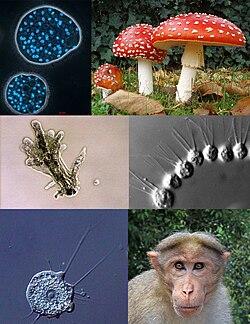
Key Facts
- Temporal Range: Exists from the Early Ectasian period to the present (approximately 1400–0 Ma).
- Core Members: Includes the Amoebozoa and Obazoa (which contains animals and fungi).
- Defining Genetic Marker: Possess a unique triple-gene fusion for pyrimidine nucleotide synthesis.
- Cellular Structure: Typically characterized by a single emergent flagellum or no flagella at all.
- Ancestry: Eukaryotes are thought to have emerged from within the archaeal phylum Promethearchaeota.
Taxonomic Structure and Classification
The Amorphea supergroup is divided into several critical clades and subgroups that define the relationships between different life forms.
Obazoa and Opisthokonta
The Obazoa is a major clade within Amorphea. Its most prominent subgroup is the Opisthokonta, a group that unites animals (Animalia), fungi (Fungi), and choanoflagellates. This relationship highlights the surprising evolutionary link between the kingdom of fungi and the kingdom of animals.
Amoebozoa
The Amoebozoa are basal members of the Amorphea. This group is considered monophyletic and is split into two primary branches:
- Conosa: Divided into the aerobic Semiconosia (including Mycetozoa and Variosea) and the secondarily anaerobic Archamoebae.
- Lobosa: Non-flagellated amoebae divided into Discosea (flattened cells) and Tubulinea (tube-shaped pseudopodia).
Other Lineages
The group also includes the Apusomonadida and Breviatea. There have been various attempts to classify these into a phylum called Sulcozoa, though recent research suggests that Sulcozoa and Apusozoa may be paraphyletic (meaning they do not include all descendants of a common ancestor), leading to ongoing taxonomic revisions.
Biological Characteristics and Evolution
The primary distinction between Amorpheans and other eukaryotes (often called bikonts, such as plants and SAR supergroup members) lies in their cellular machinery and genetics.
The Triple-Gene Fusion
One of the strongest pieces of evidence for the shared ancestry of Opisthokonta and Amoebozoa is a triple-gene fusion. This rare genetic event fused three genes encoding enzymes for the synthesis of pyrimidine nucleotides: carbamoyl phosphate synthase, dihydroorotase, and aspartate carbamoyltransferase. This fusion is absent in bacteria and bikonts, serving as a molecular "fingerprint" for the Amorphea.
The Flagellum Debate
While the name "Unikont" implies a single flagellum, the reality is more complex. While many Amorpheans have one emergent flagellum or none, flagellated opisthokonts and some Amoebozoa (like Breviata) actually possess two basal bodies—the structures that anchor flagella. This suggests that the common ancestor of all Amorpheans likely had two basal bodies, similar to the centrioles found in animal cells.
| Clade/Group | Key Members | Distinguishing Feature |
|---|---|---|
| Opisthokonta | Animals, Fungi, Choanoflagellates | Multicellularity in higher forms; posterior flagellum |
| Amoebozoa | Lobose amoebae, Slime molds | Pseudopodia for movement and feeding |
| Obazoa | Opisthokonts and related protists | Shared ancestry with animals and fungi |
| Apusomonadida | Apusomonads | Flagellated protists |
Frequently Asked Questions
What is the difference between Amorphea and Unikonta?
They refer to the same group of organisms. "Unikonta" was the original term based on the presence of a single flagellum, but "Amorphea" is now the preferred scientific term because the single-flagellum trait is not a universal characteristic of the group's ancestor.
Which animals and fungi belong to this group?
All animals and all fungi are members of the Amorphea supergroup, specifically within the clade Opisthokonta.
What is a triple-gene fusion?
It is a rare evolutionary event where three separate genes fused into one. In Amorpheans, this fusion involves enzymes used to create pyrimidine nucleotides, providing strong evidence that Amoebozoa and Opisthokonta share a common ancestor.
How do Amorpheans differ from Bikonts?
Bikonts (such as plants and various algae) typically have two emergent flagella and lack the specific triple-gene fusion found in Amorpheans.
What are the two main branches of Amoebozoa?
The two main branches are Conosa, which includes aerobic and anaerobic forms, and Lobosa, which consists of non-flagellated amoebae with either flattened cells or tube-shaped pseudopodia.