Americas: A Comprehensive Overview of Geography, Demographics, and Economy
The Americas represent a vast and diverse collection of landmasses, spanning from the Arctic reaches of the north to the southern tips of the continent. Comprising 35 countries and 23 dependencies, this region is a complex tapestry of cultures, languages, and economic systems. With a total area of approximately 42,549,000 km², the Americas host a massive population and a wide array of ecological zones.
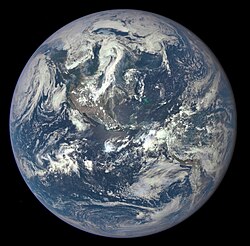
Key Facts

- Total Area: 42,549,000 km² (16,428,000 sq mi)
- Total Population: Approximately 1.02 billion
- Number of Countries: 35
- Number of Dependencies: 23
- Largest City: São Paulo, Brazil
- Highest Peak: Aconcagua, Argentina
Etymology and Naming

The name "America" is derived from the Italian explorer Amerigo Vespucci. The term first appeared on a world map created by Waldseemüller in Germany in 1507, specifically labeling the landmass in the lower-left section over what is now South America.
![America is named after Italian explorer Amerigo Vespucci.[12]](/images/ed/e4/ede4a936f9924dc618a449e09189b9bf7753ac0c46fd74b1703576dba776d674.jpg)
![World map of Waldseemüller (Germany, 1507), which first used the name America (in the lower-left section, over South America)[13][14]](/images/50/7b/507b658ffc29474b7b09d8f92ce4cdcf0303e85dc438c578316bc1e2b73e6f73.jpg)
Regional Subdivisions and Terminology
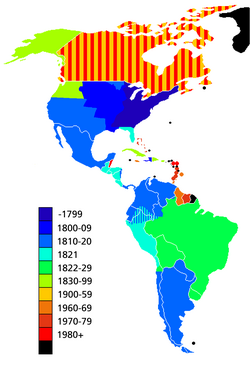
The Americas are often categorized into several distinct regions depending on the context of geography, culture, or language. These subdivisions help organize the vast territory into manageable concepts:
Geographic and Cultural Divisions
- North America (NA): A major continental division.
- South America (SA): The southern continental landmass.
- Central America: The region connecting North and South America.
- Caribbean: An island region that may be grouped with North America or Middle America.
- Latin America (LA): A cultural grouping based on language, often including Central and South America.
- Anglo-America (A-A): A cultural grouping typically referring to English-speaking regions.
Demographics and Urbanization

As of 2021, the population of the Americas reached roughly 1.03 billion people. This population is distributed unevenly across the two primary continents, with North America (including Central America and the Caribbean) housing approximately 596.6 million people, and South America housing 434.3 million.
![Map of early human migrations based on the Out of Africa theory[48]](/images/c3/7c/c37c64b6e5588f9bd603362e43473d120b97505cbd5afbe0accaf31ad132affe.webp)
Major Urban Centers
The Americas are home to some of the world's most significant metropolitan areas. Urbanization is a defining characteristic of the region's social structure.
| City | Country | City Population | Metro Area Population |
|---|---|---|---|
| Mexico City | Mexico | 9,209,944 | 21,804,515 |
| São Paulo | Brazil | 11,451,999 | 21,518,955 |
| New York City | United States | 8,405,837 | 19,949,502 |
| Buenos Aires | Argentina | 3,121,707 | 16,366,641 |
| Los Angeles | United States | 3,928,864 | 13,131,431 |
Religion and Language
Religion plays a significant role in the cultural fabric of the Americas. Christianity is the most prevalent faith, accounting for approximately 86% of the population. Within Christianity, Catholicism and Protestantism are the dominant denominations, though their prevalence varies significantly by country. For example, the United States has a high Protestant population (54%), while countries like Brazil and Argentina show higher Catholic concentrations.
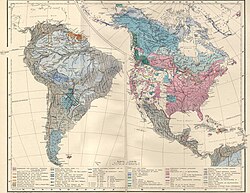
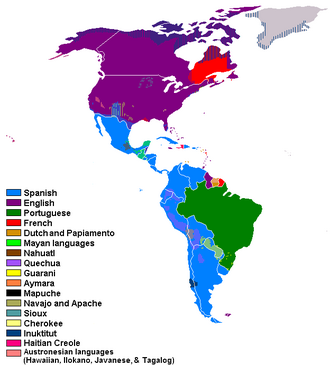
Linguistically, the region is incredibly diverse. While English, Spanish, and Portuguese are among the most widely spoken languages, many nations also recognize numerous indigenous languages. In countries like Mexico, Guatemala, and Peru, indigenous languages such as Mayan or Quechua are spoken by millions.
Economic Landscape
The economies of the Americas vary widely, ranging from highly developed industrial nations to emerging markets. The United States holds the largest nominal GDP in the region, followed by Brazil, Canada, and Mexico.
Economic Rankings (Nominal GDP)
The following table highlights the leading economies in the Americas based on peak nominal GDP:
| Rank | Country | GDP (Nominal) |
|---|---|---|
| 1 | United States | 32,383,920 |
| 2 | Brazil | 2,635,912 |
| 3 | Canada | 2,507,340 |
| 4 | Mexico | 2,120,855 |
Geography and Environment
The physical geography of the Americas is characterized by extreme diversity. From the high peaks of the Andes to the vast plains and tropical rainforests, the landscape supports a wide range of climate zones.
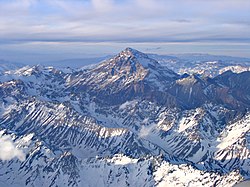
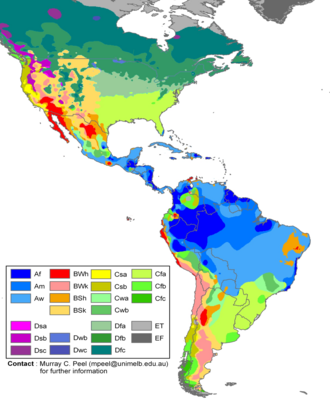
The highest point in the Americas is Aconcagua, located in Argentina. The region's hydrology and ecology are equally varied, encompassing massive river systems and diverse biological habitats.
Frequently Asked Questions
What is the largest city in the Americas?
By city population, São Paulo in Brazil is the largest, with a population of approximately 12,038,175 as of 2016.
Which country has the highest GDP in the region?
The United States has the highest nominal and PPP (Purchasing Power Parity) GDP in the Americas.
What are the main languages spoken in the Americas?
The most common languages are English, Spanish, and Portuguese, though many indigenous languages are also widely spoken throughout the continents.
How is the population of the Americas divided?
The population is roughly split between North America (including Central America and the Caribbean), which has about 596.6 million people, and South America, which has about 434.3 million people.
What is the highest mountain in the Americas?
Aconcagua, located in Argentina, is the highest peak in the Americas.