American Revolutionary Statues of Washington, D.C.
Beginning in the mid-19th century, a collective effort by the U.S. Congress, various societies, and descendants of the American Revolutionary War forces sought to transform the landscape of Washington, D.C. Their goal was to install statues honoring the notable figures who secured American independence from the Kingdom of Great Britain. Today, the nation's capital boasts the highest concentration of outdoor statues in the United States.
The 19th Century: Establishing a Tradition
The movement began in 1847 with the installation of a statue of Thomas Jefferson north of the White House, though it was later moved back to the United States Capitol in 1874. In 1853, the city saw its first equestrian statue (a statue depicting a person on horseback) with the installation of President Andrew Jackson in Lafayette Square.
The formal series of American Revolutionary statuary began in 1860 with an equestrian statue of George Washington, the first president and commander-in-chief of the Continental Army, placed in Washington Circle. This marked the first of 14 such statues to be erected in the city.
Following Washington, other key figures were memorialized:
- Major General Nathanael Greene: An 1878 equestrian statue in Stanton Park, designed by Henry Kirke Brown and regarded as one of the city's finest.
- Benjamin Franklin: A standing statue sculpted by Jacques Jouvenal in 1889, currently located in front of the Old Post Office. This was one of four statues not funded by the government, donated instead by Washington Post founder Stilson Hutchins.
- Marquis de Lafayette: Erected in 1891 in Lafayette Square, this statue was sculpted by Alexandre Falguière and Antonin Mercié. The square had been named after the French military figure during his 1824 visit to the U.S.
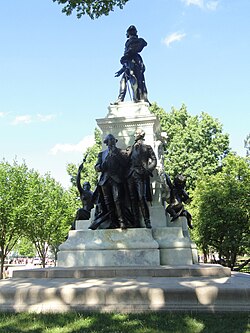
The 20th Century: Expanding the Legacy
The majority of the Revolutionary War statues were installed during the 1900s, starting with the Comte de Rochambeau in 1902. Sculpted by Fernand Hamar, Rochambeau is the second French military hero honored in Lafayette Square.
The expansion continued with a diverse array of figures:
- Doctor John Witherspoon: A signer of the Declaration of Independence, minister, and politician. His 1909 statue was funded by the Church of the Covenant.
- Tadeusz Kościuszko and Casimir Pulaski: These Polish heroes were dedicated on the same day in 1910. Kościuszko's statue is in Lafayette Square, while Pulaski's equestrian statue now stands at the eastern end of Freedom Plaza.
- Friedrich Wilhelm von Steuben: Also installed in 1910 within Lafayette Square.
- John Paul Jones: A 1912 memorial to the Continental Navy captain located in West Potomac Park.
- Commodore John Barry: A naval hero memorialized in 1914 in Franklin Square.
- Edmund Burke: A British politician who defended the Thirteen Colonies, his statue was erected in 1922 via funding from the Sulgrave Institution.
The collection was completed with two final installations: Artemas Ward at Ward Circle in 1938 and Nathan Hale in 1948, the latter being a gift from Yale University President Charles Seymour.
Preservation and Legal Status
While the Washington Monument and Jefferson Memorial are technically Revolutionary monuments, they are excluded from this specific list due to their massive scale. All 14 statues are owned and maintained by the National Park Service (NPS), an agency of the U.S. Department of the Interior.
To ensure their longevity, President Richard Nixon issued Executive Order 11593, leading the NPS to survey and register these works. Consequently, they were added to the National Register of Historic Places (NRHP) on July 14, 1978, and the District of Columbia Inventory of Historic Sites on March 3, 1979. Many of these statues are considered contributing properties to the L'Enfant Plan—the original urban design of the city—or to the Lafayette Square Historic District.
Summary of Revolutionary Statuary
| Figure | Year Installed | Location | Notable Detail |
|---|---|---|---|
| George Washington | 1860 | Washington Circle | First of the 14 Revolutionary statues |
| Benjamin Franklin | 1889 | Old Post Office | Donated by Stilson Hutchins |
| Marquis de Lafayette | 1891 | Lafayette Square | One of two French heroes in the square |
| Comte de Rochambeau | 1902 | Lafayette Square | First 20th-century installation |
| Edmund Burke | 1922 | 11th, L, and Mass Ave NW | Honors a British politician |
| Nathan Hale | 1948 | Washington, D.C. | Gift from Yale University |
Key Facts
- There are 14 official American Revolutionary statues in Washington, D.C.
- The National Park Service is responsible for the ownership and maintenance of all these statues.
- The first equestrian statue made in the U.S. was of Andrew Jackson (1853), though he is not part of the 14 Revolutionary statues.
- Four of the statues were funded by private donations rather than the U.S. government.
- The statues were collectively listed on the National Register of Historic Places in 1978.
Frequently Asked Questions
Which statues are located in Lafayette Square?
Lafayette Square hosts statues of the Marquis de Lafayette, the Comte de Rochambeau, Tadeusz Kościuszko, and Friedrich Wilhelm von Steuben.
Who maintains the Revolutionary War statues in D.C.?
All of the American Revolutionary statuary is owned and maintained by the National Park Service (NPS), which is part of the United States Department of the Interior.
Why are the Washington Monument and Jefferson Memorial not on the list?
Although they are Revolutionary monuments, they are excluded from the list of 14 statues due to their exceptional size and grandeur.
What is the L'Enfant Plan?
The L'Enfant Plan is the original urban design for Washington, D.C., created by Pierre Charles L'Enfant. Many of the statues are considered contributing properties to this historic plan.
Were all the statues paid for by the government?
No, four of the statues were not paid for by the U.S. government. For example, the statue of Benjamin Franklin was a donation from Stilson Hutchins, and the statue of Nathan Hale was a gift from Yale University.