Alsace–Lorraine: The Imperial Territory of the German Empire (1871–1918)
Between 1871 and 1918, the region of Alsace–Lorraine (known in German as Reichsland Elsaß–Lothringen) existed as a federal territory of the German Empire. Formed in the wake of the Franco-Prussian War, this strategic region became a focal point of European tension, symbolizing the struggle for national identity and territorial sovereignty between France and Germany.
The territory was formally ceded by France under the Treaty of Frankfurt in 1871. For nearly five decades, it remained under German administration until the conclusion of World War I, when the Treaty of Versailles restored the region to French sovereignty.
![French map with shading showing départements before 1870 with black lines after 1871[a]](/images/e6/a2/e6a29c31c0e1d7308e618001c9d2fe016c9c909dbcbf1e421397e6024aad522e.webp)
Key Facts
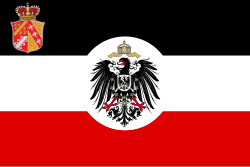
- Duration: 1871 to 1918.
- Capital: Straßburg (Strasbourg).
- Total Area: 14,496 km² (5,597 sq mi).
- Population (1910): 1,874,014 inhabitants.
- Administrative Status: A federal territory (Reichsland) of the German Empire.
- Primary Cities: Strasbourg, Mulhouse, Metz, Thionville, and Colmar.
Geography and Administration
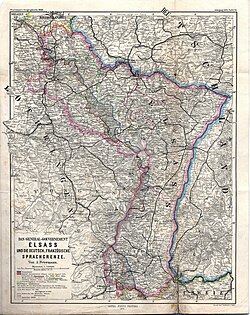
The Imperial Territory was divided into three primary districts, known as Bezirke: Oberelsass (Upper Alsace), Unterelsass (Lower Alsace), and Bezirk Lothringen (District of Lorraine). The administrative heart of the region was Strasbourg, which served as the capital.
The urban landscape was dominated by several key cities. By 1910, Strasbourg was the largest center with 220,883 residents, followed by Mülhausen (Mulhouse) with 128,190 and Metz with 102,787. Other significant towns included Diedenhofen (Thionville) and Colmar.
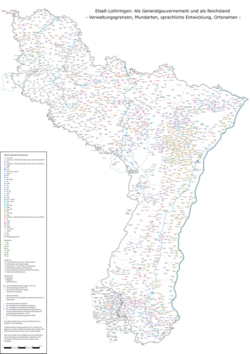
Demographics and Language
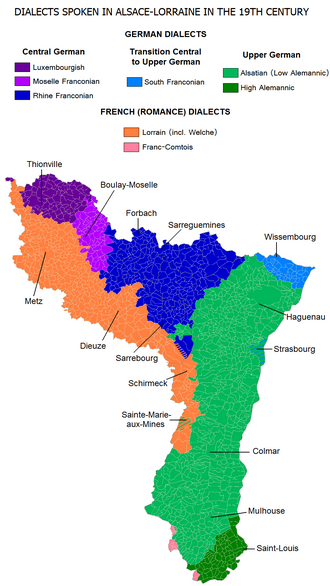
The annexation followed a geo-linguistic divide, though the borders were not strictly linguistic. While most of the region spoke Germanic dialects, certain areas—including the city of Metz and the Château-Salins region—were annexed despite a predominantly French-speaking population. In 1900, approximately 11.5% of the population spoke French as their first language.
Political History and Governance
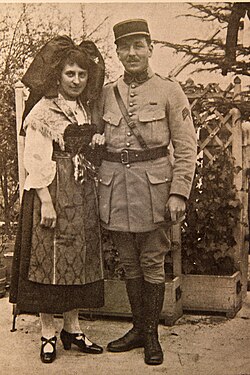
The governance of Alsace–Lorraine was characterized by a tension between imperial control and local aspirations. The territory was led by an Imperial Governor (initially titled Oberpräsident), who acted as the representative of the crown. The legislative body was the Landtag.
The Struggle for Citizenship
Under the Treaty of Frankfurt, residents were granted Alsace–Lorraine citizenship. However, those who wished to remain French citizens had until October 1, 1872, to exercise an "option." Approximately 160,878 people (10.4% of the population) chose to retain French citizenship. While many were expected to emigrate, only about 50,000 actually left for France; the remaining optants eventually retained German citizenship.
![The Black Stain[c] (1887) by Albert Bettannier[d]](/images/f9/41/f9411782f966d73d2128ef1e6710e06ccc2a1e12968f4bd0d1a2e13a939a7f3f.jpg)
Representation in the Reichstag
Starting in 1874, the territory was granted 15 seats in the German Reichstag (the national parliament). A significant group known as the "Protest Deputies" emerged, opposing the annexation and calling for a plebiscite—a direct vote by the people—to decide the region's affiliation. This motion was rejected by the Reichstag.

Military and Economic Integration
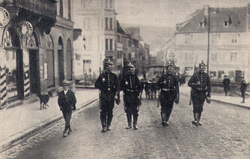
Germany viewed Alsace–Lorraine as a vital strategic buffer. This led to a massive military presence; by 1910, 4.3% of the local population (roughly 80,000 men) were military personnel, the highest concentration of troops in any German region.
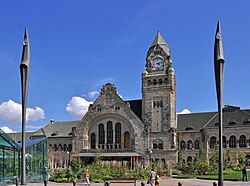
Economic integration was spearheaded by the construction of the "cannon railway," a strategic line connecting Berlin to Metz. The German Empire purchased the existing French Eastern Railway Company lines for 260 million gold marks, creating the first railway owned directly by the German Reich.
The Path to Restoration
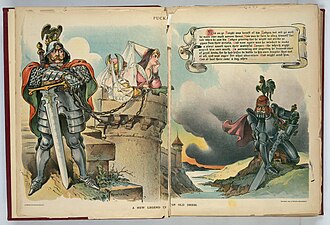
The loss of Alsace–Lorraine remained a deep wound in the French psyche, often personified in art and monuments as a separation of family. This resentment was a contributing factor to the outbreak of World War I.
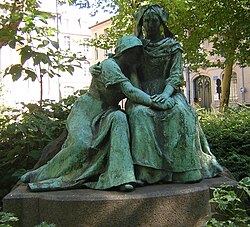
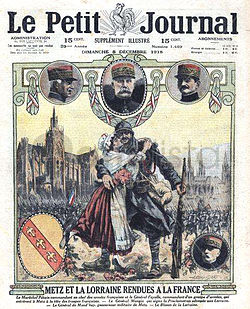
Following Germany's defeat in 1918, the region was returned to France. This transition was marked by both celebration and tragedy, including reports of violence against civilians during the early stages of the war.
![A plaque commemorating the reported murder of three farmers, at Gertwiller, Bas-Rhin, Alsace, just after World War I began.[citation needed] Apart from the victim names, the plaque reads, "ICI A GERTWILLER le 22 Aout 1914 furent fusillés contre tout justice trois fermiers alsaciens... victimes innocentes de la barbarie allemande / Alsaciens! Souvenez Vous! L'Association des Proscrits d'Alsace". [Diacritics, only as appear on the plaque.] Machine translation (Google, October 2025): "HERE IN GERTWILLER on 22 August 1914, three Alsatian farmers were shot against all justice... innocent victims of German barbarity / Alsatians! Remember! The Association of the Outlaws of Alsace".](/images/37/e7/37e7294a768122e56b96d86d304acc69be5054a3f5a118e4a50838dd759efdb1.jpg)
Later Conflicts and the Malgré-nous
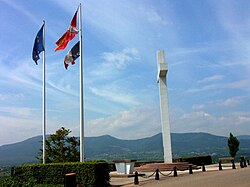
The region's complex identity resurfaced during World War II. When Germany re-occupied the area, many young men were forcibly conscripted into the German army; these individuals are known as the Malgré-nous (meaning "against our will").
Summary of Regional Statistics
| Year | Population | Key Event / Cause of Change |
|---|---|---|
| 1866 | 1,596,198 | Pre-annexation baseline |
| 1875 | 1,531,804 | Post-incorporation emigration to France/Algeria |
| 1910 | 1,874,014 | Steady growth (0.58% annually 1875–1910) |
| 1921 | 1,709,749 | Post-WWI restoration to France |
| 1946 | 1,767,131 | WWII casualties (military and civilian) |
| 2018 | 2,942,057 | Modern population |
Frequently Asked Questions
How did Alsace–Lorraine become part of the German Empire?
The region was annexed by Germany following its victory in the Franco-Prussian War and was formally ceded by France through the Treaty of Frankfurt in 1871.
What was the "option" for citizenship?
The "option" allowed residents of the annexed territories to choose to retain their French citizenship rather than accept German citizenship, provided they did so by October 1, 1872.
Who were the "Protest Deputies"?
They were members of the German Reichstag elected from Alsace–Lorraine who opposed the annexation and campaigned for a plebiscite to let the local population decide their own national affiliation.
What does the term "Malgré-nous" refer to?
It refers to the residents of Alsace and Moselle who were forcibly conscripted into the German armed forces during World War II against their will.
Which cities were the most important in the Imperial Territory?
The most significant cities were Strasbourg (the capital), Mulhouse, and Metz, which served as the primary urban and administrative centers of the region.