Aleksander Kwaśniewski: The Architect of Modern Poland's Integration
Aleksander Kwaśniewski is a pivotal figure in the political transformation of post-communist Poland. Serving as the 3rd President of Poland from 1995 to 2005, his tenure was defined by a strategic shift toward Western integration and the modernization of the Polish state. From his early days in communist youth movements to leading the nation through its accession to the world's most influential political and military alliances, Kwaśniewski's career reflects the complex evolution of Poland at the end of the 20th century.
Key Facts
- Presidency: Served two terms from December 23, 1995, to December 23, 2005.
- Economic Growth: Poland's GDP doubled during his ten-year presidency.
- Global Integration: Oversaw Poland's entry into NATO (1999) and the European Union (2004).
- Legal Milestone: Presided over the drafting of the new Polish constitution in 1997.
- Diplomacy: Acted as a key mediator during Ukraine's Orange Revolution in 2004.
Early Life and Political Ascent
Born on November 15, 1954, in Białogard, Kwaśniewski studied Transport Economics and Foreign Trade at the University of Gdańsk between 1973 and 1977, though he did not graduate. His political trajectory began within the ruling Polish United Workers' Party (PZPR), which he joined in 1977. During this era, he was a prominent activist in the communist student movement, holding leadership roles in the Socialist Union of Polish Students (SZSP).
Kwaśniewski also established himself as a journalist, serving as editor-in-chief of the student weekly ITD and the daily Sztandar Młodych. Notably, in 1985, he co-founded Bajtek, Poland's first periodical dedicated to computer science. His rise continued into government service, where he served as the Minister for Youth Affairs from 1985 to 1987.
Following the dissolution of the PZPR in 1990, Kwaśniewski helped found the Social Democracy of the Republic of Poland (SdRP), serving as its first chairman. He also co-founded the Democratic Left Alliance (SLD), a coalition that would become a powerhouse in Polish politics during the 1990s.
The Presidency (1995–2005)
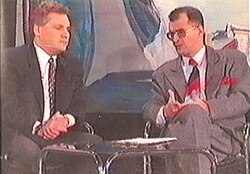
In 1995, Kwaśniewski won a hard-fought presidential election, defeating the incumbent Lech Wałęsa with 51.7% of the vote. His campaign focused on the themes of "Poland for all" and "Let's choose the future." He was later re-elected in 2000 in a decisive first-round victory, the only such occurrence in a Polish presidential election since the end of communism.
Western Integration and Security
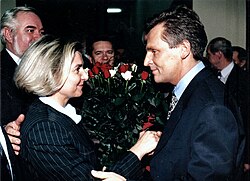
The hallmark of Kwaśniewski's presidency was the alignment of Poland with Western institutions. He led the delegation at the 1997 Madrid summit and later signed the instruments ratifying Poland's membership in NATO on February 26, 1999. He remained a vocal supporter of the alliance's "open-door policy," advocating for the inclusion of other Central and Eastern European states.
European Union and Regional Diplomacy
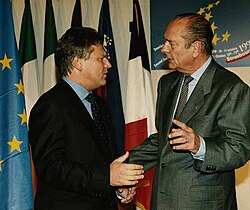
Kwaśniewski was a staunch advocate for European integration. Alongside his wife, Jolanta, he campaigned for the EU accession treaty, which culminated in Poland officially joining the European Union on May 1, 2004. He also sought to strengthen regional ties, hosting a summit of Central and Eastern European leaders in Łańcut in 1996 and repairing diplomatic relations with Lithuania through a treaty of friendship signed in 1997.
International Mediation
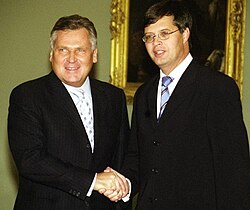
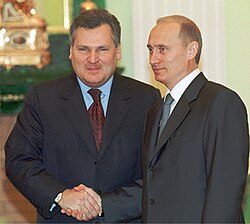
Beyond Poland's borders, Kwaśniewski utilized his diplomatic ties to foster stability. In 2004, leveraging his relationship with Leonid Kuchma, he served as a mediator during the Orange Revolution in Ukraine, helping to broker a pro-democratic agreement and a peaceful resolution to the political conflict.
Controversies and Allegations
Despite his diplomatic successes, Kwaśniewski's tenure and post-presidency were not without controversy. He faced criticism for granting pardons to figures such as Peter Vogel, a former Swiss banker convicted of murder, and Zbigniew Sobotka, a former deputy minister of Justice.
In 2007, the Institute of National Remembrance alleged that Kwaśniewski had been an agent (codenamed "Alek") for the Służba Bezpieczeństwa (SB), the communist-era secret police, between 1983 and 1989. Kwaśniewski denied these claims, and a court subsequently confirmed his statement.
More recently, reports stemming from a 2018 U.S. federal court plea agreement by Paul Manafort suggested that a former Polish president had been involved in illegal lobbying for former Ukrainian President Viktor Yanukovych starting in 2011. Some press reports identified Kwaśniewski as the individual in question.
Summary of Presidential Terms
| Metric/Event | First Term (1995–2000) | Second Term (2000–2005) |
|---|---|---|
| Election Result | 51.7% (Run-off) | 53.9% (First Round) |
| Major Legal Act | 1997 Constitution | EU Accession Treaty |
| Key Alliance | NATO (Joined 1999) | European Union (Joined 2004) |
| Economic Impact | Initial Modernization | GDP Doubled (10-year span) |
Frequently Asked Questions
How did Aleksander Kwaśniewski contribute to Poland's economy?
During his ten years in office, Poland experienced rapid economic growth and modernization, resulting in the nation's GDP doubling.
What were the most significant international achievements of his presidency?
His most significant achievements include securing Poland's membership in NATO in 1999 and the European Union in 2004, as well as mediating the Orange Revolution in Ukraine.
What was the "Orange Revolution" mediation?
In 2004, Kwaśniewski acted as a mediator in the political conflict in Ukraine known as the Orange Revolution, playing a major role in reaching a peaceful, pro-democratic solution.
Did Aleksander Kwaśniewski have ties to the secret police?
The Institute of National Remembrance alleged he was an agent for the SB from 1983 to 1989, but Kwaśniewski denied this, and his denial was confirmed by a court.
Who succeeded Aleksander Kwaśniewski as President?
He was succeeded by Lech Kaczyński in December 2005.