Albanifriedhof: The Historic Resting Place of Great Minds in Göttingen
Located just outside the southeastern city wall of Göttingen, Germany, Albanifriedhof is more than just a cemetery; it is a sanctuary of intellectual history. Named after the adjacent St Albani Evangelical Lutheran Church, this site serves as the final resting place for some of the most influential thinkers, scientists, and philosophers in European history.
Key Facts
- Location: Southeast of the city wall in Göttingen, Germany.
- Namesake: Named after the nearby St Albani Evangelical Lutheran Church.
- Most Famous Resident: The legendary mathematician Carl Friedrich Gauss.
- Significance: A hub for the interments of world-renowned academics and scientists.
A Legacy of Intellectual Achievement
The Albanifriedhof is renowned primarily for its association with Carl Friedrich Gauss (1777–1855), one of the most significant mathematicians and scientists in history. His presence makes the cemetery a point of pilgrimage for scholars and students of mathematics from around the globe.
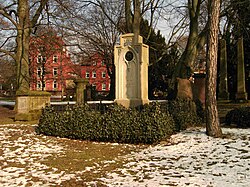
Beyond Gauss, the cemetery houses a diverse array of pioneers across various academic disciplines. From the natural sciences to the foundations of modern education, the individuals buried here shaped the way we understand the physical and mental world.
Pioneers of Science and Nature
The cemetery is home to several giants of the natural sciences. Johann Friedrich Gmelin (1748–1804) was a polymath who contributed to botany, entomology (the study of insects), and malacology (the study of mollusks). Similarly, Johann Friedrich Blumenbach (1752–1840) left a lasting mark as a zoologist and anthropologist.
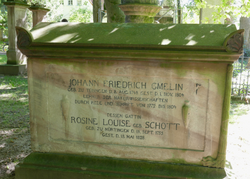
Philosophers and Educators
The intellectual breadth of Albanifriedhof extends into the humanities. Johann Friedrich Herbart (1776–1841) is credited as the founder of pedagogy—the method and practice of teaching—as an academic discipline. The site also holds the remains of Rudolf Hermann Lotze (1817–1881), a noted philosopher and logician.
Arts and Archaeology
Adding to the cultural richness of the site is Otto Jahn (1813–1869), who excelled as an archaeologist and philologist (a student of language in historical sources), while also contributing significantly to the study of art and music.
Summary of Notable Interments
| Name | Lifespan | Primary Disciplines |
|---|---|---|
| Carl Friedrich Gauss | 1777–1855 | Mathematics, Science |
| Johann Friedrich Gmelin | 1748–1804 | Botany, Entomology, Malacology |
| Johann Friedrich Blumenbach | 1752–1840 | Zoology, Anthropology |
| Johann Friedrich Herbart | 1776–1841 | Philosophy, Psychology, Pedagogy |
| Otto Jahn | 1813–1869 | Archaeology, Philology, Art/Music |
| Rudolf Hermann Lotze | 1817–1881 | Philosophy, Logic |
Frequently Asked Questions
Where is Albanifriedhof located?
It is located in Göttingen, Germany, situated just outside the city wall to the southeast.
Who is the most famous person buried at Albanifriedhof?
The cemetery is most famous as the final resting place of the mathematician and scientist Carl Friedrich Gauss.
How did the cemetery get its name?
The cemetery is named after the St Albani Evangelical Lutheran Church, which is adjacent to the grounds.
Which academic discipline was founded by one of the residents?
Johann Friedrich Herbart is recognized as the founder of pedagogy as an academic discipline.
What scientific fields did Johann Friedrich Gmelin contribute to?
Gmelin was a naturalist who specialized in botany, entomology, and malacology.