Akimel Oʼodham History: From Colonial Contact to Tribal Sovereignty
The history of the Akimel Oʼodham is a narrative of resilience, adapting to centuries of shifting political landscapes and colonial pressures. From their early encounters with Spanish missionaries to the challenges of the American era, the Akimel Oʼodham have navigated a complex path to maintain their identity and reclaim their economic independence in the arid landscapes of Arizona.
The Hispanic Era (1694–1853)
Initial colonial contact was sparse, consisting mostly of travelers or community members visiting southern settlements. This changed in 1694 when Father Kino first visited the villages, marking the start of the Hispanic era. While contact remained infrequent during the subsequent Mexican rule (1821–1853), the introduction of European elements had a profound impact. The Akimel Oʼodham integrated new crops like wheat, adopted metal tools and trade goods, and managed livestock, though they also faced the devastating arrival of infectious diseases for which they had no natural immunity.
Tensions between the indigenous population and colonial forces peaked in 1751 during the Pima Revolt (also known as the Oʼodham Uprising or Pima Outbreak). This conflict stood as one of the major northern frontier struggles within early New Spain.
Transition to American Rule
The mid-19th century brought increased Euroamerican contact following the Mexican–American War of 1846. The Akimel Oʼodham provided essential aid and trade to expeditions led by Philip St. George Cooke and Stephen Watts Kearny. Following Mexico's defeat, the territory of present-day Arizona—excluding land south of the Gila River—was ceded to the United States.
The subsequent California Gold Rush transformed the region. The Southern Emigrant Trail, stretching between Mesilla and the Colorado River crossings near Yuma, saw a surge of travelers. Akimel Oʼodham villages became vital oases where migrants could recover from desert crossings and purchase livestock and supplies for the remainder of their journey.
The American Era and the Gila River Indian Community
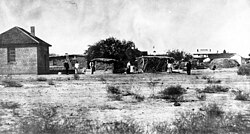
The American era officially began in 1853 with the Gadsden Purchase, the acquisition of southern Arizona by the U.S. This period initially brought prosperity; the Akimel Oʼodham developed markets to supply immigrants and provided grain for the military during the American Civil War and for the horses of the Butterfield Overland Mail. In 1859, the Gila River Indian Community (GRIC) was established.
By 1860, several key villages were recorded, including:
- Agua Raiz
- Arenal
- Casa Blanca
- Cachanillo
- Cerrito
- Cerro Chiquito
- El Llano
- Hormiguero
However, the post-Civil War era saw an influx of Euroamerican settlers along the lower Salt River and upstream Gila. This encroachment led to fierce competition for scarce resources and increased tension. The U.S. government responded with policies of pacification—the forced suppression of resistance—and confinement to reservations. Administrative centers like Vahki (Casa Blanca) and Gu U ki (Sacaton) grew during the 1870s and 1880s as churches, schools, and trading posts were established, often at the expense of smaller villages.
Economic Decline and the Famine Years
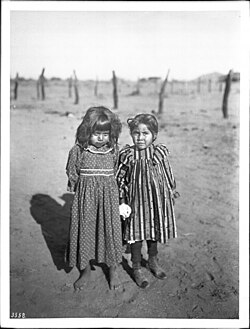
By 1898, traditional agriculture within the GRIC had nearly vanished, leaving woodcutting as the primary livelihood for many. In 1914, the government introduced allotments—the division of communal tribal lands into individual parcels—to break up collective ownership. Initially, individuals received 10-acre irrigable parcels; by 1917, this was doubled to include a secondary 10-acre tract for grazing.
The San Carlos Project Act of 1924 was intended to solve these economic hardships by constructing a water storage dam on the Gila River to irrigate 100,000 acres of land (split equally between Indian and non-Indian use). Instead, the project failed to revitalize the farming economy and effectively halted the flow of the Gila River. This loss of water triggered the "famine years," leading many Oʼodham to view these government policies as an attempt at mass genocide.
Modern Resurgence and Sovereignty
Despite decades of forced assimilation, the post-World War II era has been defined by a resurgence of tribal sovereignty. The Akimel Oʼodham have reclaimed their self-government and are officially recognized as a tribe. Today, the community has diversified its economy through telecommunications, agriculture, and gaming casinos. To ensure future stability, they are currently constructing a reservation-wide water delivery system to revive their ancestral farming economy.
Key Facts
- First Colonial Contact: Father Kino visited Akimel Oʼodham villages in 1694.
- Major Conflict: The Pima Revolt occurred in 1751 against Spanish colonial forces.
- Land Acquisition: The U.S. acquired southern Arizona via the Gadsden Purchase in 1853.
- Community Foundation: The Gila River Indian Community (GRIC) was established in 1859.
- Economic Crisis: The failed San Carlos Project Act of 1924 led to the "famine years" by cutting off river water.
- Modern Recovery: Current efforts focus on tribal sovereignty, gaming, and new water delivery infrastructure.
| Era | Time Period | Key Event/Characteristic |
|---|---|---|
| Hispanic Era | 1694–1853 | First visits by Father Kino; Pima Revolt (1751). |
| Transition Period | 1846–1853 | Mexican-American War; Southern Emigrant Trail growth. |
| American Era | 1853–1950 | Gadsden Purchase; establishment of GRIC (1859). |
| Modern Era | Post-WWII | Resurgence of sovereignty and economic diversification. |
Frequently Asked Questions
What was the Pima Revolt?
The Pima Revolt, also known as the Oʼodham Uprising, took place in 1751. It was a rebellion by the Akimel Oʼodham against colonial Spanish forces in Arizona and was a significant conflict on the northern frontier of New Spain.
How did the California Gold Rush affect the Akimel Oʼodham?
The Gold Rush increased traffic on the Southern Emigrant Trail. Akimel Oʼodham villages served as essential oases where travelers could recover and purchase supplies and livestock for their journey west.
What were the effects of the land allotment policy in 1914?
The allotment policy aimed to break up communal land ownership by assigning individual parcels of land (initially 10 acres of irrigable land) to tribal members.
Why did the San Carlos Project Act of 1924 fail?
While intended to provide irrigation for 100,000 acres, the project effectively halted the Gila River's waters. This deprived the Akimel Oʼodham of their primary water source for farming, leading to a period of famine.
How is the Gila River Indian Community developing today?
The community has regained self-government and developed profitable enterprises in telecommunications, agriculture, and gaming. They are also building a new water delivery system to restore their farming economy.