African Plate: Tectonic Dynamics and Geological Composition
The African plate, frequently referred to as the Nubian plate in scientific literature, is one of Earth's major tectonic plates. It encompasses the vast majority of the African continent, along with significant portions of the surrounding oceanic crust to the south and west. Interestingly, its reach extends beyond Africa to include a narrow strip of Western Asia along the Mediterranean, covering much of Lebanon, Palestine, and Israel.
To distinguish the tectonic plate from the continent itself, geologists use the term Nubian plate. This is necessary because the easternmost part of the African landmass is actually part of a separate entity: the Somali plate.
Key Facts
- Approximate Area: 61,300,000 km² (23,700,000 sq mi).
- Average Speed: Approximately 2.15 cm (0.85 in) per year.
- General Movement: Northeast direction over the last 100 million years.
- Major Boundaries: Bounded by the North American, South American, Antarctic, Somali, Arabian, Eurasian, Aegean Sea, and Anatolian plates.
- Primary Composition: A collection of ancient cratons connected by orogenic belts.
Plate Boundaries and Interactions
The African plate is defined by a complex network of boundaries, most of which are divergent boundaries—areas where plates pull apart from one another.
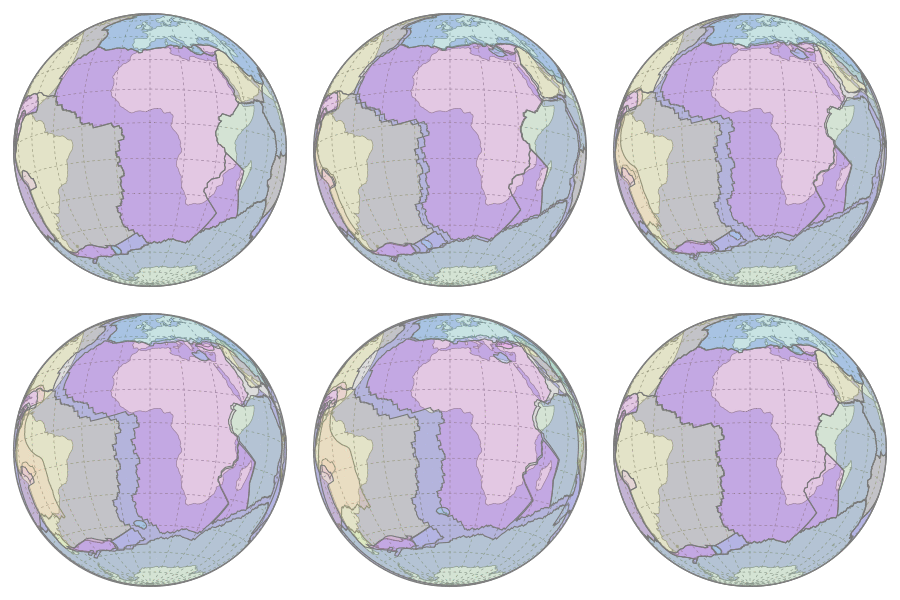
To the west, the plate is separated from the North American and South American plates by the Mid-Atlantic Ridge. To the south, it meets the Antarctic plate at the Southwest Indian Ridge. In the northeast, the Red Sea Rift marks the point where the Arabian plate is moving away from the African plate.
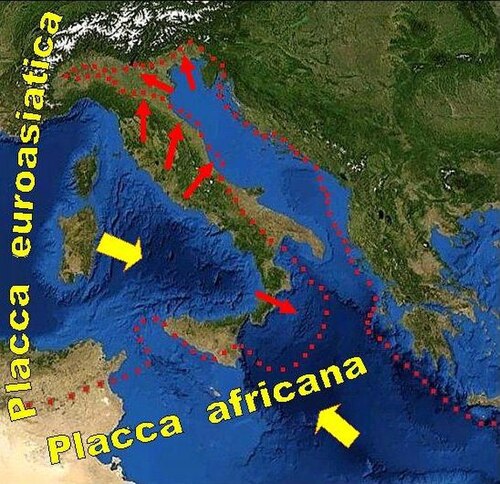
However, the northern boundary is different. Here, the African plate interacts with the Eurasian, Aegean Sea, and Anatolian plates. This region is characterized by convergence, where the African plate pushes toward Eurasia, leading to subduction—a process where one plate sinks beneath another—particularly in the central and eastern Mediterranean.
In the western Mediterranean, these interactions create a mix of compressive and lateral forces, concentrated within the Azores–Gibraltar Fault Zone.
Geological Composition and Structure
The African plate was assembled approximately 250 million years ago during the formation of the supercontinent Pangea. Its structure is composed of several cratons—stable blocks of ancient crust with deep roots in the subcontinental lithospheric mantle—and less stable terranes.
The Major Cratons
From south to north, the plate is anchored by four primary cratons:
- Kalahari Craton
- Congo Craton
- Tanzania Craton
- West African Craton
These blocks were once widely separated but were fused together during the Pan-African orogeny (a period of mountain building) and remained joined even after the breakup of the supercontinent Gondwana. They are linked by orogenic belts, which are regions of highly deformed rock resulting from tectonic collisions.
Other Geological Features
The plate also contains the Saharan Metacraton, which may be a detached craton or a collection of crustal fragments. Additionally, large sedimentary basins—such as the Congo, Taoudeni, and Tindouf basins—overlay the archaic crust with Neoproterozoic sediments. The plate's history is further marked by shear zones, like the Central African Shear Zone (CASZ), and rifts such as the Anza Trough.
Modern Tectonic Movements
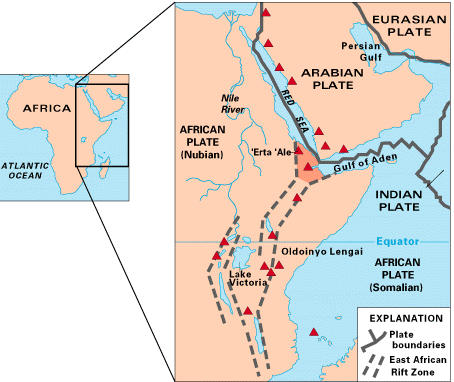
One of the most significant current events is the rifting in the eastern interior of the continent. The East African Rift is actively separating the African (Nubian) plate from the Somali plate. This process began between 60 million and 10 million years ago.
Scientists propose two main theories for this rifting: one suggests a mantle plume (a rising column of hot rock) beneath the Afar region is pushing the crust outward; the other suggests the rift is a result of crustal weakness as eastern plates move rapidly northward.
Additionally, the New England hotspot in the Atlantic Ocean likely created a series of seamounts on the African plate during the mid- to late-Tertiary period, though it is now considered inactive.
Summary of African Plate Characteristics
| Feature | Details |
|---|---|
| Alternative Name | Nubian Plate |
| Total Area | ~61.3 million km² |
| Movement Speed | 2.15 cm/year |
| Primary Direction | Northeast |
| Key Cratons | Kalahari, Congo, Tanzania, West African |
| Active Rift | East African Rift |
Frequently Asked Questions
Why is the African plate also called the Nubian plate?
It is called the Nubian plate to distinguish the tectonic plate from the entire African continent, as the easternmost part of the continent actually belongs to the Somali plate.
What is happening at the East African Rift?
The East African Rift is a divergent boundary where the African plate is splitting apart from the Somali plate, potentially creating a new ocean basin over millions of years.
How does the African plate interact with Europe?
The African plate is moving northeast and pushing into the Eurasian plate. This causes subduction in the central and eastern Mediterranean and creates complex compressive forces in the western Mediterranean.
What are cratons and why are they important to the African plate?
Cratons are stable, ancient blocks of the Earth's crust. The African plate is built around four major cratons (Kalahari, Congo, Tanzania, and West African) that provide the structural foundation of the continent.
What is the Mid-Atlantic Ridge's role?
The Mid-Atlantic Ridge serves as the western divergent boundary of the African plate, where it is moving away from the North American and South American plates.