Adolfo Pedernera: The Legacy of El Maestro
In the golden era of 1940s football, few names commanded as much respect as Adolfo Alfredo Pedernera. Known affectionately as "El Maestro" (The Teacher), Pedernera was more than just a player; he was the intellectual heartbeat of some of the most dominant teams in South American history. A master of the inside forward position—a role that blended playmaking with goalscoring—Pedernera's vision and technique redefined the game in Argentina and Colombia.
Key Facts
- Nickname: El Maestro (The Teacher).
- Major Teams: River Plate, Millonarios, and the Argentina national team.
- Defining Squads: Led "La Máquina" at River Plate and "Ballet Azul" at Millonarios.
- International Success: Won the Copa América in 1941 and 1946.
- Career Total: 417 senior appearances and 170 goals.
- Historical Ranking: Ranked 58th in FourFourTwo's 100 greatest all-time footballers.
Early Career and the Rise of La Máquina
Born on November 15, 1918, in Avellaneda, Argentina, Pedernera's journey began at Cruceros de la Plata before he moved to Club Atlético Huracán. However, it was his move to River Plate in 1933 that catapulted him to stardom. Debuting at just 16 years old in 1935, he quickly became the conductor of a legendary squad known as La Máquina ("The Machine").
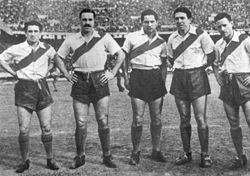
Alongside teammates like Ángel Labruna and José Manuel Moreno, Pedernera led River Plate to five Primera División titles between 1936 and 1945. His ability to create chances for others while remaining a prolific scorer made him one of the most feared players in the world. Despite the interruption of the Second World War, which prevented him from participating in a World Cup, his domestic and continental dominance remained unmatched.
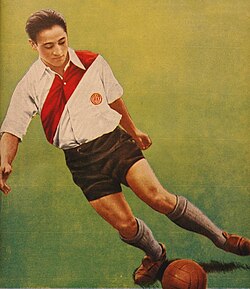
Pedernera's influence extended to the Argentina national team, where he secured Copa América titles in 1941 and 1946, earning the title of the tournament's Best Player in the latter year.
The Colombian Era: Ballet Azul
In 1949, Pedernera embarked on a transformative move to Bogotá, Colombia, joining Millonarios. His arrival was a cultural event, greeted by thousands of fans at the airport. He became the centerpiece of the Ballet Azul ("Blue Ballet"), a team renowned for its elegance and technical superiority.
Teaming up with fellow legends Alfredo Di Stéfano and Néstor Rossi, Pedernera implemented a sophisticated style of play. Di Stéfano famously recalled the "5 and dance" strategy, where the team would stop scoring once they led by five goals to avoid humiliating their opponents. Under Pedernera's guidance as a player-manager from 1951 to 1953, Millonarios won three consecutive championships and the 1953 Copa Colombia.
One of the pinnacle moments of this era was a 1952 tour of Europe, where Millonarios defeated Real Madrid 4–2 at the Santiago Bernabéu Stadium. Pedernera also led the club to victory in the 1953 Small Club World Cup in Venezuela, cementing his status as a pioneer of Colombian football.
Managerial Career and Later Years
After the Lima Pact of 1954 forced "illegal" players to return to their home clubs, Pedernera transitioned more fully into coaching. His managerial resume is extensive, including stints at Nacional (Uruguay), Boca Juniors, Independiente, and América de Cali.
His coaching legacy is a mixture of historic firsts and heartbreak. He is credited with leading the Colombian national team to its first-ever FIFA World Cup qualification in 1962. Conversely, he managed Argentina during the 1970 World Cup qualifiers, where the team failed to qualify for the first time in history following a 2–2 draw with Peru.
In his final years, Pedernera shared his wisdom through his 1993 autobiography, El fútbol que viví ... y que yo siento. He passed away on May 12, 1995, in his birthplace of Avellaneda at the age of 76.
Career Summary
| Team | Years | Appearances | Goals |
|---|---|---|---|
| River Plate | 1935–1946 | 278 | 131 |
| Atlanta | 1947 | 28 | 4 |
| Huracán | 1948–1949, 1954–1955 | 30 | 2 |
| Millonarios | 1949–1954 | 81 | 33 |
| Total | 1935–1955 | 417 | 170 |
Frequently Asked Questions
Why was Adolfo Pedernera called "El Maestro"?
He earned the nickname "The Teacher" because of his exceptional intelligence on the pitch, his technical mastery, and his ability to organize and direct his teammates' movements.
What was "La Máquina"?
La Máquina ("The Machine") was the legendary River Plate attacking line of the 1940s, of which Pedernera was the natural conductor, winning five Argentine league titles.
What was the "5 and dance" strategy?
This was a tactical approach used by Millonarios where they would stop scoring once they reached a five-goal lead to avoid humiliating the opposing team.
Which national teams did Pedernera coach?
Pedernera coached both the Colombian national team, leading them to their first World Cup in 1962, and the Argentine national team.
What was the Small Club World Cup?
The Small Club World Cup (Pequeña Copa del Mundo) was an international club tournament held in Venezuela, which Pedernera and Millonarios won in 1953.