The 2026 Ceuta Migrant Crisis: A Breakdown of the Border Emergency
In late July 2026, the Spanish autonomous city of Ceuta became the epicenter of a massive international incident. An estimated 60,000 people, primarily young men, attempted to cross the border from Morocco into the Spanish enclave, overwhelming local infrastructure and triggering a diplomatic crisis across Europe. The event, characterized by desperate sea crossings and sudden land breaches, has reignited debates over border security, humanitarian obligations, and the stability of the Schengen Area.
Understanding the Spain-Morocco Border Dynamics
The Role of Ceuta and Melilla
Ceuta and Melilla are Spanish autonomous cities located on the North African coast. They represent the only external land borders the European Union shares with Africa. These territories are the subject of a long-standing sovereignty dispute: while Spain considers them integral parts of its national territory, Morocco claims sovereignty over both cities.
Because of their location, these enclaves are frequent focal points for irregular migration. While most migrants typically reach Spain via maritime routes to the Canary Islands, the land borders at Ceuta and Melilla are often used as leverage in diplomatic tensions between Spain and Morocco.
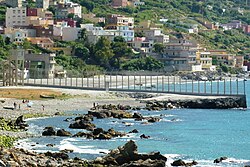
Many migrants attempt to enter by swimming around breakwaters—massive stone structures built into the sea to protect the harbor from waves—to bypass the heavily fortified land fences.
Historical Precedents
The 2026 crisis follows a pattern of periodic surges. In May 2021, approximately 8,000 people entered Ceuta irregularly over two days. That incident was widely viewed as a response to a diplomatic rift caused by Spain's treatment of Brahim Ghali, the secretary-general of the Polisario Front, for COVID-19. More recently, in August 2024 and July 2025, smaller groups of migrants, including unaccompanied minors, exploited fog and poor visibility to swim into the city.
The Catalysts: Legal Rulings and Political Shifts
The End of "Hot Returns"
A critical legal trigger occurred on June 29, 2026, when the Supreme Court of Spain ruled against the use of summary returns (often called "hot returns"). A summary return is a legal procedure that allows authorities to immediately expel migrants intercepted at the border without following the standard, lengthier immigration process.
The court ruled that this expedited process could only be applied to those breaching physical land barriers, such as fences. It could not be applied to migrants intercepted at sea. Spain's Interior Ministry argued that smuggling networks exploited this ruling to encourage more sea crossings, while humanitarian groups noted that such crossings had already been common for years.
Diplomatic Tensions and Amnesty Policies
Political shifts also played a role. In January 2026, Prime Minister Pedro Sánchez authorized a royal decree to regularize approximately 500,000 undocumented migrants. However, the scheme saw an overwhelming response, with nearly 1.2 million people applying for legal status by early July.
Additionally, Spain's foreign relations were in flux. After years of frozen ties over the Western Sahara conflict—where Algeria supports the Polisario Front's independence movement against Moroccan annexation—Spain and Algeria reconciled. Prime Minister Sánchez visited Algeria on July 20, 2026, a move that some analysts suggest may have prompted Morocco to increase border permeability as a form of political pressure.
Timeline of the July 2026 Crisis
The Mass Crossing and Humanitarian Impact
The crisis escalated rapidly in the second half of July. Between July 20 and 29, roughly 1,500 people arrived in Ceuta. By July 30, the situation turned critical as thousands gathered on the coast. On July 31, a massive surge occurred; estimates vary between 49,000 and 60,000 arrivals within a 24-hour window.
The influx completely overwhelmed local reception facilities. Mayor-president Juan Jesús Vivas reported that centers for unaccompanied minors were operating at 2,400% of their capacity. In response, the Spanish government deployed Army units to provide logistical support to the Civil Guard and National Police.
The human cost was severe. At least 57 people died, many from drowning during the swim around the Tarajal and Benzú breakwaters. Rescue operations involving the Red Cross and Maritime Safety teams treated numerous survivors for hypothermia and exhaustion.
Response in Melilla
While the primary surge occurred in Ceuta, Melilla also experienced significant pressure. Groups gathered near the Beni Enzar crossing, leading to clashes with Moroccan security forces. To prevent a mass entry, the Government Delegation ordered the temporary closure of the Beni Enzar crossing, the city's only remaining operational border post with Morocco.
International Fallout and the Schengen Area
The crisis triggered a wave of reactions across Europe, threatening the unity of the Schengen Area—the zone of 29 European countries that have abolished internal border controls.
- France: President Emmanuel Macron expressed solidarity with Spain but announced reinforced border controls between France and Spain to prevent migrants from moving further into Europe.
- Italy: Italy suspended the Schengen agreement with Spain, citing security assessments from its Committee for Migration Analysis and Border Security.
- Northern Europe: The governments of Finland, Czechia, Sweden, Denmark, and Austria supported Italy's call to suspend Spain from the Schengen Area, arguing that Spain had failed its obligation to protect the EU's external borders.
Within Spain, the government faced heavy criticism from the People's Party and other right-wing politicians, who claimed the administration reacted too late and that its migration policies encouraged the surge.
Summary of the 2026 Ceuta Crisis
| Category | Details |
|---|---|
| Estimated Arrivals | 49,000 to 60,000 people |
| Confirmed Deaths | At least 57 |
| Primary Entry Points | Tarajal and Benzú breakwaters (Ceuta); Beni Enzar (Melilla) |
| Key Legal Trigger | Supreme Court ruling against "hot returns" for sea arrivals |
| Major Political Factors | Sánchez's visit to Algeria; 2026 Amnesty Scheme |
| EU Consequences | Border checks by France; Schengen suspension by Italy |