2004 Universal Forum of Cultures: Barcelona's Global Celebration of Diversity
From May 9 to September 26, 2004, the city of Barcelona, Spain, hosted the 2004 Universal Forum of Cultures (Catalan: Fòrum Universal de les Cultures; Spanish: Fórum Universal de las Culturas). This ambitious 141-day international event served as a global platform for dialogue, hosted primarily at the Centre de Convencions Internacional de Barcelona (CCIB) and its surrounding venues.
Conceived by then-Mayor Pasqual Maragall, the Forum was designed to bolster Barcelona's growing tourist industry following the success of the 1992 Olympic Games. It also served as a strategic political move after the city's unsuccessful bid for an international exposition in 1996. The event was organized through a collaboration between Barcelona's city council, the regional government (Generalitat de Catalunya), the Spanish National Government, and UNESCO.
Key Facts
- Duration: 141 days (May 9 – September 26, 2004).
- Location: CCIB and the surrounding seaside area, Barcelona, Spain.
- Core Goals: Promoting peace, sustainable development, human rights, and respect for diversity.
- Scale: Over 40 international conventions and 423 concerts.
- Legacy: The event site is now the public Parc del Fòrum.
Infrastructure and Urban Regeneration
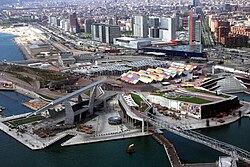
The Forum acted as the culmination of an urban regeneration program that began with the 1992 Olympics. Under the direction of Josep Acebillo, Director for Architecture and Infrastructures, 30 hectares of seaside land between the Barcelona Olympic port and Sant Adrià de Besòs were developed.
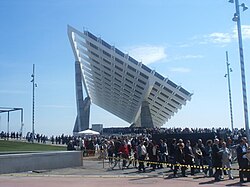
The development was situated at the eastern end of Avinguda Diagonal, a primary cross-city artery. This new district featured a convention center, a central plaza, auditoriums, a new port, and the iconic Forum Building, which was designed by the architectural firm Herzog & de Meuron.
A Global Gathering of Minds and Arts
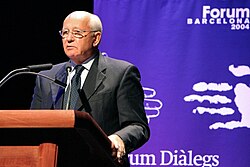
The event was a massive intersection of politics, diplomacy, and the arts. It hosted more than 40 international conventions featuring a diverse array of global figures, including Mikhail Gorbachev, Muhammad Yunus, Angelina Jolie, José Saramago, and Luiz Inácio Lula da Silva.
Beyond political discourse, the Forum was a vibrant cultural hub. The programming included:
- 423 concerts and 57 street performances.
- 44 theatre, dance, and cabaret companies.
- 20 circus acts and over 20 exhibitions.
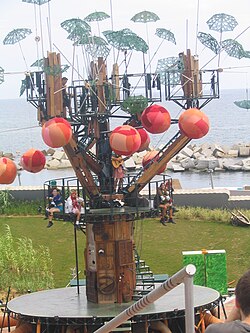
One notable highlight was the performance "L'Arbre de la Memòria" by the group Els Comediants.
The Porto Alegre Forum
Within the broader framework of the event, the 4th Porto Alegre Forum of Local Authorities for Social Inclusion took place, resulting in the approval of the Agenda 21 for culture on May 8, 2004.
Thematic Exhibitions
The Forum featured four primary exhibitions designed to analyze the conditions for peace and sustainable development in the 21st century:
- Voices: Designed by Ralph Appelbaum Associates with creative direction by Mona Kim, this exhibit celebrated linguistic and cultural diversity through the world's languages.
- Inhabiting the World: This study examined the human relationship with the environment, highlighting the impact of urbanization and the high levels of waste and consumption in Western society.
- Cities-Corners: An exploration of urban architecture and growth, featuring models of famous landmarks like New York's Flatiron Building and Barcelona's La Pedrera, as well as studies on megacities such as Cairo, Istanbul, and Bombay.
- Warriors of Xi'an: A showcase of Chinese funerary art, featuring terracotta warriors from the Qin dynasty discovered in the tombs of Yangling and Qinshihuang.
The Legacy: Parc del Fòrum
Today, the infrastructure created for the event has transitioned into a permanent public asset. The central plaza and surrounding open spaces are now known as the Parc del Fòrum. This versatile public area continues to host major annual events, including the Primavera Sound Festival, Summercase, the Catalonia April Fair, and various La Mercè concerts.
| Category | Details |
|---|---|
| Dates | May 9 to September 26, 2004 |
| Organizers | Barcelona City Council, Generalitat de Catalunya, Spanish Government, UNESCO |
| Key Infrastructure | CCIB, Forum Building (Herzog & de Meuron), Parc del Fòrum |
| Major Themes | Peace, Sustainable Development, Human Rights, Diversity |
| Cultural Reach | 423 concerts, 40+ conventions, 20+ exhibitions |
Frequently Asked Questions
What was the primary purpose of the 2004 Universal Forum of Cultures?
The official aims were to support peace, human rights, sustainable development, and respect for cultural diversity, while also promoting Barcelona's tourism industry.
Who were some of the notable participants?
The event hosted a wide range of international figures, including Mikhail Gorbachev, Angelina Jolie, Muhammad Yunus, and Luiz Inácio Lula da Silva.
What happened to the event site after the Forum ended?
The open space and central plaza were converted into a public park called Parc del Fòrum, which now hosts large-scale events like the Primavera Sound Festival.
Which architectural firm designed the Forum Building?
The Forum Building was designed by the renowned architectural firm Herzog & de Meuron.
What were the main themes of the exhibitions?
The exhibitions focused on human communication (Voices), environmental impact (Inhabiting the World), urban development (Cities-Corners), and ancient Chinese art (Warriors of Xi'an).