1st Cavalry Division
The 1st Cavalry Division was a distinguished formation of the British Army that spanned several eras of conflict, evolving from the traditional mounted charges of the Napoleonic Wars to the mechanized warfare of the mid-20th century. Throughout its history, the division served as a versatile tool for the British Crown, alternating between roles as a mobile strike force and reinforced infantry.
Key Facts
- Active Periods: August 1914 – March 1919 and October 1939 – August 1941.
- WWII Strength: Approximately 11,097 men, 6,081 horses, and 1,815 vehicles.
- WWI Role: Part of the British Expeditionary Force (BEF) on the Western Front.
- WWII Transition: Converted into the 10th Armoured Division on August 1, 1941.
- Notable Commander: Edmund Allenby, 1st Viscount Allenby.
Early Origins and the Napoleonic Era
The roots of the division trace back to the Peninsular War, where the Duke of Wellington organized his cavalry under Major-General Sir William Payne in June 1809. Initially, this organization served an administrative purpose rather than a tactical one, as tactical control remained with the brigades. By June 1811, the force was split into two divisions, with the original formation redesignated as the 1st Cavalry Division.
Under the leadership of Major-General (later Lieutenant-General) Stapleton Cotton, who acted as Wellington's chief of cavalry, the division was eventually amalgamated back into a single Cavalry Division in April 1813. The unit was later re-raised for service during the Second Boer War before its most famous deployment in the early 20th century.
The First World War (1914–1919)
The 1st Cavalry Division was among the first British units to deploy to France in August 1914. As part of the British Expeditionary Force (BEF), it remained on the Western Front for the duration of the conflict. The division was utilized as a mounted mobile force for rapid movement, but frequently fought as dismounted troops, effectively serving as infantry in the grueling conditions of trench warfare.
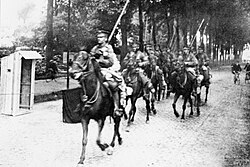
The division participated in nearly every major cavalry engagement of the war, from the early Battle of Mons to the final advances in Artois and Picardy in 1918. Following the armistice on November 11, 1918, the division led the Second Army's advance into Germany, securing the Rhine bridgehead at Cologne by December 6.
WWI Order of Battle
The division's strength was built around three primary brigades:
- 1st Cavalry Brigade: Comprising the 2nd Dragoon Guards, 5th Dragoon Guards, and 11th Hussars.
- 2nd Cavalry Brigade: Comprising the 4th Dragoon Guards, 9th Lancers, and 18th Hussars.
- 9th Cavalry Brigade: Formed in France in April 1915, including the 15th and 19th Hussars, and later the 8th Hussars.
The Second World War (1939–1941)
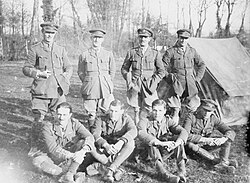
Reformed on October 31, 1939, the 1st Cavalry Division was the only cavalry division in the British Army during World War II. Unlike its WWI predecessor, this formation was composed of Yeomanry Regiments (volunteer cavalry). After departing the UK in January 1940, the division was deployed to Palestine and Trans-Jordan as a garrison force.
In May 1941, the division's headquarters and the 4th Cavalry Brigade were reorganized into Habforce. This specialized task force operated in Iraq to relieve the RAF Habbaniya base and occupy Baghdad. Subsequently, Habforce operated against Vichy French forces in Syria, capturing Palmyra and securing the critical Haditha-Tripoli oil pipeline.
The era of horse-mounted warfare for the division ended on August 1, 1941, when it was converted into the 10th Armoured Division, which later fought in the pivotal Battles of Alam Halfa and El Alamein.
Summary of Division Specifications
| Attribute | First World War | Second World War |
|---|---|---|
| Primary Role | Mobile Force / Dismounted Infantry | Garrison / Specialized Task Force |
| Key Region | Western Front (France/Belgium) | Middle East (Palestine, Iraq, Syria) |
| Composition | Regular Army | Yeomanry Regiments |
| Final Status | Demobilized 1919 | Converted to 10th Armoured Division |
Frequently Asked Questions
What was the role of the 1st Cavalry Division in WWI?
The division served as a mobile force for the British Expeditionary Force on the Western Front, performing both traditional mounted roles and serving as dismounted infantry.
Who was a notable commander of the division?
One of the most prominent commanders was Edmund Allenby, 1st Viscount Allenby, during the First World War.
What was Habforce?
Habforce was a reorganization of the 1st Cavalry Division's headquarters and 4th Cavalry Brigade, used for operations in Iraq and Syria during 1941.
When did the division stop using horses?
The division officially transitioned from horse-mounted cavalry to mechanized warfare on August 1, 1941, when it became the 10th Armoured Division.
Which major battles did the division fight in during WWI?
The division was involved in numerous engagements, including the Battle of Mons, the Battle of the Marne, the First and Second Battles of Ypres, and the final advance in Picardy.