1955 Argentine Coup d'état: The Fall of Juan Perón
The 1955 Argentine coup d'état, known by its architects as the Revolución Libertadora (Liberating Revolution), was a pivotal civic-military uprising that ended the second presidency of Juan Domingo Perón. Occurring within the broader geopolitical context of the Cold War, this event shifted Argentina from a populist government to a military dictatorship, leaving a lasting scar on the nation's political landscape.
Key Facts
- Date: September 16–23, 1955.
- Primary Outcome: Overthrow of President Juan Perón and establishment of a military dictatorship.
- Major Event: The bombing of Plaza de Mayo on June 16, 1955, which killed over 300 civilians.
- Key Figures: Juan Perón (deposed president), Eduardo Lonardi and Pedro Aramburu (coup leaders).
- Immediate Result: Dissolution of the National Congress and the removal of Supreme Court and university authorities.
The Road to Rebellion
Juan Perón first rose to power in 1946 following the end of a military junta. His administration was initially characterized by strong support from labor unions, the military, and the Catholic Church. However, a 1949 constitutional amendment—which introduced labor reforms and allowed for unrestricted presidential reelection—created long-term controversy regarding the government's legitimacy.
By the early 1950s, the political climate began to sour. An early attempt to overthrow Perón occurred on September 28, 1951, led by Benjamín Menéndez. While this rebellion failed within half a day due to a lack of support from non-commissioned officers, it signaled growing unrest within the armed forces.
Several factors contributed to the erosion of Perón's power base:
- Economic Decline: Downturns resulting from foreign trade policies.
- Authoritarianism: The rise of a personality cult, suppression of press freedom, and the persecution of political dissidents.
- Religious Conflict: A breakdown in relations with the Catholic Church, which became openly anti-Peronist by 1954.
- Political Opposition: The formation of the Christian Democratic Party and alliances between the Radical Civic Union, the Socialist Party, and conservative groups.
The June Bombing and Escalation
Tensions reached a breaking point on June 16, 1955. In the largest aerial bombing ever executed on the Argentine mainland, 30 Navy and Air Force aircraft attacked Plaza de Mayo in Buenos Aires. The target was the Casa Rosada (the government seat), where crowds had gathered to support Perón. The attack resulted in over 300 civilian deaths and hundreds of injuries.
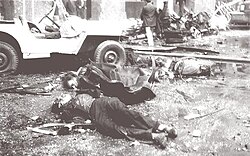
The bombing triggered a violent backlash, with extremist Peronist groups burning several churches. Despite the chaos, Perón maintained the support of the General Confederation of Labour, the nation's primary labor union confederation, which called for workers to defend the presidency.
The September Uprising
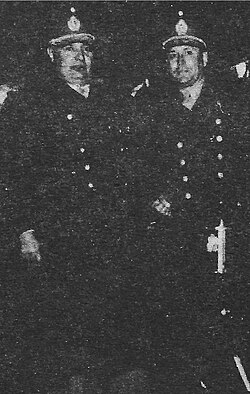
The final blow came on September 16, 1955, when a new uprising led by General Eduardo Lonardi, General Pedro E. Aramburu, and Admiral Isaac Rojas deposed Perón. Fighting broke out across several provinces, including Córdoba and Corrientes, and naval bombardments targeted Mar del Plata.
To avoid a full-scale civil war and massive bloodshed, Perón resigned and sought asylum in Paraguay aboard the ship ARP Paraguay.
The Struggle for Leadership
The transition of power was marked by confusion. On September 19, Perón sent a vague letter to General Franklin Lucero that was interpreted by some as a resignation. This led to the brief formation of a Military Junta presided over by José Domingo Molina Gómez, the highest-ranking general present.
However, the rebel forces in Córdoba, led by Lonardi, demanded a formal resignation before agreeing to a truce. After negotiations aboard the cruiser 17 de Octubre, an agreement was reached. General Eduardo Lonardi officially assumed the provisional presidency on September 23, 1955.
Aftermath and the "Liberating Revolution"
The resulting dictatorship, the Revolución Libertadora, took a hardline approach to erasing Peronism. The regime shut down the National Congress, placed the Judiciary under commission, and banned any public mention of the name "Perón." In a particularly controversial move, the remains of Eva Perón were kidnapped and secretly moved to Italy.
The dictatorship also targeted high-profile figures, including Olympic athletes like Osvaldo Suárez and Delfo Cabrera, accusing them of achieving success only through their ties to Perón. The Peronist Party remained proscribed (legally banned) until 1973.
The military rule lasted until May 1, 1958, when conditional elections transferred power to Arturo Frondizi of the Radical Civic Union. However, the cycle of instability continued, as Frondizi was himself overthrown in another military coup in 1962.
| Category | Details |
|---|---|
| Belligerents | Peronist Government vs. Revolutionary Provisional Government (Military & Opposition) |
| Key Leaders (Rebels) | Eduardo Lonardi, Pedro Aramburu, Isaac Rojas |
| Key Leaders (Loyalists) | Juan Perón, Alberto Teisaire, Franklin Lucero |
| Major Conflict Sites | Buenos Aires (Plaza de Mayo), Córdoba, Corrientes, Mar del Plata |
| Political Outcome | Establishment of the Revolución Libertadora dictatorship |
Frequently Asked Questions
What was the Revolución Libertadora?
It was the self-named civic-military dictatorship that ruled Argentina after overthrowing President Juan Perón in September 1955. The regime was characterized by its intense anti-Peronism and the dissolution of democratic institutions.
Why did the military turn against Juan Perón?
The military was influenced by Perón's increasing authoritarianism, the suppression of civil liberties, the politicization of the armed forces, and a severe conflict with the Catholic Church.
What happened to Eva Perón after the coup?
Her remains were kidnapped by members of the military dictatorship and secretly transported to Italy, where they were buried in Milan under a fake identity to prevent her grave from becoming a site of Peronist pilgrimage.
How did the coup end?
The coup concluded when Juan Perón resigned to avoid a civil war and went into exile. General Eduardo Lonardi was sworn in as the provisional president on September 23, 1955.
Was the 1955 coup the only one during this era?
No. While the 1955 coup was a major turning point, it was part of a pattern of instability; for example, the constitutional government of Arturo Frondizi, which followed the dictatorship, was also overthrown by a military coup in 1962.