1948 Olympic Football Tournament: Sweden's Historic Gold Medal
The football tournament of the 1948 Summer Olympics, hosted by Great Britain, stands as a landmark event in sporting history. Beyond the competition on the pitch, it marked a technological milestone as the first international football tournament ever broadcast on television, with the BBC Television Service providing live coverage of the semi-finals, the bronze medal play-off, and the final.
The tournament saw 18 teams from five confederations compete across 13 venues in three host cities. While many nations sought glory, it was Sweden that emerged triumphant, securing their first and only international title at a senior male football level.
Key Facts
- Champions: Sweden (1st title)
- Runners-up: Yugoslavia
- Third Place: Denmark
- Top Scorers: Gunnar Nordahl and John Hansen (7 goals each)
- Total Goals: 102 goals across 18 matches (average of 5.67 per match)
- Historic Debut: The first international appearance of the legendary Gre-No-Li trio.
The Rise of the Gre-No-Li Trio
Sweden's victory was fueled by a dominant forward line that attracted significant attention, particularly during their matches at White Hart Lane. This squad featured the trio of Gunnar Gren, Gunnar Nordahl, and Nils Liedholm—later known as Gre-No-Li. This legendary group would go on to dominate the Italian league with A.C. Milan during the 1950s.
Sweden's path to the gold was characterized by offensive brilliance, including a staggering 12–0 victory over South Korea in the quarter-finals. Gunnar Nordahl proved to be a powerhouse, finishing the tournament as a joint top scorer.
Tournament Progression and Notable Matches
The competition began on 26 July 1948 with preliminary rounds where Luxembourg defeated Afghanistan 6–0 and the Netherlands beat Ireland 3–1. The first round brought high drama, including a 4–3 extra-time victory for Great Britain over the Netherlands at Highbury. This match featured Ronnie Simpson in goal, who would later become a member of the famous Lisbon Lions and the oldest Scottish international debutant in history.
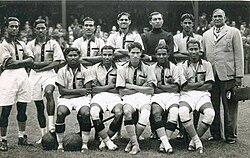
Other notable early results included France eliminating India and South Korea securing a 5–3 win over Mexico. In one of the tournament's most one-sided affairs, Italy defeated the United States 9–0. Interestingly, the U.S. team—featuring players like Walter Bahr and Charlie Colombo—would later shock the world by defeating England in the 1950 FIFA World Cup.
The Road to the Final
As the tournament progressed to the knockout stages, Sweden continued their momentum by defeating South Korea in the quarter-finals and Denmark in the semi-finals. In the other semi-final at Wembley Stadium, Yugoslavia overcame the hosts, Great Britain, with a 3–1 victory.
The bronze medal match saw Denmark edge out Great Britain 5–3 in a high-scoring encounter. This set the stage for the gold medal match on 13 August 1948.
The Gold Medal Match
In the final, Sweden faced Yugoslavia. Sweden secured the gold medal with a 3–1 victory, with goals from Gunnar Gren (including a penalty) and Gunnar Nordahl. This victory cemented Sweden's place in Olympic history.
Tournament Summary
| Category | Details |
|---|---|
| Host Country | Great Britain |
| Dates | 26 July – 13 August 1948 |
| Number of Teams | 18 |
| Total Matches | 18 |
| Champions | Sweden |
| Runners-up | Yugoslavia |
| Third Place | Denmark |
Frequently Asked Questions
Which team won the 1948 Olympic football gold medal?
Sweden won the gold medal, defeating Yugoslavia 3–1 in the final. This remains Sweden's only senior male international football title.
Who were the top scorers of the tournament?
The top scorers were Gunnar Nordahl of Sweden and John Hansen of Denmark, both of whom scored 7 goals.
What was the significance of the Gre-No-Li trio?
The 1948 Olympics marked the first international appearance of Gunnar Gren, Gunnar Nordahl, and Nils Liedholm. They later became a world-famous attacking trio at A.C. Milan in the 1950s.
How was the 1948 tournament a first for media coverage?
It was the first international football tournament to be broadcast on television, with the BBC providing live coverage of the semi-finals, bronze medal match, and the final.
Which match had the highest score in the tournament?
The highest-scoring match was Sweden's 12–0 victory over South Korea during the quarter-finals.