1912 Summer Olympics Football: Great Britain's Golden Triumph in Stockholm
Football at the 1912 Summer Olympics in Stockholm, Sweden, marked the fourth time the sport appeared on the Olympic schedule. As one of 102 events during the Games, the tournament showcased the growing international appeal of the sport, featuring a record number of entries from across Europe.
The competition was managed by the Swedish Football Association, following the precedent set by the English Football Association during the 1908 Games. The tournament took place from June 29 to July 4, 1912, utilizing three primary venues in the Stockholm area: the Olympiastadion, Råsunda Idrottsplats, and Tranebergs Idrottsplats.
Key Facts
- Champions: Great Britain won their 3rd Olympic title.
- Top Scorer: Gottfried Fuchs (Germany) scored a record 10 goals in a single match.
- Total Goals: 94 goals were scored across 17 matches, averaging 5.53 per game.
- Participation: 11 nations competed in the main tournament, with a total of 163 footballers involved.
- Venue Capacity: The Stockholm Olympic Stadium hosted the final with a capacity of 33,000.
Tournament Participation and Logistics
While 14 teams initially entered, the final field was reduced to 11. Bohemia's entry was rejected after their association was voted out of FIFA in 1908. Belgium withdrew two weeks before the draw due to travel availability, and France withdrew shortly after the draw, resulting in a 2–0 awarded victory for their opponents, Norway.
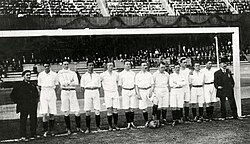
The team representing Great Britain consisted entirely of English players, leading many contemporary reports to refer to them simply as "England."
The Road to the Gold Medal
The tournament began with a dramatic opening match where the hosts, Sweden, were eliminated by the Netherlands in a 4–3 extra-time thriller, decided by a late goal from Jan Vos.
Great Britain entered the contest in the second round, delivering a dominant 7–0 victory over Hungary. The team was captained by Vivian Woodward, a prolific centre-forward from Chelsea and a veteran of the 1908 gold-medal squad. However, the standout performer was Harold Walden, who scored six goals in that single match.
In the semi-finals, Great Britain continued their momentum with a 4–0 win over Finland, with Walden scoring four of the goals. Meanwhile, Denmark secured their place in the final by defeating the Netherlands 4–1.
The final match was a repeat of the 1908 showdown between Great Britain and Denmark. Despite a competitive game, Great Britain secured the gold medal with a 4–2 victory. The match was notably impacted by the lack of substitution rules; Denmark was forced to play with only ten men after Charles Buchwald was stretchered off the pitch in the 30th minute.
The Bronze Medal and Consolation Tournament
The Netherlands secured the bronze medal with a commanding 9–0 victory over Finland. This win cemented their position as the third-best team of the tournament.
Parallel to the main event, a consolation tournament was held for teams eliminated in the first and second rounds. This secondary competition, which did not award official Olympic medals, was eventually won by Hungary.
Individual Brilliance and Records
One of the most remarkable individual feats occurred during the consolation tournament. German player Gottfried Fuchs scored 10 goals in a single match against Russia, equalling the international record set by Sophus Nielsen in 1908. This record remained unbeaten until 2001.
| Position | Team | Played | Goals For | Goals Against | Result |
|---|---|---|---|---|---|
| 1 | Great Britain | 3 | 15 | 2 | Gold |
| 2 | Denmark | 3 | 13 | 5 | Silver |
| 3 | Netherlands | 4 | 17 | 8 | Bronze |
| 4 | Finland | 4 | 5 | 16 | Fourth |
Frequently Asked Questions
Who won the gold medal at the 1912 Olympic football tournament?
Great Britain won the gold medal after defeating Denmark 4–2 in the final.
Who was the top scorer of the tournament?
Gottfried Fuchs of Germany was the top scorer, netting 10 goals in a single match against Russia.
Why did Denmark play with ten men in the final?
Denmark played with ten men because Charles Buchwald was injured in the 30th minute, and the rules of the time did not allow for substitutions.
What was the purpose of the consolation tournament?
The consolation tournament provided additional matches for the seven teams eliminated in the first two rounds of the main competition; it was won by Hungary.
Which venues were used for the matches in Stockholm?
The matches were held at the Stockholm Olympic Stadium (Olympiastadion), Råsunda Idrottsplats, and Tranebergs Idrottsplats.