1940 United States Census: Population Trends and Historical Impact
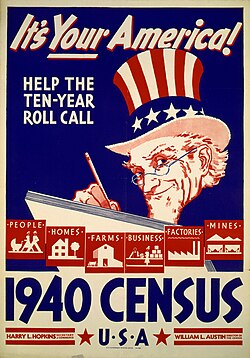
The 1940 United States census, conducted by the Census Bureau with a record date of April 1, 1940, serves as a vital snapshot of American life on the eve of the country's entry into World War II. This sixteenth decennial census recorded a total resident population of 132,164,569 people, marking a 7.6 percent increase from the 1930 population of 122,775,046.
Beyond simple headcounts, the 1940 census was a period of significant methodological evolution. It introduced sampling techniques and the first "long form," a detailed questionnaire sent to a subset of households to gather deeper socioeconomic and housing data. This long form remained a staple of US censuses until 2000, when it was replaced by the American Community Survey.
Key Facts
- Total Population: 132,164,569 (a 7.6% increase since 1930).
- Most Populous State: New York (13,479,142).
- Least Populous State: Nevada (110,247).
- Innovation: First census where all 48 states had populations exceeding 100,000.
- Methodology: Introduced the "long form" and sampling techniques (1 in 20 people).
- Public Release: Personally identifiable records were released on April 2, 2012.
Census Innovations and Data Collection
The 1940 census expanded the scope of information collected to better understand the American workforce and educational landscape. For the first time, the Bureau asked where residents had lived five years prior and requested the highest educational grade achieved.
Standard Information Collected
Every household was asked for basic details, including:
- Name, age, sex, race, and marital status.
- Address and relationship to the head of household.
- Home ownership status (including value if owned or monthly rent if rented).
- Birthplace and citizenship status for foreign-born residents.
- Employment status, including whether work was private, non-emergency government, or public emergency work (such as the WPA, CCC, or NYA).
The Long Form and Sampling
To gather more granular data without burdening every citizen, the Bureau utilized sampling. One in 20 individuals were asked additional questions regarding fertility, age at first marriage, and other specific socioeconomic characteristics. This approach allowed the government to analyze trends in wages, salary income, and hours worked per week more effectively.
Population Distribution and State Rankings
The 1940 data highlights a period of shifting demographics. While New York remained the most populous state, other regions saw dramatic growth. Florida, for example, experienced a 29.2% increase, and California grew by 21.7%.
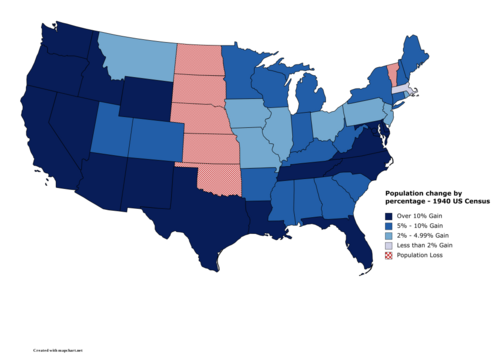
| Rank | State | 1940 Population | 1930 Population | Percent Change |
|---|---|---|---|---|
| 1 | New York | 13,479,142 | 12,588,066 | 7.1% |
| 2 | Pennsylvania | 9,900,180 | 9,631,350 | 2.8% |
| 3 | Illinois | 7,897,241 | 7,630,654 | 3.5% |
| 4 | Ohio | 6,907,612 | 6,646,697 | 3.9% |
| 5 | California | 6,907,387 | 5,677,251 | 21.7% |
| 6 | Texas | 6,414,824 | 5,824,715 | 10.1% |
| 7 | Michigan | 5,256,106 | 4,842,325 | 8.5% |
| 8 | Massachusetts | 4,316,721 | 4,249,614 | 1.6% |
| 9 | New Jersey | 4,160,165 | 4,041,334 | 2.9% |
| 10 | Missouri | 3,784,664 | 3,629,367 | 4.3% |
Data Availability and Privacy
Following the census, original enumeration sheets (the forms filled out by census takers) were microfilmed and the originals destroyed. Under Title 13 of the U.S. Code, personally identifiable information was restricted for 72 years to protect privacy.
On April 2, 2012, the National Archives and Records Administration released these microfilmed images to the public. While the records were initially indexed only by enumeration district, various organizations have since worked to create more detailed indices through crowdsourcing. Non-personally identifiable microdata remains available via the Integrated Public Use Microdata Series (IPUMS).
Controversy: Use in Japanese American Internment
The 1940 census is also remembered for its role in a dark chapter of American history. During World War II, the Census Bureau provided information to government agencies, including the U.S. Army and the U.S. Secret Service, to assist in the internment of Japanese Americans. U.S. Army Lt. Gen. John L. DeWitt explicitly stated that the 1940 Census of Population was the most important single source of information used prior to the evacuations.
Frequently Asked Questions
What was the total population of the U.S. in 1940?
The total resident population was determined to be 132,164,569, which was a 7.6% increase over the 1930 population.
What is the "long form" introduced in 1940?
The long form was a detailed census questionnaire sent to a subset of households to collect additional data on socioeconomic and housing characteristics.
When were the 1940 census records made public?
Microfilmed images of the enumeration sheets were released by the National Archives and Records Administration on April 2, 2012, following a 72-year privacy restriction.
Which state had the largest population in 1940?
New York was the most populous state with 13,479,142 residents.
How was the 1940 census used during World War II?
The Census Bureau provided data to the U.S. Army and Secret Service to facilitate the internment of Japanese Americans.