15th Lancers (Cureton's Multanis)
The 15th Lancers (Cureton's Multanis) was a distinguished cavalry regiment of the British Indian Army that served from 1858 to 1921. Raised during the turmoil of the 1857 uprising, the regiment became known for its unique cultural traditions and its role in critical campaigns across Asia and Europe.
As a single-class regiment, all its troops were recruited from the Punjab region. This shared heritage contributed to a strong internal bond and a distinct identity within the broader British Indian military structure.
Key Facts
- Active Period: 1858–1921.
- Recruitment: Exclusively from the Punjab.
- Notable Campaigns: Second Afghan War and World War I.
- Unique Tradition: Use of the salaam (Muslim salute) instead of the standard military salute.
- Final Fate: Amalgamated in 1921 to form the 20th Lancers.
Origins and Early History
The roots of the regiment trace back to the Second Anglo-Sikh War, where risalas (independent cavalry troops) served under Herbert Edwardes. During the 1857 rebellion, Ghulam Hasan Khan led 300 horsemen to Peshawar to help suppress rebel sepoys. Following the restoration of peace west of the Indus, Khan petitioned for the formal creation of a regiment.
The British agreed, raising a risala of 600 sabres under the command of Captain Charles Cureton. Formally instituted in Lahore in 1858, the unit was originally known as The Multani Regiment of Cavalry. Its first native commandant, Nawab Ghulam Hassan Khan, also held the position of British Political Agent to Afghanistan. By 1859, the regiment expanded by incorporating men from several other units, including the Khakwani Risala, Lind's Multani Horse, and Pathan Horse risalas.
The Multanis were heavily involved in the 1857 Uprising, participating in numerous skirmishes. One of their most celebrated moments was a charge against the cavalry of Prince Firoz Shah, described as one of the finest examples of cavalry shock action during the conflict, though the regiment received no official battle honour for this specific campaign.
Identity and Regimental Traditions
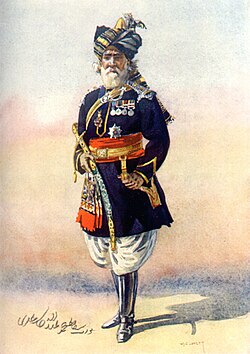
The 15th Lancers maintained a striking visual identity. Their uniforms were blue with scarlet facings. The regimental badge featured two crossed lances and a pennon adorned with a star and crescent; the star was inscribed with "XV" and the crescent bore the words "CURETON'S MOOLTANEES".
Beyond their appearance, the regiment was granted a rare cultural exception. Lord Napier of Magdala permitted the soldiers to perform the salaam—a traditional Muslim gesture of obeisance—rather than the regulation military salute.
Service in World War I
At the start of World War I, the 15th Lancers served as the divisional cavalry for the 3rd (Lahore) Division. After mobilizing on August 9, 1914, and stopping briefly in Egypt, they landed in Marseille on September 26, making them the first British Indian cavalry regiment to arrive in France. They saw action at several major engagements, including Neuve Chapelle, Aubers, Festubert, the battle of Loos, La Bassee, Messines Ridge, Givenchy, and the battle of St Julien.
In 1915, the regiment was redeployed to the Middle East. Upon landing at Basra, a significant internal conflict arose: 429 soldiers refused to fight the Turks in the Holy Land of Islam, though they agreed to serve elsewhere. This led to the regiment being sent to Persia to patrol the East Persia Cordon, a strategic line designed to block German and Turkish agents from infiltrating Afghanistan.
The refusal to fight in the Holy Land resulted in heavy penalties for 329 soldiers, though most were later commuted except for the ringleaders. Due to these events and a lack of reinforcements, two Jat squadrons were added to the regiment in 1916.
Amalgamation and Legacy
Following the war, the British Indian Army underwent a reduction in cavalry. In 1921, the 15th Lancers were amalgamated with the 14th Murray's Jat Lancers at Sialkot to form the 20th Lancers. The 20th Lancers were later de-listed in 1937 to become the Indian Armoured Corps Training Centre at Lucknow. In 1956, both India and Pakistan re-raised successor regiments.
It is important to note that a separate "15th Lancers" was raised in 1921 through the merger of the 17th Cavalry and 37th Lancers; this new unit was entirely distinct from Cureton's Multanis.
Regimental Summary
| Category | Details |
|---|---|
| Active Years | 1858–1921 |
| Recruitment Area | Punjab |
| Uniform | Blue with scarlet facings |
| Battle Honours | Afghanistan 1878–80, Neuve Chappelle, France and Flanders 1914–15, Persia 1916–19 |
| Successor Unit | 20th Lancers (via amalgamation) |
Frequently Asked Questions
Why were the 15th Lancers unique in their salute?
The regiment was permitted by Lord Napier of Magdala to use the salaam, a traditional Muslim gesture of obeisance, instead of the standard British military salute.
What happened to the soldiers who refused to fight in the Holy Land?
Of the 429 soldiers who refused to fight the Turks in the Holy Land, 329 received heavy penalties, although most of these were later commuted, except for the ringleaders.
Which was the first British Indian cavalry regiment to land in France during WWI?
The 15th Lancers (Cureton's Multanis) were the first, disembarking in Marseille on September 26, 1914.
What was the purpose of the East Persia Cordon?
The cordon was a patrolling operation intended to prevent German and Turkish agent-provocateurs from infiltrating Afghanistan.
How did the regiment's name change over time?
The unit evolved from Independent Risalas of Pathan Horse (1857) to the Multani Regiment of Cavalry (1858), eventually becoming the 15th Lancers (Cureton's Multanis) by 1903 before its 1921 amalgamation.