155 mm Creusot Long Tom: The Heavy Artillery of the Second Boer War
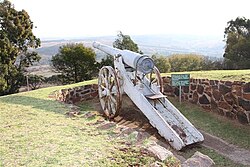
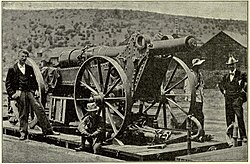
The 155 mm Creusot Long Tom was a formidable French-made siege gun that became a symbol of Boer artillery power during the Second Boer War. Manufactured by Schneider et Cie in Le Creusot, France, these massive weapons provided the South African Republic (the Transvaal) with a significant tactical advantage in range and firepower over the British forces during the early stages of the conflict.
In 1897, the Transvaal government purchased four of these guns, accompanied by a vast stockpile of 4,000 common shells, 4,000 shrapnel shells, and 800 case shot. Initially, they were stationed in four strategic forts protecting the capital, Pretoria.
Key Facts
- Manufacturer: Schneider et Cie, Le Creusot, France.
- Caliber: 155 millimeters (15.5 cm).
- Maximum Range: 9,880 metres.
- Weight: Total mass of 6,500 kilograms.
- Crew: One warrant officer (commander) and six gunners.
- Rate of Fire: 20 rounds per hour.
Technical Design and Operation
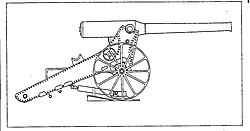
The Long Tom was a breech loader—a type of artillery where the projectile is loaded through the rear of the barrel—consisting of a 4.2-metre barrel weighing 2,500 kg and a separate carriage weighing 3,000 kg.
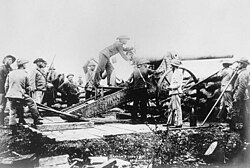
To ensure accuracy and stability, the gun was mounted on a specialized wooden platform measuring 4.5 m by 4.5 m. This platform consisted of three layers of beams placed at right angles to one another. A pivot plate and a hydraulic recoil cylinder were used to manage the force of the blast, while chocks were placed behind the wheels to further limit recoil.
Transport and Logistics
Moving the Long Tom was a massive logistical undertaking. To prepare for transport, a large tripod and block and tackle were used to shift the barrel from the front to the back trunnion cups. The carriage was then placed on a limber and pulled by 16 to 20 oxen over hard soil. Additional wagons were required to transport the heavy wooden platform and the ammunition.
Ammunition and Ballistics
The gun utilized black powder propellant carried in canvas bags. While powerful, this created a dense cloud of white smoke upon firing, which inadvertently revealed the gun's position to the enemy.
| Shell Type | Weight | Range | Purpose/Notes |
|---|---|---|---|
| Common Shell | 43 kg | 9,880 m | Filled with MC 30 explosive. |
| Fragmentation Shell | 41 kg | 6,800 m | Used percussion and time fuses. |
| Case Shot | N/A | Up to 400 m | Last resort for close-range infantry. |
Combat History in the Second Boer War
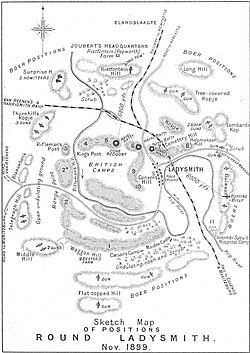
The Long Toms were deployed as both field and siege guns at several critical locations, including Vaal Krantz, Ladysmith, Mafeking, Kimberley, and Bergendal. Their superior range initially allowed the Boers to outgun British artillery.
The Siege of Mafeking
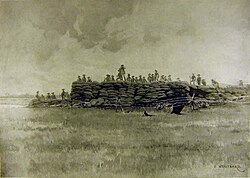
Arriving on 23 October 1899, the Long Tom at Mafeking was positioned at Jackal Tree Hill. Throughout the siege, the gun was moved seven times to evade counter-fire and change angles. By the time it returned to Pretoria in April 1900, it had fired nearly 1,500 shells into the town.
![Long Tom "Grietjie" (or "Creaky") was i.a. placed on a constructed platform south of Jackal Tree Hill, to the south of Mafeking. It was however moved 7 times during the siege.[5]](/images/05/25/05259e47a29d8d94fc8a20f00df5e25189a7b02781e81b0921204963a6a37c89.jpg)
Ladysmith and Vaal Krantz
At Ladysmith, the Boers utilized three Long Toms across Pepworthy, Bulwana, and Middle Hills. One gun was eventually damaged by a British commando attack using gun cotton. Another was moved to "Doringkop" (Thorn Hill) during the Battle of Vaal Krantz, where it began firing on 6 February 1900 despite the difficulty of hauling the gun up the steep slope.
Kimberley and "The Jew"
One gun, damaged at Ladysmith and repaired by cutting off the front of its muzzle, became known as "The Jew." It was deployed at Kimberley on a mine dump near Kamfers Dam in February 1900.
The Battle of Bergendal and Long Tom Pass
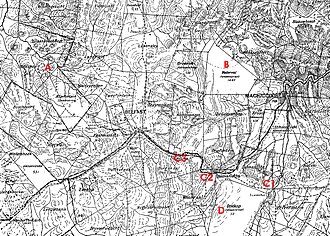
The Battle of Bergendal in August 1900 was the only engagement where all four Long Toms were used simultaneously. Following this, the guns retreated toward Lydenburg. During the pursuit, the guns fired from a mountain pass, which was subsequently named Long Tom Pass.
The End of the Long Toms
To prevent the weapons from falling into British hands, the Boers destroyed the guns one by one as their ammunition ran out:
- Komatipoort: Destroyed on 22 September 1900 near the Komati River.
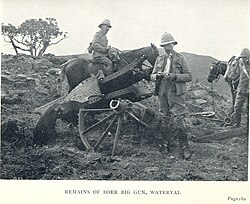
- Letaba River: Destroyed on 18 October 1900; remains were thrown into the river (now under the Ebenezer Dam).
- Rietfontein: "The Jew" was blown up by its crew on 16 April 1901.
- Feeskoppie: The final gun was destroyed on 29 April 1901 near Haenertsburg.
Frequently Asked Questions
Who manufactured the Long Tom guns?
The guns were manufactured by Schneider et Cie in Le Creusot, France, and were likely designed by De Bange.
Why was the gun called "The Jew"?
One specific gun earned this nickname after it was damaged by British forces and repaired in Pretoria by cutting off the front end of its muzzle.
What was the maximum range of a Long Tom?
The maximum firing range of the 155 mm Creusot Long Tom was 9,880 metres.
How were the guns transported across the South African terrain?
The guns were transported using a limber pulled by 16 to 20 oxen, with additional wagons used to carry the heavy wooden platform and ammunition.
Where can replicas of the Long Tom be seen today?
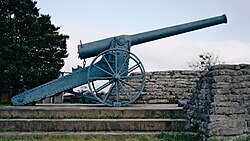
Replicas are located at Fort Klapperkop near Pretoria, the Long Tom Pass in Mpumalanga, the Anglo-Boer War Museum in Bloemfontein, and in Ladysmith.