129th Duke of Connaught's Own Baluchis
The 129th Duke of Connaught's Own Baluchis was a distinguished infantry regiment with a storied history spanning over a century of global conflict. From its origins in the mid-19th century under the British Indian Army to its current role within the Pakistan Army, the regiment has earned a reputation for resilience and bravery across three continents.
Key Facts
- Founded: May 6, 1846, in Karachi by General Sir Charles Napier.
- Lineage: Evolved from the 2nd Bellochee Battalion to the 11th Battalion of The Baloch Regiment.
- Notable Honor: Produced Sepoy Khudadad Khan, the first Indian to receive the Victoria Cross.
- Global Service: Fought in Persia, China, Japan, Africa, Europe, and the Middle East.
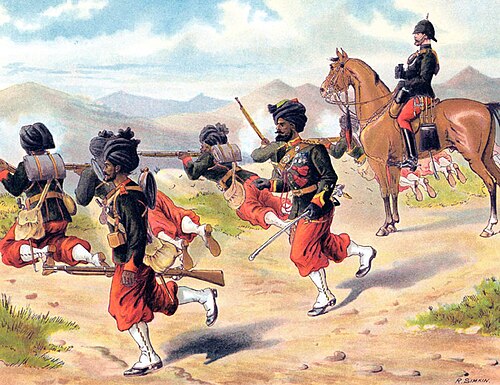
- Distinctive Uniform: Known for rifle green tunics and iconic red trousers.
Foundations and Early Campaigns
The regiment was established in 1846 as the 2nd Bellochee Battalion. Its initial ranks were primarily composed of Balochis, Sindhis, and Pathans from Sindh, later expanding to include Brahuis and Punjabi Muslims. This diverse recruitment base extended across Baluchistan, the Punjab, and the North-West Frontier Province.
The unit's early years were marked by rapid deployment to foreign theaters. In 1856, they were dispatched to Persia for the Anglo-Persian War. Following the realignment of the army in 1861, they became the 29th Regiment of Bombay Native Infantry (or the 2nd Belooch Regiment). By 1862, the regiment was deployed to China to suppress the Taiping Rebellion, and shortly thereafter, they became the first foreign troops stationed in Japan, guarding the British legation in Yokohama.
Expansion and Royal Patronage
The late 19th century saw the regiment engage in the Second Afghan War (1878–1880) and the Anglo-Egyptian War of 1882. A significant milestone occurred in 1883 when the Duke of Connaught was appointed as the Colonel-in-Chief, adding royal prestige to the unit.
The 129th DCO Baluchis in the World Wars
In 1903, Lord Kitchener implemented reforms in the British Indian Army, adding 100 to the numbers of all former Bombay Army units. Consequently, the regiment was redesignated as the 129th Duke of Connaught's Own Baluchis. By 1912, General Sir Garrett O'Moore Creagh, a former commanding officer, was appointed Colonel of the regiment.
During the First World War, the 129th DCO Baluchis served on the Western Front in France and Belgium. They hold the distinction of being the first Indian regiment to attack German forces. It was during the First Battle of Ypres at Hollebeke that Sepoy Khudadad Khan earned the Victoria Cross, the highest British award for valor.
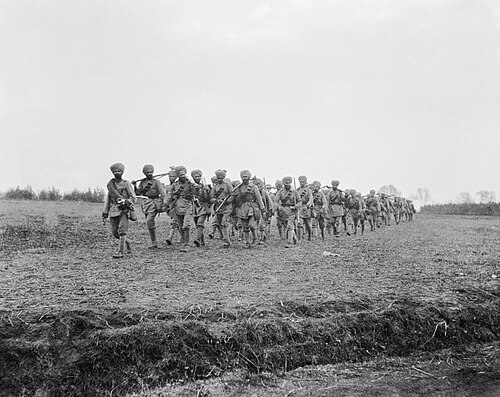
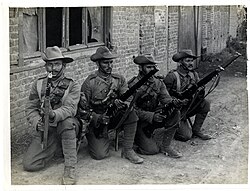
The regiment's service extended beyond Europe to German East Africa, where their efficiency was praised by the German commander, General von Lettow-Vorbeck. However, the cost of war was severe; the regiment suffered 3,585 casualties out of 4,447 personnel, including 348 deaths.
Interwar Period and World War II
Following the First World War, the regiment fought in the Third Afghan War (1919) and the Iraqi revolt of 1920. In 1922, the unit was reorganized as the 4th Battalion (Duke of Connaught's Own) 10th Baluch Regiment.
During the Second World War, the 4/10th Baluch operated in North Africa, Italy, and Italian East Africa. Their performance remained commendable, though it came at the cost of 1,677 casualties and numerous gallantry awards.
Transition to the Pakistan Army
With the Partition of India in 1947, the battalion was allocated to the Pakistan Army. They immediately entered active service during the 1948 Indo-Pakistan War, where they successfully captured the strategic heights of Pandu in Kashmir. In 1956, following a merger with the 8th Punjab and Bahawalpur Regiments, the unit was redesignated as the 11th Battalion of The Baloch Regiment (11 Baloch).
The battalion continued to serve with distinction during the Indo-Pakistani Wars of 1965 and 1971, specifically within the Zafarwal and Lahore sectors.
Regimental Summary
| Period/Year | Designation | Primary Affiliation | Key Conflict |
|---|---|---|---|
| 1846–1903 | 2nd Belooch / 29th Bombay Native Infantry | British Indian Army | Anglo-Persian War, Taiping Rebellion |
| 1903–1922 | 129th Duke of Connaught's Own Baluchis | British Indian Army | World War I |
| 1922–1947 | 4th Battalion, 10th Baluch Regiment | British Indian Army | World War II |
| 1947–Present | 11th Battalion, The Baloch Regiment | Pakistan Army | Indo-Pakistani Wars |
Uniforms and Identity
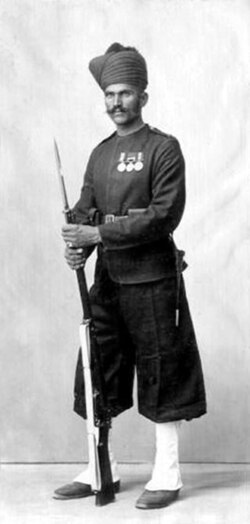
The regiment's visual identity was striking. The full dress featured a rifle green turban and knee-length tunic (kurta) with red facings. The most distinctive element was the wide, red "knickerbocker" style trousers, a trait shared by all five Baluch infantry regiments of the time. British officers wore green rifle-pattern tunics with silver pouch-belts. While khaki drill uniforms were introduced around 1880, they became the standard field dress after 1914.
Frequently Asked Questions
Who was the first Indian to win the Victoria Cross?
Sepoy Khudadad Khan of the 129th DCO Baluchis was the first Indian soldier to be awarded the Victoria Cross, achieving this honor during the First Battle of Ypres at Hollebeke.
What was the significance of the red trousers?
The red trousers were a distinctive uniform feature worn by all five Baluch infantry regiments serving in the British Indian Army, distinguishing them from other units.
How did the regiment's name change over time?
It began as the 2nd Bellochee Battalion (1846), became the 129th Duke of Connaught's Own Baluchis (1903), then the 4th Battalion 10th Baluch Regiment (1922), and finally the 11th Battalion of The Baloch Regiment (1956).
Where did the regiment serve during World War I?
The regiment served on the Western Front in France and Belgium, and later campaigned in German East Africa.
Which modern army does the regiment belong to?
Following the Partition of India in 1947, the regiment was allocated to the Pakistan Army, where it continues to serve as part of The Baloch Regiment.