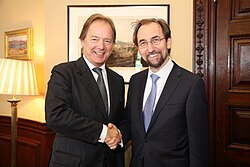
Zeid Ra'ad Al Hussein and the UN High Commissioner for Human Rights
The role of the United Nations High Commissioner for Human Rights is one of the most critical positions in global diplomacy, tasked with monitoring and advocating for the fundamental rights of all people. During his tenure, Zeid Ra'ad Al Hussein utilized this platform to confront systemic violence, challenge state-sponsored atrocities, and advocate for a global shift in how human rights are taught to future generations.
Key Facts
- Core Advocacy: Championed human rights education for all children starting before age nine.
- Major Critiques: Strongly condemned the Islamic State (ISIS), Saudi-led interventions in Yemen, and post-coup purges in Turkey.
- Legal Stance: Asserted that the U.S. must prosecute those responsible for CIA torture under international law.
- Honors: Appointed Honorary Knight Commander of the Order of St Michael and St George (KCMG) and inducted into the American Academy of Arts and Sciences in 2019.
Combating Extremism and the "House of Blood"
In September 2014, during his maiden speech to the 47-member Human Rights Council in Geneva, Zeid issued a scathing critique of the Islamic State (ISIS). He described the group's vision as a "house of blood," characterized by beheadings, rape, and torture. He specifically highlighted the nature of a Takfiri state—referring to the practice of declaring other Muslims as apostates or "excommunicators"—warning that such a regime would offer no shelter or mercy to non-believers.
Drawing parallels to the Holocaust, Zeid argued that history teaches us that pursuing narrow political or religious ideologies at the expense of others eventually leads to horror for everyone. He proposed a systemic solution: universal human rights education. By introducing values of equality, justice, and respect in kindergarten—across secular schools, Catholic parochial schools, and Islamic madrassahs—he believed the world could prevent future atrocities.
Addressing Global Human Rights Violations
Zeid's mandate extended to numerous conflict zones and political crises. He reported to the Security Council on the situations in Iraq, Ukraine, Gaza, and Venezuela, emphasizing that moral courage is required to ensure equality for all. He warned that the horrors seen in South Sudan, the Central African Republic, and Syria are never far away, and that children must be taught to recognize how blind obedience can be exploited by authority figures for wicked ends.
Accountability and International Law
The Commissioner was vocal about the necessity of legal accountability. He stated that the United States had a clear obligation under international law to prosecute all individuals involved in CIA torture, including both the interrogators and the high-level policy-makers who authorized the actions.
Regional Conflicts and State Actions
- Yemen: In 2015, Zeid criticized the Saudi Arabian-led intervention, suggesting the coalition may have committed war crimes and lamenting the Human Rights Council's failure to launch an international investigation.
- Turkey: While opposing the 2016 coup d'état attempt, he condemned the subsequent wide-ranging purges as an alarming "thirst for revenge."
- Iran: He strongly criticized the execution of juveniles, specifically citing the case of Hassan Afshar, describing such death sentences as abhorrent.
- Kashmir: He expressed deep regret over the UN Human Rights Office's inability to gain access to the region despite reports of state-sponsored violence.
Internal Challenges and Public Advocacy
Zeid's tenure was not without internal controversy. In April 2015, he placed Anders Kompass, the OHCHR field operations director, on administrative leave after Kompass shared an internal report regarding the sexual abuse of children by French UN peacekeepers in the Central African Republic. This decision was later overturned by the United Nations Dispute Tribunal, which found the leave to be "prima facie unlawful."
Beyond official reports, Zeid used his voice to combat dehumanizing language. He criticized a column by Katie Hopkins in The Sun that referred to migrants as "cockroaches," comparing such rhetoric to the propaganda used by the Nazis and the perpetrators of the Rwandan genocide.
Legacy and Recognition
Zeid's commitment to human rights was evident in his reaction to the death of Liu Xiaobo, the Chinese Nobel Peace Prize laureate. He praised Liu as a principled champion who devoted his life to the peaceful promotion of human rights despite being jailed for his beliefs.
| Issue/Region | Zeid's Position/Action | Key Concern |
|---|---|---|
| ISIS | Condemned as a "house of blood" | Takfiri extremism and massacres |
| Education | Proposed universal HR education | Prevention of future atrocities |
| Yemen | Reported potential war crimes | Climate of impunity |
| USA | Called for CIA torture prosecutions | International law compliance |
| Iran | Opposed juvenile executions | Human rights of minors |
Frequently Asked Questions
What did Zeid mean by a "house of blood"?
He used this term to describe the envisioned state of the Islamic State (ISIS), arguing that their reliance on Takfiri ideology—excommunicating others—would result in a regime defined by slaughter, torture, and a total lack of shelter for non-believers.
What was Zeid's proposal for preventing future genocides?
He proposed that every child in the world receive human rights education before the age of nine, regardless of whether they attend secular schools, Catholic schools, or Islamic madrassahs, to instill values of equality and respect from a young age.
How did Zeid view the role of the United States regarding CIA torture?
He asserted that the U.S. was obligated under international law to prosecute everyone involved in the torture programs, from the personnel conducting the interrogations to the high-ranking officials who issued the orders.
What was the controversy regarding Anders Kompass?
Zeid placed Kompass on administrative leave after he leaked a UN report about child sexual abuse by French peacekeepers in the Central African Republic. The UN Dispute Tribunal later ruled this action unlawful, and the decision was reversed.
What honors did Zeid receive in 2019?
In 2019, he was appointed as an Honorary Knight Commander of the Order of St Michael and St George (KCMG) and was inducted into the American Academy of Arts and Sciences.