ZBW German National Library of Economics: The World's Largest Economic Research Infrastructure
The ZBW – Leibniz Information Centre for Economics (formerly the Deutsche Zentralbibliothek für Wirtschaftswissenschaften) stands as the most extensive research infrastructure for economic literature globally. Operating both online and offline, the ZBW provides an essential foundation for researchers, students, and business professionals seeking authoritative data on economics, finance, and business.
As a member of the Leibniz Association and a foundation under public law since 2007, the ZBW is renowned for its innovation in librarianship, having received the international LIBER Award multiple times. By partnering with over 40 research institutions, it fosters a connected social web of research through an Open Access portal—a movement dedicated to making scholarly research freely available to the public.
Key Facts
- Established: 1919
- Total Holdings: 4.43 million items and 27,119 journal titles
- Locations: Main branches in Kiel and Hamburg, Germany
- Key Portals: EconBiz (search portal) and EconStor (repository)
- Budget: €22.56 million
- Staff: 280 employees under Director Klaus Tochtermann
History and Evolution
Founded on February 1, 1919, as a department of the Kiel Institute for the World Economy, the ZBW began as a specialized research library. Its importance grew in 1966 when it was designated as Germany's central subject library for economics, receiving joint funding from the Federal and Länder Governments.
The institution joined the Leibniz Association in 1990 and achieved independence as a public law foundation in 2007. This transition included the integration of the Hamburg Institute of International Economics' library and the acquisition of the journals Wirtschaftsdienst and Intereconomics.
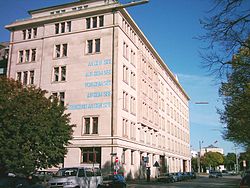
In recent years, the ZBW has expanded its physical and digital footprint, maintaining off-site stacks in Flintbek since 2012 and establishing a dedicated research arm for computer and information science in 2010. Its commitment to modernization was recognized in 2014 when the German Library Association (DBV) named it Library of the Year.
Collection Mandate and Holdings
The ZBW serves as Germany's central hub for economic information. Its primary mandate is to acquire, index, and archive theoretical and empirical literature in economics and business studies. To support the modern trend of interdisciplinary research, the library also collects publications from closely related auxiliary disciplines.
The scale of the collection is immense, comprising nearly 4.4 million items. The library provides access to 2.3 million electronic documents and subscribes to over 27,100 journals. To ensure high-quality discovery, the ZBW uses the Standard Thesaurus for Economics to create detailed metadata and keywords for books, journal articles, and working papers.
Digital Services and Open Science
The ZBW is a pioneer in Open Science—the practice of making scientific findings and processes transparent and accessible. This is achieved through several key digital tools:
- EconBiz: A search portal providing free access to over 10 million datasets of bibliographic references.
- EconStor: A free repository where over 400 institutions publish working papers and journal articles. It serves as a major input for RePEc and is indexed by Google Scholar and WorldCat.
- EconDesk: An online reference service that guides users through complex literature and data searches.
- ZBW Journal Data Archive: A specialized service allowing editors to deposit datasets to ensure the reproducibility of empirical research.

Strategic Projects and Research
The ZBW conducts application-oriented research in computer and information science, focusing on how Web 2.0 applications transform the research process. Key projects include:
- GeRDI (Generic Research Data Infrastructure): A DFG-funded project creating a linked-up infrastructure for research data across Germany.
- LOC-DB (Linked Open Citation Database): Utilizing linked data technologies to automate the indexation of citations.
- Digital Preservation: A collaborative effort with TIB and ZB MED to ensure digital resources remain readable as hardware and software evolve.
- da|ra: A registration agency developed with GESIS to make social science and economic research data identifiable and replicable.
Institutional Overview
| Feature | Details |
|---|---|
| Primary Scope | Economics, Finance, Business |
| Kiel Location | Düsternbrooker Weg 120, 24105 Kiel |
| Hamburg Location | Neuer Jungfernstieg 21, 20354 Hamburg |
| Key Publications | Wirtschaftsdienst, Intereconomics |
| Affiliation | Leibniz Association |
Frequently Asked Questions
What is the difference between EconBiz and EconStor?
EconBiz is a search portal used to find bibliographic references and datasets across a vast array of economic literature. EconStor is a digital repository specifically for the free publication and archiving of full-text research outputs, such as working papers and articles.
Who can access the ZBW's resources?
The ZBW serves a diverse population, including professional researchers, business clients, students, and the general public.
What is the ZBW's role in Open Access?
The ZBW is a leading advocate for Open Access in Germany, acting as the chief negotiator for national licenses in economics and providing free platforms like EconStor for the dissemination of scholarly work.
How does the ZBW ensure research can be reproduced?
Through the ZBW Journal Data Archive, the library allows editors and authors to deposit the raw datasets used in empirical articles, enabling other scientists to verify and reproduce the findings.
Where is the ZBW located?
The ZBW operates two main branches in Germany: one in Kiel (Düsternbrooker Weg 120) and one in Hamburg (Neuer Jungfernstieg 21).