Yulia Tymoshenko and the 2009 Gas Case: A Legal and Political Timeline
The 2009 gas dispute between Ukraine and Russia culminated in one of the most controversial legal battles in Ukrainian history. At the center of this conflict was Yulia Tymoshenko, the former Prime Minister of Ukraine, who faced severe criminal charges over a natural gas imports contract signed with Russia. What began as a diplomatic effort to restore energy flows to Europe evolved into a years-long judicial saga involving allegations of power abuse and claims of political persecution.
The Origins of the Gas Case
The roots of the case lie in the severe energy crisis of January 2009, when Russia cut gas supplies to Ukraine and western Europe. This freeze significantly impacted countries including Hungary, Slovakia, Bulgaria, Romania, Germany, France, and Italy. Under intense pressure from the European Union and western leaders to resolve the crisis, Tymoshenko reached an agreement of principle with Russian Prime Minister Vladimir Putin in Moscow on January 17, 2009.
On January 19, 2009, the national joint stock company Naftogaz (Ukraine's state-owned gas company) and Gazprom (Russia's state-owned energy giant) signed the contract. The Ukrainian cabinet officially confirmed the contracts on January 21, and gas flows were fully restored by January 22.
Legal Charges and the Prosecution
On June 24, 2011, the Ukrainian General Prosecutor’s Office delivered a ruling to sue Tymoshenko under Article 365, Part 3 of the Criminal Code of Ukraine. She was accused of abuse of office or exceeding her authorities, which carried a potential sentence of 7 to 10 years of imprisonment. The prosecution claimed she acted in her personal interest and accepted unfavorable conditions for Ukraine during negotiations.
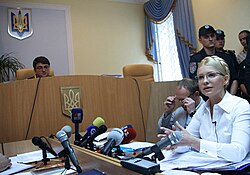
The trial began in Kyiv on June 24, 2011. The proceedings were marked by significant controversy regarding the admission of witnesses. While the prosecution planned to call 38 witnesses, the judge admitted only two out of 33 requested witnesses for the defense: Alexander Turchinov and Michail Lyvinsky.
Key Witness Testimonies
Several testimonies challenged the prosecution's narrative. Oleg Dubina, the former head of Naftogaz, testified that the 2009 agreement allowed Ukraine to terminate the contract at any time without penalty sanctions from Russia. He also confirmed that the gas price was based on a standard formula linked to the price of oil.
Furthermore, witnesses including Dubina and Turchinov suggested that former President Viktor Yushchenko had undermined the original price agreement of $235 per thousand cubic meters by recalling Dubina from Moscow. Later, reports from Kremlin representatives suggested that Yushchenko had previously expressed full trust in Tymoshenko's authority to conclude the agreements.
Expert Findings
Vladimir Nagrebelny, deputy director of the Koretzky Institution of State and Law, provided an expert conclusion on August 15, 2011. He stated that Tymoshenko did not exceed her authorities and that her directives were necessary means for implementing her official duties.
Conviction and Imprisonment
On October 11, 2011, the court found Tymoshenko guilty of abuse of power. She was sentenced to seven years in prison and ordered to pay the state $188 million. Following her arrest, she was held at Lukyanivska Prison, where her defense reported she suffered from pneumonia and physical bruising.
Tymoshenko appealed the verdict, comparing the process to "Stalin's Great Terror." Despite attempts by opposition politicians to decriminalize abuse of office, the Ukrainian Parliament voted against such changes in November 2011 and February 2012. After losing her appeal on December 23, 2011, she was transferred to the Kachanivska penal colony in Kharkiv.
International Perspective and Final Resolution
The Parliamentary Assembly of the Council of Europe (PACE) examined the case in a 2013 report. PACE noted that the deal was reached during a severe crisis and highlighted that the court judgment ignored the fact that the Ukrainian cabinet had approved the deal. Consequently, PACE recognized Tymoshenko as a presumed political prisoner.
Tymoshenko also lodged a complaint with the European Court of Human Rights (ECHR), which granted the case priority treatment. After several failed cassation appeals in Ukraine, the legal tide turned following the Ukrainian revolution of November 2013-February 2014.
On April 14, 2014, the Supreme Court of Ukraine, sitting en banc, reversed the conviction and closed the case, ruling that no crime was committed.
Key Facts
- Charge: Abuse of office under Article 365 of the Criminal Code of Ukraine.
- Sentence: 7 years imprisonment and a $188 million fine (later overturned).
- Context: The 2009 gas crisis that cut supplies to Ukraine and several EU nations.
- PACE Finding: Recognized Yulia Tymoshenko as a presumed political prisoner.
- Final Outcome: Conviction reversed by the Supreme Court of Ukraine on April 14, 2014.
| Date | Event | Outcome/Detail |
|---|---|---|
| Jan 19, 2009 | Contract Signing | Naftogaz and Gazprom sign the gas deal. |
| Jun 24, 2011 | Legal Action | General Prosecutor's Office delivers ruling to sue Tymoshenko. |
| Oct 11, 2011 | Verdict | Found guilty; sentenced to 7 years and $188 million fine. |
| Dec 23, 2011 | Appeal Result | Appeal against the sentence is lost. |
| May 2013 | PACE Report | Tymoshenko identified as a presumed political prisoner. |
| Apr 14, 2014 | Final Ruling | Supreme Court reverses conviction; case closed. |
Frequently Asked Questions
Why was Yulia Tymoshenko charged in the gas case?
She was charged with abuse of office for ordering Naftogaz to sign a 2009 gas import contract with Russia that the prosecution claimed was financially disadvantageous to Ukraine and signed without prior written cabinet approval.
What was the role of the European Union in the 2009 deal?
The EU and western European leaders placed intense pressure on Tymoshenko to reach an agreement with Russia to unblock gas supplies that had been cut off, affecting several European countries during bitterly cold weather.
Did any experts support Tymoshenko during the trial?
Yes, Vladimir Nagrebelny of the Koretzky Institution of State and Law testified that Tymoshenko did not exceed her authorities and that her directives were necessary for her duties.
How did the PACE report characterize the trial?
The PACE report described the charges as based on "vague" abuse-of-office laws and concluded that Tymoshenko should be recognized as a presumed political prisoner.
When was the conviction finally overturned?
The conviction was reversed by the Supreme Court of Ukraine on April 14, 2014, following the revolution of 2013-2014, on the grounds that no crime had been committed.