Yellow Buses: The Evolution of Bournemouth's Public Transport
The story of Yellow Buses is a reflection of the changing landscape of British urban transit, evolving from a municipal tramway into a private bus operation. For over a century, this service provided the primary means of movement for residents and visitors across Bournemouth, Poole, and Christchurch.
Origins and the Era of Trams and Trolleybuses
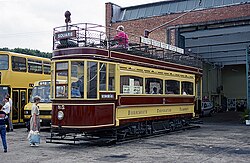
The journey began in July 1902, when the Bournemouth Corporation launched its first tram operations. To support this network, bus services were introduced in 1906 to act as feeders, bringing passengers from outlying areas to the tram lines. By 1930, the scope of bus services expanded further to serve the newly added borough areas of Kinson and Holdenhurst.
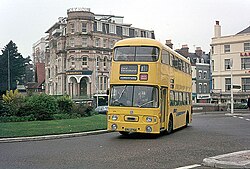
Technological shifts led the corporation to introduce trolleybuses—electric buses that draw power from overhead wires—in 1933. By 1936, these had completely replaced the original tram system. However, the trend eventually shifted back toward flexible motor buses, which replaced the trolleybuses between 1963 and 1969.
The Transition to Bournemouth Transport Limited
The landscape of British transit changed significantly with the Transport Act 1985, which led to the deregulation of bus services. In response, the operation was incorporated as a private limited company known as Bournemouth Transport Limited, though the Bournemouth Borough Council remained the sole shareholder.
By 2005, the Council recognized that the company needed modernization and greater agility to compete with rivals like Wilts & Dorset. This led to the decision to pursue privatization.
The Transdev Era and Network Overhaul
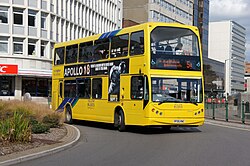
In December 2005, the Bournemouth Borough Council sold 90% of Bournemouth Transport Limited to Transdev, retaining a 10% stake. The service was rebranded as Transdev Yellow Buses.
Transdev implemented a sweeping transformation known as the "Big Network Change" on July 2, 2006. This overhaul modified every route, journey, and route number in the system. To introduce these changes, the company held road shows across Bournemouth, Poole, and Christchurch to showcase new branding, liveries, and fare structures.

Subsequent adjustments included the introduction of routes 37 and 38, the extension of route 41 to Boscombe Pier and Throop Church, and the restoration of route 24. In April 2010, the network expanded into East Dorset with the launch of route 29, connecting Bournemouth, Winton, Ferndown, and West Moors.

Ownership by RATP Group
Corporate restructuring in 2009 saw Transdev's majority owner, Caisse des dépôts et consignations, negotiate a merger with Veolia Transport. As part of this deal, the RATP Group took ownership of several Transdev operations, including Yellow Buses, on March 3, 2011. The business returned to trading simply as Yellow Buses.
During this period, the A1 Airport Shuttle returned to the Yellow Buses portfolio in November 2013 after six years under Discover Dorset. By 2016, RATP Group acquired the remaining 10% shareholding, becoming the full owner of the company.
Operational Challenges and Financial Decline
In January 2017, the company attempted a major reorganization based on passenger work and life patterns. This introduced lettered services, such as 'P' for Priory (Christchurch), 'B' for Bourne, 'U' for University, and 'V' for Kinson Village. However, the rushed implementation led to widespread passenger complaints.
Financial instability followed. In October 2017, the company reported pre-tax losses of £124,000, leading to the resignation of managing director Andrew Smith. By the end of 2017, pre-tax losses had climbed to £1,818,000, and reached £1,975,000 by the end of 2018.
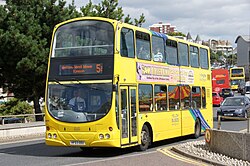
In an effort to stabilize, the company reverted to its original numbering format (e.g., 1, 1a, 1b) on April 8, 2018. This required rebranding 140 buses and updating over 1,000 bus stops.
Management Buyout and Administration
On July 2, 2019, RATP Group sold Bournemouth Transport Limited to the company's three directors via a management buyout. Despite this change in leadership, financial struggles continued, with losses of £2.65 million over the 15 months leading to March 2020, attributed to the cost of the buyout and new computer systems. Additionally, the company ceased using Poole Bus Station in February 2020 due to anti-social behavior.
The COVID-19 pandemic dealt a final blow. Facing increased running costs and lost revenue, Yellow Buses entered administration in July 2022 and ceased all operations on August 4, 2022. Key routes were subsequently taken over by morebus.
The remnants of the business were split: Yellow Coaches was purchased by Xelabus (ceasing operations in February 2023), and the intercity coaching and engineering arms were acquired by the National Express Group on August 8, 2022.
Key Facts
- Founded: July 1902 (as Bournemouth Corporation trams).
- Major Transitions: Trams → Trolleybuses (1933) → Motor Buses (1963-1969).
- Ownership History: Bournemouth Borough Council → Transdev (2005) → RATP Group (2011) → Management Buyout (2019).
- Final Closure: Ceased operations on August 4, 2022.
- Successors: Key routes taken by morebus; coaching/engineering by National Express.
| Period | Owner/Operator | Key Event |
|---|---|---|
| 1902 – 2005 | Bournemouth Corporation / Council | Transition from trams to buses |
| 2005 – 2011 | Transdev | "Big Network Change" (2006) |
| 2011 – 2019 | RATP Group | Full acquisition and route restructuring |
| 2019 – 2022 | Company Directors | Management buyout and administration |
Frequently Asked Questions
When did Yellow Buses stop using trams?
The Bournemouth Corporation began replacing trams with trolleybuses in 1933, and all trams were completely replaced by 1936.
What was the "Big Network Change" of 2006?
It was a complete overhaul by Transdev that changed every bus route, journey, and route number, accompanied by new branding and a new fare structure.
Why did the company face financial difficulties in 2017?
The company underwent a rushed route reorganization that led to significant passenger complaints and subsequent financial losses, including a pre-tax loss of £1.8 million by the end of 2017.
Who took over the services after Yellow Buses ceased operations?
Some key routes were taken over by morebus, while the intercity coaching and engineering operations were purchased by the National Express Group.
What happened to Yellow Coaches?
Yellow Coaches was purchased by Xelabus of Eastleigh on August 5, 2022, but operations ended in February 2023 when their service tender expired.