London United Bus Garages: A History of Operations and Infrastructure
London United manages a complex network of public transport across the city, supported by six strategic bus garages. These facilities serve as the operational heart of the network, providing maintenance, staffing, and vehicle storage for a wide array of routes. From historic tram depots to modern facilities, these garages reflect the evolution of London's transit landscape.
Key Facts
- Six active garages: Fulwell, Hounslow, Hounslow Heath, Shepherd's Bush, Stamford Brook, and Tolworth.
- Historical Firsts: Hounslow was the first London garage to operate pneumatic tyre buses (1925) and low-floor buses (1993).
- Technological Shifts: Fulwell was the first to receive trolleybuses (electric buses powered by overhead wires) in 1931.
- Infrastructure Evolution: Several sites, such as Stamford Brook and Fulwell, transitioned from tram depots to bus garages.
Fulwell Garage (FW)
The Fulwell site spans 11 acres (4.5 ha) and was once regarded as one of the finest plants in the country. Originally the main depot for London United Tramways, it featured 20 covered tracks. Today, the facility is split between London United (accessed via Wellington Road) and Transport UK London Bus (accessed via Stanley Road).
Fulwell holds a significant place in transit history as the first London garage to introduce trolleybuses in 1931; it remained one of the last to operate them until 1962. While tram operations ceased in 1935, remnants of the tracks remained visible in the cobbled surface of the Stanley Road entrance for many years. The garage has historically maintained high capacity, absorbing work from the Twickenham closure in 1970 and housing 107 buses by 2001.
In 1999, the garage temporarily accommodated 13 London Country buses following the closure of Arriva's Leatherhead garage, with route 85 operated from the forecourt by Arriva drivers.
Hounslow Garage (AV)
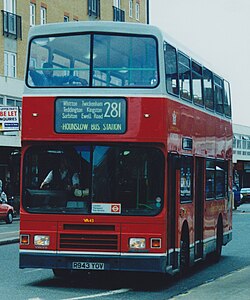
Opened in 1913 by the London General Omnibus Company on the site of the former District Railway Hounslow Town station, this garage has a legacy of innovation. It introduced London's first pneumatic tyre buses in 1925 and the original Dennis Dart in 1930. Early operations were limited to single-deckers and open-toppers due to a low roof, which was eventually raised in the mid-1930s.
By 1947, the garage was operating over capacity, with 92 vehicles allocated to a 72-space facility, necessitating the use of a rear plot for layovers. A rebuild in the early 1950s added a new bus station and increased planned capacity to 120 vehicles. In 1982, Hounslow introduced its first one-man operated double-deckers (MCW Metrobuses) for routes 111 and 202.
Hounslow continued its trend of "firsts" in December 1993 by operating London's first low-floor bus, the Wright Pathfinder bodied Dennis Lance SLF. Despite plans in 2005 to relocate to the former Williams Dye Works on Hanworth Road, the project was abandoned in 2009 following resident campaigns favoring a public park.
Hounslow Heath (WK) and Shepherd's Bush (S)
Hounslow Heath serves as a vital operational hub for routes 105, 116, 235, and 423. Meanwhile, the Shepherd's Bush garage is one of the oldest in the network, having opened its doors in 1906 to serve the central and western corridors of the city.
Stamford Brook Garage (V)
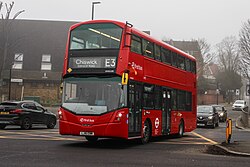
Stamford Brook opened as a bus garage in 1980, though the site originally served as the Chiswick Tram depot. Before its conversion, it was used for British European Airways services connecting Heathrow Airport to the West London Air Terminal.
The garage was initially intended as a temporary site for Riverside garage staff during reconstruction. However, plans shifted, and it instead absorbed the workload and garage code (V) from the closed Turnham Green depot. Following the closure of Mortlake and Riverside in 1983, Stamford Brook took on further responsibilities.
In 1981, the garage operated Airbus routes A1 and A2 after British Airways services were withdrawn. These were moved to West Ramp (a V outstation) in 1994, leaving the main garage to manage a fleet of MCW Metroriders, MCW Metrobuses, Leyland Olympians, and Dennis Darts.
Tolworth Garage (TV)
Built on the site of a former coal yard behind Tolworth railway station, this garage was planned in the late 1990s following the closure of Kingston Garage. The development was part of a larger plan to convert the Kingston site into a bus station.
Tolworth has recently expanded its route portfolio, taking over route K5 from Quality Line on January 25, 2020, followed by routes 406, 418, and 465 on April 25, 2020.
Operational Summary
| Garage | Code | Primary Routes Served |
|---|---|---|
| Fulwell | FW | 33, 65, 71, 216, 281, 290, 371, 681, K3, N33, N65 |
| Hounslow | AV | 110, 117, 203, 419, 695, 696, 698, H22, H37, H98 |
| Hounslow Heath | WK | 105, 116, 235, 423 |
| Shepherd's Bush | S | 49, 70, 72, 94, 148, C1, N72 |
| Stamford Brook | V | 220, 272, 440, E3 |
| Tolworth | TV | 85, 293, 406, 411, 418, 467, 613, 662, 665, K1, K2, K4, K5 |
Frequently Asked Questions
Which garage was the first to use trolleybuses in London?
Fulwell garage was the first in London to receive trolleybuses in 1931 and was one of the last to operate them until 1962.
Why was Hounslow garage limited to single-deckers until the 1930s?
The original roof of the Hounslow garage was too low to accommodate double-decker buses; it was not raised until the mid-1930s.
What is the history of the Stamford Brook site?
Stamford Brook originally served as the Chiswick Tram depot and later operated British European Airways buses before officially opening as a bus garage in 1980.
When did Tolworth garage take over routes from Quality Line?
Tolworth took over route K5 on January 25, 2020, and routes 406, 418, and 465 on April 25, 2020.
Which garage introduced the first low-floor bus to London?
Hounslow garage introduced the first low-floor bus in December 1993 with the arrival of the Wright Pathfinder bodied Dennis Lance SLF.