Wrens: The Diverse World of Troglodytidae
Wrens are a family of small, brown passerine (perching) birds known scientifically as Troglodytidae. Comprising 96 species divided into 19 genera, these birds are primarily found in the New World. The only exception is the Eurasian wren, which is widely distributed across the Old World and serves as the namesake for the entire group in English-speaking regions.
While the name "wren" is common, it is often applied to unrelated bird families, such as the New Zealand wrens (Acanthisittidae) and Australian wrens (Maluridae). True wrens are distinguished by their compact size, drab plumage, and remarkably complex vocalizations.
Key Facts
- Species Count: 96 species across 19 genera.
- Primary Range: The Americas (New World), with one species in Europe, Asia, and North Africa.
- Size Range: From the white-bellied wren (under 10 cm) to the giant wren (approximately 22 cm).
- Plumage: Generally gray, brown, black, and white, often featuring barring on the wings or tail.
- Vocalizations: Known for loud, complex songs, sometimes performed as duets.
Etymology and Cultural Significance
The history of the wren is steeped in folklore. In Old High German, the bird was called kuningilin (kinglet), linked to a fable where a tiny bird became the "king of birds" by hiding in an eagle's plumage to reach the highest altitude. This legend, noted by Aristotle and Pliny, likely originated with kinglets (genus Regulus) but transferred to wrens due to their small size and linguistic similarities in Ancient Greek.
In modern languages, this "royal" association persists; the German name Zaunkönig means "king of the fence," and the Dutch winterkoning means "king of winter." Culturally, the Eurasian wren is viewed with superstition in Europe, where harming one is thought to bring bad luck. In Ireland, "Wren Day" is celebrated on December 26th, traditionally involving the parade of a wren on a decorative pole.
Wrens also appear on official currency and state symbols. The Cactus wren is the state bird of Arizona, and the Carolina wren is the state bird of South Carolina and appears on its state quarter. Historically, the British farthing featured a wren from 1937 to 1960.
Physical Characteristics
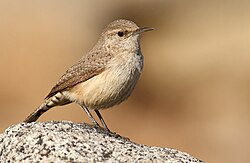
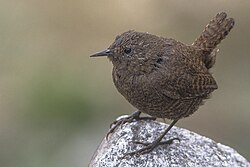
Wrens are medium-small to very small birds. Their plumage is typically drab, consisting of earthy tones that provide camouflage in their natural habitats. Most species exhibit barring on their tails or wings, and there is virtually no sexual dimorphism (physical difference between males and females) or significant difference between adults and juveniles.
Their bills are generally long and straight, though some are marginally decurved (curving slightly downward). Beyond their appearance, wrens are most famous for their songs. Genera such as Cyphorhinus and Microcerculus produce melodies so complex and pleasant that they are often called musician or flutist wrens.
Distribution and Habitat
The greatest species richness of wrens is found in the Neotropics, though the family extends from Alaska and Canada down to southern Argentina. The Eurasian wren is the sole representative outside the Americas, inhabiting Europe, Asia, and northern Africa.
Wrens occupy a vast array of environments, from rainforests to dry, sparsely wooded regions. While most stay at low elevations, the genus Campylorhynchus is often found at higher altitudes, and Odontorchilus species are restricted to the forest canopy. Some, like the house wren, have adapted to live in close proximity to humans.
Most tropical species are resident year-round, whereas those in the Northern Hemisphere's temperate zones are partially migratory, moving south for the winter.
Taxonomy and Diversity
The classification of Troglodytidae is complex and subject to ongoing revision. Recent molecular phylogenetic studies have helped refine the relationships between genera. While the black-capped donacobius was traditionally grouped with wrens, it is now believed to be more closely related to certain warblers.
| Genus | Common Species | Notable Characteristic |
|---|---|---|
| Campylorhynchus | Cactus wren | Conspicuous, often sing from exposed perches |
| Troglodytes | Eurasian wren | Widely distributed in the Old World |
| Uropsila | White-bellied wren | One of the smallest species (under 10 cm) |
| Campylorhynchus | Giant wren | One of the largest species (approx. 22 cm) |
| Cyphorhinus | Musician wren | Renowned for pleasant, complex songs |
Representative Species
The diversity of the family is evident in its varied members. For instance, the Rock wren (Salpinctes obsoletus) and Canyon wren (Catherpes mexicanus) occupy rugged terrains, while the Bewick's wren (Thryomanes bewickii) and Black-throated wren (Pheugopedius atrogularis) represent different ecological niches in the Americas.










Frequently Asked Questions
Are all birds called "wrens" part of the same family?
No. While true wrens belong to the family Troglodytidae, the name is also used for unrelated birds such as the New Zealand wrens (Acanthisittidae) and Australian wrens (Maluridae).
Where are wrens primarily found?
Wrens are principally a New World family, distributed from Alaska and Canada to southern Argentina. The Eurasian wren is the only species found in the Old World (Europe, Asia, and northern Africa).
What makes wren songs unique?
Wrens are known for loud, complex songs that are often delivered in duets by pairs. Some species, such as the musician wren, are specifically noted for the melodic quality of their calls.
Do wrens migrate?
Most wrens, especially those in Central and South America, are resident birds. However, species living in the temperate regions of the Northern Hemisphere are often partially migratory.
How do wrens differ in size?
There is significant variation within the family; the white-bellied wren is among the smallest at under 10 cm, while the giant wren can reach approximately 22 cm.