Work and Society: The Evolution of Organizations, Institutions, and Values
Human effort, when scaled beyond individual survival, requires a structured approach to succeed. From the smallest team to the largest global economy, the way we organize labor reflects our social values, legal frameworks, and historical evolution. The transition from simple cooperation to complex institutional management defines how resources are allocated and how individuals find meaning in their daily toil.
The Role of Economic Organizations
Coordination is the cornerstone of any collective effort. While a small team may rely solely on communication and cooperation, increasing complexity—such as specialized tasks and long-term planning—necessitates a reliable organization. These entities often mirror the social beliefs of their era, including prevailing views on hierarchy and human nature.
Historically, these organizations serve as pillars of economic systems. For example, the transition in European history from guilds (associations of artisans) to joint-stock companies coincided with the rise of capitalism and the growth of centralized states.
In industrialized economies, labor unions emerged as a critical organizational tool. Because an individual worker is often easily replaceable, they possess little leverage to negotiate wages. By forming a corporate entity, workers can collectively claim a larger share of the value they create. Although this requires a sacrifice of some individual autonomy, it often grants workers greater control over their work processes and improved material benefits.
Societal Institutions and Resource Allocation
Beyond individual companies, society requires broad institutions to manage resource allocation—the process of distributing necessities, materials, and investments like equipment and facilities. While traditional societies may rely on custom, larger societies require more formal systems.
Modern economic institutions generally fall into two categories:
- Free Markets: Capitalist systems fundamentally based on trade.
- Command Economies: Systems, common in 20th-century communist states, that rely on bureaucratic redistribution and strict hierarchies.
Institutions also define the legal and practical boundaries of a worker's life. A caste system may restrict a person to a specific job inherited from their parents, while serfdom attaches a peasant to a specific piece of land, requiring the landholder's permission to travel. Even in modern wage-labor societies where legal equality and mobility exist in theory, a lack of social support can practically force workers to cede certain freedoms to secure a livelihood.
Cultural and Spiritual Values of Work
The value placed on work varies across cultures. In some societies, high social status is linked to leisure, making work a sign of low rank. In others, a strong work ethic views labor as a virtue. Sociologist Max Weber hypothesized that European capitalism grew out of a Protestant work ethic following the Reformation.
Theological perspectives further shape these values. In Christian tradition, references to the Book of Genesis suggest that work is a natural human function, as humans were created in the image of a Creator who worked. However, the "fall of man" is often interpreted as the point where work became toil—labor that is wearisome or distasteful. Despite this, figures like Pope John Paul II argued that work remains essential to human dignity and fulfillment.
Other perspectives emphasize balance or spiritual discipline:
- The Golden Mean: Drawing on Aristotle, some suggest the moral ideal lies between laziness and workaholism.
- Spiritual Labor: In various monastic traditions, manual labor is used to cultivate humility, self-discipline, and mental focus.
- Technological Impact: While some hope technology will eliminate the need for work, Pope Francis has warned that replacing human labor entirely could be detrimental to humanity. Similarly, McKinsey suggests that AI and automation will change the nature of work rather than end it.
Contemporary Labor Issues
While the global economy has evolved, several critical issues persist or have emerged due to urbanization and industrialization.
Unemployment and Social Identity
The shift from subsistence economies to industrial ones increased overall productivity but removed the baseline material security of the home. Unemployment now poses not only a financial threat but a psychological one, as jobs are central to many people's self-identity. Governments attempt to mitigate this through job-matching services, unemployment insurance, and work-relief programs.
Invisible Labor
Economic policies often fail when they ignore "out-of-view" work. This includes uncompensated domestic labor in private life or furtive economic exchanges in criminal activity. Ignoring these sectors can lead to counter-intuitive policy effects and societal strain.
Modern Slavery
Despite the rise of universal human rights, slave labor and human trafficking persist in lawless regions or in attenuated forms on the margins of global economies.
The Debate Over Child Labour
Child labor persists globally due to poverty, weak legal supervision, and the demand for cheap labor.
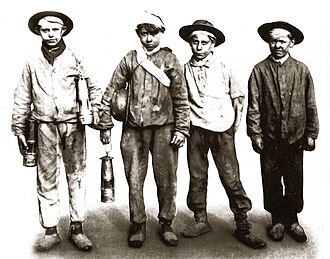
Data from the World Bank indicates that the global rate of child labor dropped from 25% in the 1960s to 10% by the early 21st century. However, due to population growth, the absolute number remains high; UNICEF and the ILO estimated 168 million children aged 5–17 were involved in child labor in 2013.
There are two primary scholarly views on this issue:
- The Prohibitionist View: Scholars like Jean-Marie Baland and James A. Robinson argue for a blanket ban on labor for those under 18, citing the loss of education and investment in human capital (the skills and knowledge gained by a worker).
- The Symptomatic View: Scholars like Christiaan Grootaert and Kameel Ahmady argue that child labor is a symptom of poverty. They suggest that banning all lawful work may inadvertently drive the poor toward illicit underground businesses.
Key Facts
- Labor Unions: Allow replaceable workers to act as a corporate entity to negotiate better wages and conditions.
- Economic Systems: Range from free markets based on trade to command economies based on bureaucratic redistribution.
- Child Labor Stats: While the rate fell from 25% (1960s) to 10% (early 21st century), roughly 168 million children were still working in 2013.
- Work Ethic: Max Weber linked the rise of European capitalism to the Protestant work ethic.
- Unemployment: Beyond financial loss, it impacts psychological well-being because work is tied to self-identity.
| Structure | Primary Mechanism | Key Characteristic |
|---|---|---|
| Labor Unions | Collective Bargaining | Increases worker leverage against owners |
| Free Markets | Trade | Decentralized resource allocation |
| Command Economies | Redistribution | Bureaucratic and hierarchical control |
| Caste/Serfdom | Inheritance/Legal Attachment | Restricted professional and physical mobility |
Frequently Asked Questions
How do labor unions benefit workers who are easily replaceable?
By banding together as a single corporate entity, workers move from being individual, replaceable units to a collective force. This allows them to demand a larger share of the value they create and gain more control over their working conditions.
What is the difference between a free market and a command economy?
Free markets rely fundamentally on trade and decentralized exchange, whereas command economies utilize a highly bureaucratic and hierarchical system to redistribute resources.
Why is unemployment considered a psychological issue as well as a financial one?
Because a job often forms a major part of a person's self-identity, losing employment can lead to severe social and psychological consequences beyond the immediate loss of income.
What are the two main scholarly arguments regarding child labor?
One side argues for a total ban on labor for those under 18 to prevent illiteracy and protect human capital. The opposing side argues that child labor is a symptom of poverty and that banning lawful work may push children into dangerous illicit operations.
How has the view of work evolved in Christian theology?
Work is seen as a natural human function reflecting the image of God, but the "fall of man" transformed this work into toil. Despite the wearisome nature of toil, it is still viewed as a means of achieving human dignity and fulfillment.