Words: The Complex Units of Human Language
At first glance, a word seems like a simple concept: a basic element of language that carries meaning, can stand on its own, and is uninterruptible. Most speakers have an intuitive grasp of what a word is, yet for linguists, the definition is surprisingly controversial. Depending on whether one looks at sound, grammar, or writing, the criteria for what constitutes a "word" can shift significantly.
Because there is no single global consensus, scholars often use different standards based on their theoretical background. Some define words through phonology (sound), others through grammar, and some through orthography (writing). In some cases, the term is viewed simply as a convenient convention for everyday communication.
Key Facts
- Morphemes are the smallest meaningful units of language; a word must contain at least one morpheme.
- Lexemes are the abstract units in a speaker's internal dictionary, encompassing all inflected forms of a word.
- Compound words are formed when two or more roots are joined together.
- Word boundaries can be identified via pauses, indivisibility, or orthographic markers like spaces.
- Morphology is the scientific study of how words are formed and structured.
The Building Blocks: Morphemes and Lexemes
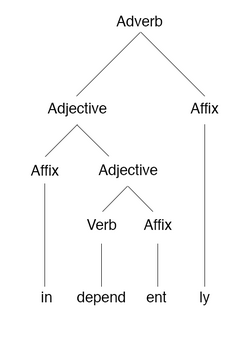
To understand words, one must first distinguish them from morphemes. A morpheme is the smallest unit of language that carries meaning, though it may not be able to stand alone. Words are constructed from one or more morphemes. In English, this typically involves a root (the core meaning, such as "rock" or "type") and optional affixes (prefixes or suffixes like "-s" or "un-").
When multiple roots are combined, they create compound words, such as "cowboy" or "typewriter." Additionally, contractions like "can't" merge multiple words into one. These words then serve as the foundation for larger linguistic structures: phrases, clauses, and eventually full sentences.

From a dictionary perspective, language is organized into lemmas—the individual forms listed in a lexicon. The written form of such a word is known as a lexeme. A lexeme represents the overarching concept; for example, the lexeme "teapot" includes both the singular "teapot" and the plural "teapots." In agglutinative languages like Turkish, the boundaries of a lexeme can be more complex, as regular suffixation can create long strings of meaning from a single root.
Analyzing Words Through Different Lenses
Phonology (Sound)
In phonology, stress often helps identify word boundaries. However, a "phonological word" does not always match our intuition. For instance, the Finnish word for capital, pääkaupunki, is phonologically two words because it violates Finnish vowel harmony patterns. Conversely, the English contraction "I'll" is treated as a single phonological word despite containing two syntactical elements.
Grammar and Semantics
Grammatical words are generally seen as elements that occur together in a fixed order to convey a specific meaning. In some languages, like Dyirbal, changing the order of suffixes can entirely change the meaning of the word. Semantically, Leonard Bloomfield proposed the concept of Minimal Free Forms in 1928, defining words as the smallest meaningful units of speech that can stand alone. Some semanticists further suggest the existence of semantic primes—fundamental, indefinable words that form the basis for all other conceptual meanings.
Orthography (Writing)
For many, the definition of a word is learned through the writing system. In English, spaces and punctuation mark the boundaries. However, this is not universal. East Asian systems, such as Chinese and Japanese (which use logographic characters) or Thai and Lao (which use abugidas), often do not use spaces to separate words.
Morphology and Word Formation
Morphology examines how words are structured through two primary processes: derivation and inflection. Derivation creates new words, often changing the word class (e.g., the verb "convert" becoming the adjective "convertible"). Inflection adds grammatical data, such as tense or gender, without changing the word's core meaning (e.g., "love" becoming "loved").
In synthetic languages, a single stem can take various inflected forms. In Indo-European languages, these are typically analyzed as a combination of a root, potential adfixes, and an inflectional suffix.
| Term | Definition | Example |
|---|---|---|
| Morpheme | Smallest unit of meaning | "-ness" in happiness |
| Lexeme | Abstract unit in the lexicon | RUN (includes run, runs, running) |
| Root | The core part of a word | "type" in typewriter |
| Compound | Word made of multiple roots | "cowboy" |
Philosophical and Historical Perspectives
The philosophy of language has debated the nature of words since the 5th century BC. Plato explored the connection between sound and meaning, while John Locke argued that words are arbitrary marks of ideas. Later, Ludwig Wittgenstein shifted the focus, suggesting that the meaning of a word is defined by its use within a language.
Historically, Ancient Greek and Roman traditions viewed the word as a unitary construct—the minimal unit of an utterance expressing a complete thought. They did not decompose words into morphemes, likely due to the synthetic nature of their languages.
Frequently Asked Questions
What is the difference between a word and a morpheme?
A morpheme is the smallest unit of meaning, whereas a word is a basic element of language that can stand on its own. A word can consist of a single morpheme or multiple morphemes joined together.
How do linguists identify word boundaries in speech?
Linguists use several methods: identifying potential pauses when a speaker slows down, testing indivisibility by adding words to a sentence, or relying on orthographic markers like spaces in written text.
What is a lexeme?
A lexeme is an item in a speaker's internal lexicon that encompasses all inflected forms of a word. For example, "walk," "walks," and "walking" are all part of the same lexeme.
What are semantic primes?
Semantic primes are theorized to be indefinable words that represent fundamental concepts. They serve as the basic building blocks used to describe the meaning of all other words without circularity.
How does word classification vary by language?
Word classes are not universal. For example, English uses articles (a, the) to mark definiteness, a class not found in Japanese. Conversely, Japanese uses particles to mark grammatical functions, which English typically handles through word order.