Woodstock, Virginia: A Journey Through Colonial Roots and Civil War History
Nestled in the heart of the Shenandoah Valley, Woodstock, Virginia, stands as a testament to the diverse currents of American history. From its origins as a German settlement to its strategic importance during the American Revolution and the Civil War, the town has evolved from a frontier outpost into the enduring county seat of Shenandoah County.
Colonial Foundations and Early Settlement
The story of Woodstock begins in the mid-18th century when Pennsylvania Germans migrated south through the Shenandoah Valley. Unlike the English society prevalent east of the Blue Ridge Mountains, these settlers typically farmed small plots of land, avoided tobacco cultivation, and did not hold slaves. Their Protestant faiths often differed from the established Anglican Church of Virginia.
Long before European arrival, the region was home to the Senedo people, who disappeared as a tribe prior to settlement, possibly due to conflicts with the Catawba people. While few Native Americans remained by the time German settlers arrived, the valley continued to be used for hunting by the Shawnee, Occoneechee, Monocans, Piscataways, and the Iroquois Confederation. Evidence of the Late Woodland Period (AD 900–1650) persists in the form of Indian mounds between Woodstock and Strasburg, though many were erased by centuries of farming.
The town's physical layout was influenced by the Indian Road, an ancient trail used by the Catawba and Lengape. This route eventually became the Great Wagon Road, the Valley Pike, and today's Route 11.
The Establishment of Woodstock
Founded in 1752 by Jacob Muller (or Mueller) as Muellerstadt (Miller Town), the settlement began with a 400-acre land grant from Lord Fairfax. Muller, a German immigrant who arrived in 1749, expanded his holdings to between 1,200 and 2,000 acres and laid out the town's initial plan.
In March 1761, the town was officially established by charter. This act was sponsored by George Washington, who represented Frederick County in Virginia's House of Burgesses. Washington renamed the town Woodstock; while the exact reason for the name change is unknown, some suggest it refers to a wood stockade used for protection against Indian raids. Washington also named the Shenandoah Valley, River, and County after Chief John Skenandoa, a Christian Oneida leader who assisted Americans during the Revolutionary War.
Woodstock became the county seat of Shenandoah County (originally Dunmore County) upon its formation in 1772.
The Revolutionary Era and Peter Muhlenberg
Woodstock played a pivotal role in the American Revolution, largely through the influence of John Peter Gabriel Muhlenberg. A former British Army soldier turned pastor, Muhlenberg served the local Lutheran and Episcopalian congregations starting in 1771.
Muhlenberg is most famous for a dramatic event on January 21, 1776. During a farewell sermon in Woodstock, he cast off his clerical robes to reveal a Continental Army officer's uniform, declaring that the time for preaching had passed and the time to fight had come. He went on to lead the 8th Virginia Regiment—known as "The German Regiment"—and eventually rose to the rank of general, serving in major battles from Brandywine to Yorktown.
Civil War Conflict and the "Woodstock Races"
During the American Civil War, Woodstock was a place of divided loyalties. While some residents joined Confederate units like the Muhlenberg Rifles, others—including Mennonites and German Dunkards—were religiously opposed to war and slavery.
The town served as a strategic point for troop movements. General Thomas "Stonewall" Jackson used a small brick law office near the courthouse as his headquarters during the 1862 Valley Campaign. Conversely, Union General Phil Sheridan used Woodstock as a base in 1864 during his scorched-earth campaign to deny the Confederacy resources in the valley.
One of the most notable events occurred on October 9, 1864, at the Battle of Tom's Brook. Union cavalry under George Armstrong Custer and Wesley Merritt routed Confederate forces. The resulting disorderly retreat of the Confederate troopers through the town became known as the "Woodstock Races."
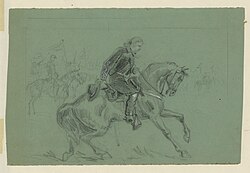
Another significant event occurred in May 1864, when Union General Franz Sigel captured Woodstock. During the occupation, Union forces captured critical Confederate telegrams revealing the strength and location of General John C. Breckinridge's forces. Despite this intelligence coup, Sigel's cautious advance allowed the Confederates to concentrate their forces, leading to the Battle of New Market.
Railroads and Economic Growth
The arrival of the railroad in the mid-19th century transformed Woodstock into a commercial hub. The Manassas Gap Railroad extended its line toward Mount Jackson in 1859, and by 1868, the Baltimore & Ohio (B&O) Railroad extended service to Harrisonburg.
In 1888, a limestone passenger station was built, facilitating the shipment of grain, cattle, and fruit. However, the rise of the national highway system led to a decline in rail use. Passenger service ended in 1948, and the passenger station was demolished in 1954. While the Norfolk Southern Railroad still owns the line, the section between Strasburg and Edinburg remains out of service.
Historic Preservation
Today, Woodstock preserves its heritage through several landmark sites. The Shenandoah County Courthouse, featuring a limestone building designed by Thomas Jefferson in 1795, is the oldest courthouse still in use west of the Blue Ridge Mountains. Additionally, Lantz Hall at the Massanutten Military Academy and the Woodstock Historic District are listed on the National Register of Historic Places.
| Era/Event | Key Figure/Entity | Significance |
|---|---|---|
| Founding (1752/1761) | Jacob Muller & George Washington | Established as Muellerstadt, then renamed Woodstock. |
| Revolutionary War | Peter Muhlenberg | Raised the 8th Virginia Regiment after a famous sermon. |
| Civil War (1864) | Gen. George A. Custer | Battle of Tom's Brook led to the "Woodstock Races." |
| Infrastructure | B&O Railroad | Transformed town into a freight rail entrepot. |
| Architecture | Thomas Jefferson | Designed the 1795 limestone courthouse. |
Key Facts
- Founder: Jacob Muller founded the town as Muellerstadt in 1752.
- Naming: George Washington sponsored the 1761 charter and named the town Woodstock.
- Military Legacy: Peter Muhlenberg transitioned from pastor to General in the Continental Army in Woodstock.
- Civil War: The "Woodstock Races" refers to the Confederate retreat following the Battle of Tom's Brook.
- Architecture: The Shenandoah County Courthouse is the oldest active courthouse west of the Blue Ridge Mountains.
- Transport: Route 11 follows an ancient Indian trail once known as the Indian Road.
Frequently Asked Questions
Why was the town originally called Muellerstadt?
The town was named Muellerstadt (Miller Town) after its founder, Jacob Muller, who obtained the original land grant from Lord Fairfax in 1752.
Who was Peter Muhlenberg and why is he important to Woodstock?
Peter Muhlenberg was a pastor in Woodstock who famously shed his clerical robes during a sermon in 1776 to reveal a military uniform, subsequently leading the 8th Virginia Regiment during the American Revolution.
What were the "Woodstock Races"?
The "Woodstock Races" was the nickname given to the disorderly retreat of Confederate cavalry through the town of Woodstock after being routed by Union forces at the Battle of Tom's Brook on October 9, 1864.
What is the significance of the Shenandoah County Courthouse?
Designed by Thomas Jefferson and built with native limestone in 1795, it is the oldest courthouse still in use west of the Blue Ridge Mountains.
How did the railroad affect Woodstock's development?
The railroad turned Woodstock into a freight entrepot for cattle, grain, and fruit, boosting its commercial importance until the mid-20th century when trucking and highways led to its decline.