Wind Turbines: Engineering, Technology, and Global Energy Impact
A wind turbine is a sophisticated device designed to convert the kinetic energy of wind into electrical energy. As the world shifts toward sustainable power, these machines have become a cornerstone of the global energy transition. By 2024, hundreds of thousands of large turbines, organized into installations known as wind farms, were generating over 1,136 gigawatts of power, with an annual growth rate of approximately 117 GW.
Wind energy serves as a critical source of intermittent renewable energy, helping nations lower electricity costs and decrease their reliance on fossil fuels. Research from 2009 indicated that wind power offers the lowest relative greenhouse gas emissions, the least water consumption, and the most favorable social impacts when compared to other energy sources such as coal, gas, geothermal, hydro, and photovoltaic systems.
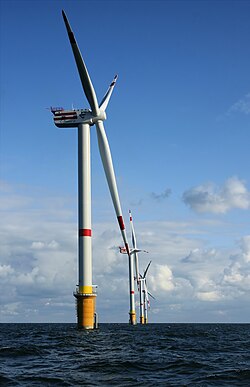
Key Facts
- Global Capacity: Over 1,136 GW generated as of 2024.
- Theoretical Limit: Betz's law states no turbine can capture more than 59.3% of wind's kinetic energy.
- Primary Types: Horizontal-axis (HAWT) and Vertical-axis (VAWT).
- Environmental Edge: Lowest relative greenhouse gas emissions among major power sources.
- Scale: Modern offshore turbines can reach capacities up to 20 MW.
The Physics of Wind Power
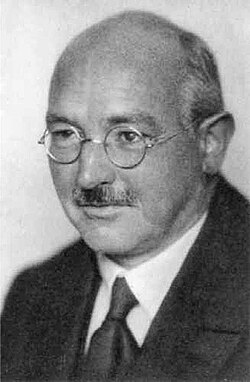
The efficiency of a wind turbine is governed by the laws of physics. A fundamental principle in this field is Betz's law, developed by German physicist Albert Betz. This law establishes a theoretical maximum efficiency, stating that no wind turbine can capture more than 59.3% of the kinetic energy from the wind.
Wind power density is categorized by wind speed and turbulence, which determines the class of turbine required for a specific location. This classification ensures that the machinery can withstand local environmental stresses while maximizing energy output.
| Class | Avg Wind Speed (m/s) | Turbulence |
|---|---|---|
| IA | 10 | 16% |
| IB | 10 | 14% |
| IC | 10 | 12% |
| IIA | 8.5 | 16% |
| IIB | 8.5 | 14% |
| IIC | 8.5 | 12% |
| IIIA | 7.5 | 16% |
| IIIB | 7.5 | 14% |
| IIIC | 7.5 | 12% |
Types of Wind Turbines
Wind turbines are manufactured in various sizes and configurations, primarily divided by the orientation of their axis of rotation.
Horizontal-Axis Wind Turbines (HAWT)
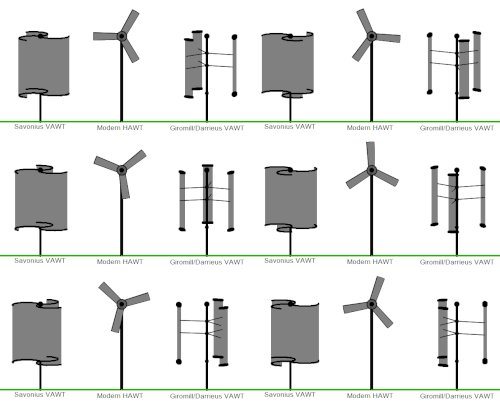
The most common commercial design is the horizontal-axis turbine. These typically feature three blades positioned upwind of a tall tower. They are highly efficient for large-scale power production both onshore and offshore.
Vertical-Axis Wind Turbines (VAWT)
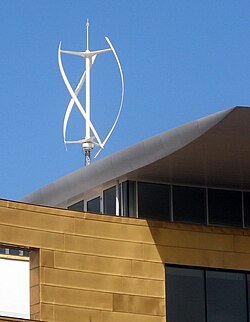
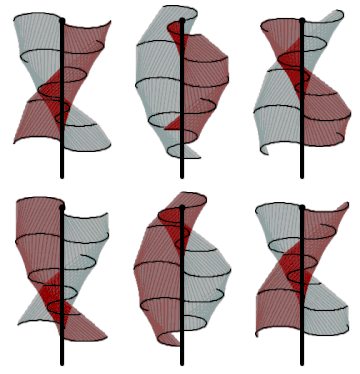
Vertical-axis turbines are more versatile in their design and can capture wind from any direction without needing to rotate the turbine. Common types include:
- Darrieus: Often described as an "eggbeater" design.
- Savonius: Uses scoops, making them ideal for rooftops and ships.
- Giromill: Features straight blades.
Unconventional Designs
Innovation continues with airborne turbines (wings tethered to the ground), floating platforms for deep-sea installation, and counter-rotating blade systems.
Design and Construction
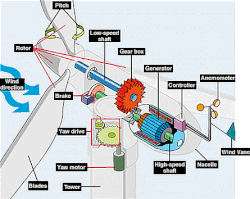
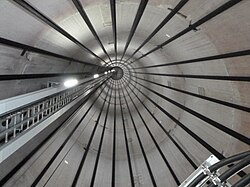
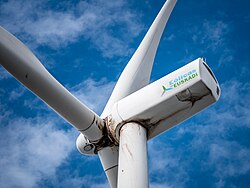
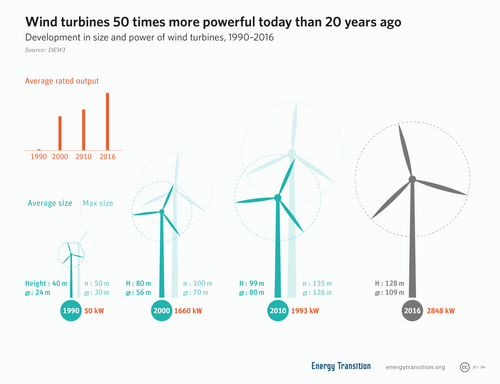
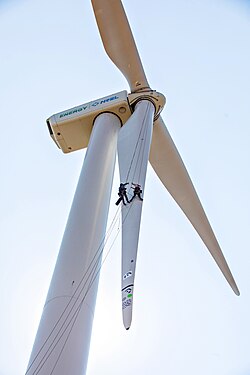
A typical 1.5 MW turbine found in the United States consists of a tower approximately 80 meters high and a rotor assembly (blades and hub) with a diameter of 80 meters. At the top sits the nacelle—the housing that contains the generator—which can weigh around 300 tons and measure over 15 meters in length.
Materials and Manufacturing
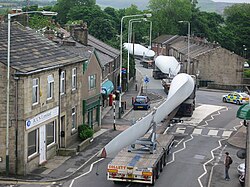
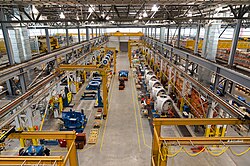
Blade construction is a critical engineering challenge. Manufacturers use a variety of materials to balance strength and weight, including:
- Glass and carbon fibers.
- Hybrid reinforcements.
- Nano-engineered polymers and composites.
Global Records and Implementations
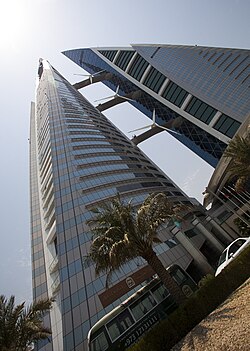
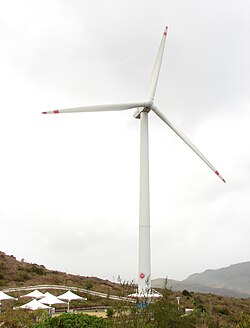
Wind technology has scaled rapidly, leading to massive installations worldwide. From the Nordex N50 in Hong Kong to the Bahrain World Trade Center's integrated turbines, the application of wind power is diverse.
| Record | Model/Name | Location | Manufacturer |
|---|---|---|---|
| Largest and Most Powerful | DEC 26MW H26-313 | Fuzhou, China | Dongfang Electric Wind Power |
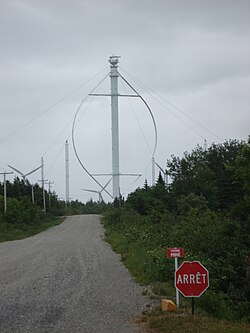
| Largest Vertical-Axis | Éole | Cap-Chat, Canada | NRC, Hydro-Québec |
| Largest Offshore | MySE18.X-20MW | Hainan, China | Ming Yang Smart Energy |
| Tallest | Schipkau GICON | Schipkau, Germany | Vensys, GICON |
Environmental and Operational Considerations
While wind energy is a clean alternative to fossil fuels, it presents certain challenges. One primary concern is the impact on wildlife; however, some studies suggest that in the U.S., cats kill significantly more birds—on the order of 10,000 times more—than wind turbines do.
![In the U.S. cats kill on the order of 10,000 times as many birds as wind turbines.[130]](/images/62/4c/624c489c97b0ebc9fb2ef33594eb194347a33f3d7ea5f0fa789663c01f6a80f0.webp)
Operational maintenance includes managing ice formation in cold climates and the eventual decommissioning of turbines. A current industry focus is the recycling of turbine blades, which have historically ended up in landfills due to their composite nature, though new recyclable blade technologies are emerging.
Frequently Asked Questions
What is the difference between a wind turbine and a windmill?
A wind turbine converts wind energy into electricity, whereas a windmill uses wind energy for mechanical tasks, such as grinding grain or pumping water.
What is Betz's Law?
Betz's law is a physical principle stating that no wind turbine can capture more than 59.3% of the kinetic energy in the wind.
Which is better: horizontal or vertical axis turbines?
Horizontal-axis turbines (HAWT) are generally more efficient and common for large-scale power production. Vertical-axis turbines (VAWT) are often better for smaller, urban environments or locations where wind direction changes frequently.
Do wind turbines kill many birds?
While turbines do impact some birds, data indicates that other factors, such as domestic cats, are responsible for significantly higher bird mortality rates.
Can wind turbine blades be recycled?
Historically, blades were difficult to recycle and often went to landfills, but the industry is now developing and deploying fully recyclable blade materials.